
Editor's Note: This article is the third installment in a RANE series on the geopolitical impacts of water stress. The first provides a broad overview of how unequal distribution of freshwater shapes geopolitical patterns. The second examines the risks of water stress destabilizing economies across the globe.
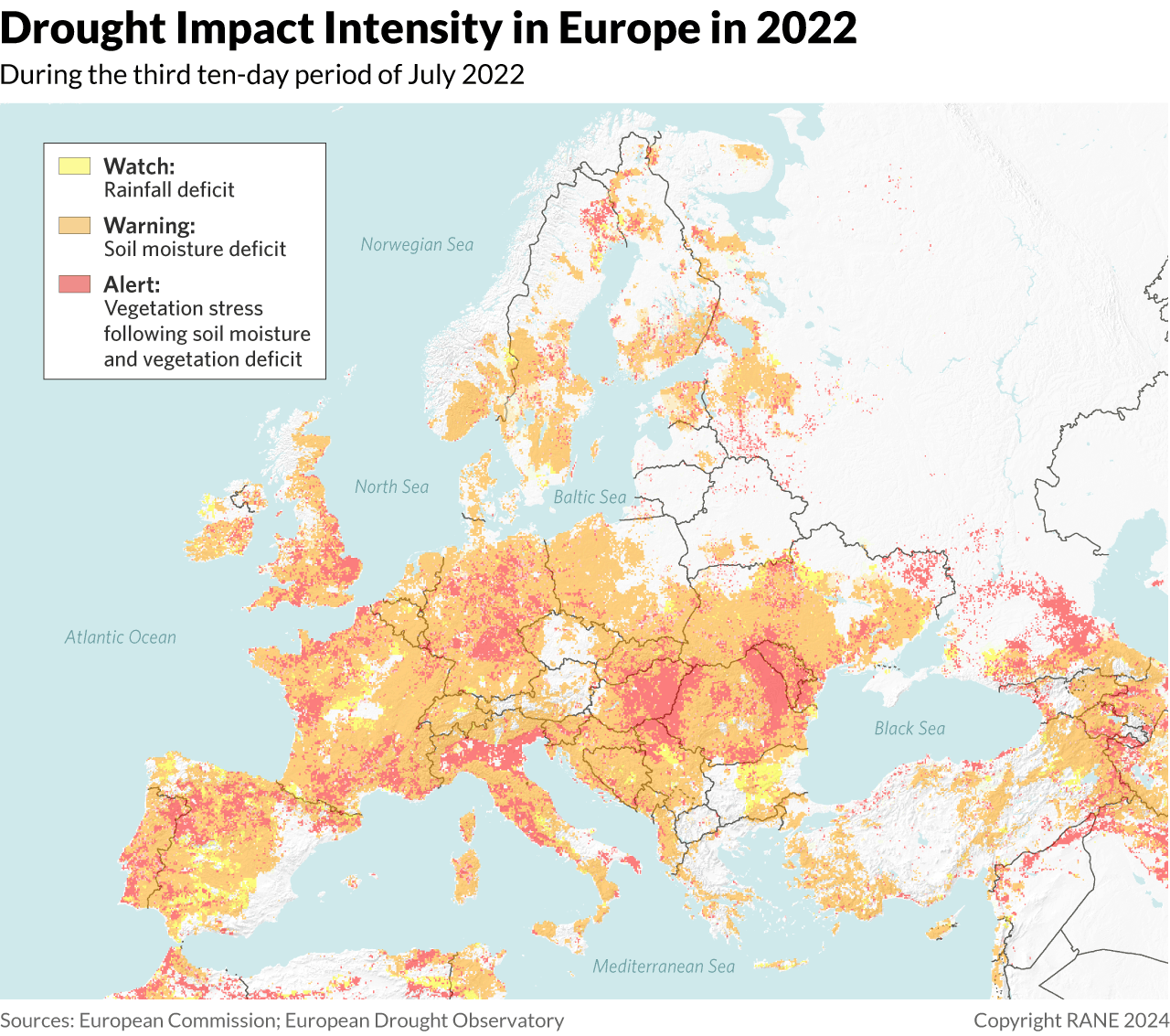
More severe, widespread and frequent droughts in Europe will have increasing economic impacts on the Continent over the coming years, with lower water availability and decreased river flows particularly affecting agriculture, energy production and the industrial sector. While most of Europe has adequate water resources, water scarcity and droughts on the Continent have been increasing in frequency, scale and intensity in recent years amid rising temperatures, reduced rainfall in some regions and decreasing flows of Alpine meltwater. Southern Europe, including countries like Spain, Italy, Greece and parts of France, faces the most severe challenges, with water levels in rivers, as well as surface and underground reservoirs, reaching record lows in recent years. However, other traditionally less affected areas, including Germany and Central and Eastern European countries, are also experiencing growing water stress, particularly concerning water levels in river basins. Between 2022 and the first half of 2023, a particularly severe drought affected nearly two-thirds of the Continent (especially the Mediterranean region), forcing several countries to introduce water rationing measures at the national or regional levels and causing billions of euros in damage. As of June 2024, the European Drought Observatory shows persistent drought conditions in Southern Europe, worsening drought conditions in Eastern Europe, and "severe, enduring and critical conditions" in the southwestern Mediterranean region.
- The European Drought Observatory shows "warning drought conditions" in eastern Spain, southern and central Italy, Romania, Poland, the Baltic countries, Greece, the northern Balkans and nearly all the Mediterranean islands.
- In 2023, France, Italy and Spain implemented temporary emergency water rationing measures in response to shortages, with France, Italy, Germany and the United Kingdom also introducing long-term strategies aimed at saving water across all sectors over the coming years. The European Commission pledged in September 2023 to implement a water resilience strategy in the European Union following the 2022-23 droughts but eventually paused the plan amid farmers' protests.
- Besides more widespread and severe droughts overall in recent years, changing weather patterns as a result of rising temperatures in Europe are also creating wetter-than-average conditions in some parts of the Continent and an increase in extreme rainfall. This has led to catastrophic events across the region such as floods in northern Italy, Greece, Slovenia, Norway and Sweden in the second half of 2023 and again in northern Italy, southern Germany, Ireland and the United Kingdom so far in 2024.
- Poor management of water resources also exacerbates water scarcity in the European Union, where on average 25% of drinking water is lost due to leaks in pipes, according to industry body EurEau. Faulty water distribution is especially problematic in Southern and Eastern Europe due to aging infrastructure and underinvestment.
Climate change is expected to exacerbate water scarcity in Europe over the coming decades amid rising temperatures and changing precipitation patterns, particularly in Southern Europe. According to the European Commission, on average, water scarcity affects about 20% of Europe and 30% of the European population every year. While the situation is not critical, the commission expects these figures to increase over the coming years as temperatures rise. Climate change models predict higher temperatures will lead to increased evaporation and decreased soil moisture, while changing precipitation patterns will result in more intense but less frequent rainfall overall, particularly affecting Southern Europe, where severe summer droughts are set to become a regular occurrence in the future, especially during the last decades of the century. By contrast, Northern Europe is projected to see higher rainfall and more extreme precipitations as a result of rising temperatures. Overall, river flows are expected to decrease significantly across most of Europe during summer compared with present levels. Against this backdrop, these changes will gradually reduce water levels in rivers and aquifers and strain water resources in most of the Continent, impacting agriculture, ecosystems like wetlands and forests, and water supplies for households and industry.
- A 2020 study by the European Commission's Joint Research Center shows that, under a 3-degree Celcius global warming scenario, drought frequency is projected to double over nearly 25% of the Mediterranean region (Portugal, Spain, Italy, Croatia, Greece, Malta and Cyprus) and 15% of the Atlantic region (France, Belgium, Netherlands, the United Kingdom and Ireland), by the end of the century.
- In November 2023, the United Nations released its annual Emissions Gap report that assesses countries' climate pledges in light of what is needed to meet the Paris Agreement's warming target of keeping global temperatures at or below 1.5 degrees Celcius above pre-industrial levels. The report said the world is on track for a warming scenario of between 2.5 degrees Celcius (4.5 degrees Fahrenheit) and 2.9 degrees Celcius (5.2 degrees Fahrenheit) under current emissions reduction pledges. The report added that a 1.5-degree Celcius scenario is only 14% likely without substantially increasing climate action.
- A scenario in which global warming is limited to 1.5 degrees Celcius would be significantly less severe than higher temperature increases, but it would still increase drought frequency over 60%-70% of the Mediterranean and 30% of the Atlantic region. By contrast, drought hazard would decline in boreal Europe (Sweden, Finland, Latvia, Estonia and Lithuania) and the northeastern parts of Continental Europe (Denmark, northern Germany and northern Poland) as rising temperatures result in increased precipitation.
- The European Commission estimates that droughts in Europe since 2019 have cost the Continent 9 billion euros ($9.64 billion) per year and that climate change will increase this figure, especially in Southern Europe. Under a 3-degree Celcius global warming scenario, the commission estimates drought-related losses at 17.3 billion euros a year, with the Mediterranean and Atlantic regions losing the most. However, particularly severe drought events will cost much more. For instance, the combined economic impacts of the 2022 drought, the worst in Europe in the last 500 years, was estimated to be around 40 billion euros.
Europe's agricultural sector will be the hardest hit by more severe and frequent droughts, threatening food security and contributing to higher prices in the region. Droughts usually impact countries' agricultural sectors the most, accounting for roughly half of the total estimated direct economic losses, according to recent studies. Lower water levels and drought conditions make it harder for plants to extract water from the soil, leading to widespread stress on vegetation, crop failure and, ultimately, reduced crop yields, particularly in the Mediterranean region. More frequent, widespread and intense droughts as a result of rising temperatures and dropping rainfall on the Continent will reduce soil moisture and water availability for crops. This will depress crop yields and increase irrigation demands, stressing already scarce water resources. Prolonged droughts will also exacerbate soil degradation and reduce pasture land for livestock, further threatening agricultural productivity. The volatility in precipitation patterns will also likely affect the timing of planting and harvesting, potentially leading to crop failures and financial instability for farmers. This will be particularly impactful for countries most exposed to drought-related risks, such as Spain, Portugal, Greece, Italy and France, and those most reliant on their agricultural sectors for economic growth and job creation, such as Romania, Poland and Bulgaria. More broadly, droughts and precipitation volatility could cause Europe's food production to drop by millions of tons every year, resulting in higher food prices and potentially affecting food security and drinking water supplies. Present and future mitigation measures — including greater irrigation efficiency, more effective crop rotation, pricing schemes for water conservation and greater levels of water reuse — will help decrease water usage and the risk (or impact) of eventual shortages.
- Italy is one of the European Union's largest agricultural producers and food processors, but a severe drought in 2022 reduced crop yields by up to 45% and caused farmers to harvest almost 8,000 fewer hectares of rice in 2023, according to Italian farmers association Coldiretti.
- Lower domestic agricultural production would force Europe to increase certain food imports over the long term. However, recent studies show that more severe droughts will also increasingly affect about a third of the locations from which Europe currently imports agricultural products due to climate change.
Drought-related impacts on energy output could ripple across Europe, potentially affecting the region's energy security and transition targets. The projected increase in water scarcity over the coming years will particularly affect hydropower generation, as inconsistent river flows will reduce electricity output and potentially create energy shortages. Thermal power plants and nuclear reactors, which use water for cooling, will also struggle with limited water availability and higher temperatures, potentially causing operational disruptions, lower output and increased costs for end users. Lost nuclear power output will be particularly impactful in France, where nuclear power accounts for almost 70% of total electricity generation, a share that is set to increase as the country relies on reactors to accelerate its transition away from fossil fuels. Overall, reduced local hydro and nuclear power generation could have rippling effects on the entire Continent, as countries that usually import electricity from hydro or nuclear power producers (including Germany) would need to get more energy from alternative sources, including by burning fossil fuels such as coal and natural gas. Future water crises may complicate Europe's plans to reduce its energy import dependence, increasing the region's vulnerability to supply disruptions and price spikes. Finally, water constraints may also affect the Continent's transition to green energy, as energy sources such as biomass, green hydrogen and certain solar power technologies depend on water for cooling, electrolysis and cleaning, while the production and refining of critical raw materials used in green technologies such as batteries and wind turbines require significant water usage. Against this backdrop, adaptation measures (such as improvements in reservoir management for hydropower) and innovation in plant cooling technologies for thermoelectric energy (such as dry or hybrid systems) will help mitigate some of the drought-related impacts.
- Hydropower is the European Union's second-largest renewable electricity source, accounting for about a third of renewable electricity production and 17% of total electricity output in the bloc, according to Eurostat. Austria, France, Italy, Spain and Sweden account for about 70% of the European Union's hydro generation, with Italy, Spain and France — the hardest hit by 2022's drought — generating 36%, 33% and 24% less hydropower, respectively, in 2022 compared with the previous year, according to data from the European Network of Transmission System Operators.
- While less exposed than other parts of Europe to drought-related risks, northern Europe may still lose power production amid a general decrease in river flows across the region due to the importance of hydropower in its overall energy mix.
- According to a July 2023 study by clean energy industry group Energy Transitions Commission, demand for water used in power generation, electrolysis, nuclear power plant cooling and carbon capture could amount to 58 billion cubic meters per year by 2050, roughly twice what Europe currently consumes for drinking. Meanwhile, critical raw materials mining could increase this figure by 5 billion cubic meters per year.
Increased drought frequency will also affect industrial operations in Europe by limiting water availability for manufacturing processes, cooling systems, and the transportation of key industrial goods and raw materials by river. Industries that heavily depend on water, such as food processing, textiles, chemicals, data centers, mining and semiconductors, will face heightened competition for water resources, potentially slowing production and raising operational costs. Water-intensive industries will likely increasingly invest in more efficient technologies and recycling systems to reduce their overall water usage, but these measures will come with significant financial burdens and only partially mitigate these impacts. Changes in water levels will also significantly affect river transport, with lower river flows reducing navigability and transport capacity, adding pressure on the energy and industrial sectors, particularly in Central Europe. Falling water levels in major rivers like the Rhine and the Danube will disrupt two crucial shipping routes for the transportation of energy and industrial goods such as chemicals, minerals, coal and oil products across Europe. Lower water levels mean barges will need to sail with reduced cargoes, translating into higher shipping costs and higher end prices for transported goods, particularly as alternative transport methods such as rail or road may not be as efficient or cost-effective. Water scarcity's economically disruptive impact on river transport could be mitigated through adaptation measures, such as designing barges to adapt to lower flow conditions and stockpiling key products and raw materials for affected industries to account for lower supply flows via river during droughts.
- The Rhine dropped to such a low level during the 2022 drought that shipments through Germany's industrial heartland, from Switzerland to the North Sea and vice versa, had to be loaded to only 30%-40% capacity. According to a study by the Kiel Institute for the World Economy, a month of low water levels in the Rhine (below 78 centimeters, or about 30.7 inches, at the Kaub chokepoint) roughly corresponds to a 1% decline in Germany's industrial output. Economic damage from a severe drought in 2018 (similar to that of 2022) that resulted in shallower water levels in the Rhine for more than a month is estimated at around 0.4% of Germany's gross domestic product.
Recurring water crises could also have significant socio-political implications by contributing to high inflation and causing social tensions to rise over the distribution of scarce water resources. More frequent, intense and widespread droughts will raise costs and lower production for farmers, energy producers and other industries, increasing pressure on consumer purchasing power. Moreover, water scarcity will create or exacerbate societal conflicts related to resource distribution. For instance, a major issue arising during droughts is the uneven distribution of water resources, which creates tensions between different regions, as well as between different social and economic groups. These dynamics were already visible in countries most affected by the 2022-23 drought in Europe, such as France and Spain, where tensions over the allocation of scarce water resources led to social unrest, protests and even violent clashes between farmers, environmental groups and the authorities. As more governments across Europe implement water management measures that may affect some groups more than others, access to water is bound to become an increasingly contentious and politicized issue, and similar social tensions could become increasingly widespread.
- In France, the government's decision to create irrigation reservoirs to collect and store rainwater that would otherwise naturally infiltrate the subsoil in winter to provide a stable supply of water for farmers to use in spring and summer led to violent clashes between climate activists and the police near the French town of Sainte-Soline in March 2023.
- In Spain, the government's mitigation efforts led to significant protests from farmers and trade unions that argued the move would hurt economic activity in the regions of Alicante, Murcia and Almeria. Mitigation efforts included the five-year Hydrological Plan, which prioritizes the protection of ecosystems and the "ecological flow" of rivers over agricultural needs.
