
The ongoing Israel-Hamas conflict is unlikely to have a significant impact on Latin America, though an escalation of the war could temporarily strain Israel and the United States' relations with left-wing governments in the region, while countries with large Jewish or Arab populations may see more security-related incidents. On Oct. 31, Bolivia became the first country in the world to sever diplomatic ties with Israel over its military response to the Oct. 7 Hamas terror attack, citing what it says were Israel's ''crimes against humanity'' in Gaza. Several other countries across the region – including Colombia, Chile and Honduras – have also condemned the Israeli government via social media and have recently recalled their ambassadors from Israel, though they have so far stopped short of more severe action. Colombia, however, may soon join Bolivia in fully severing ties, as Colombian President Gustavo Petro has emerged as the region's most vocal critic of Israel's actions in Gaza. On Oct. 15, Petro shared a post on X (formerly Twitter) accusing the Israeli government of committing ''genocide'' against Palestinians, adding ''If foreign relations with Israel must be suspended, let's suspend them.''
- Contrasting with his Colombian counterpart, Salvadoran President Nayib Bukele, who has Palestinian ancestry, has notably thrown his full support behind Israel in the wake of the latest conflict. On Oct. 8, Bukele called members of Hamas ''animals'' via social media, and advocated for a hard-line policy similar to El Salvador's crackdown on violent gangs in the country.
Latin American countries' different (and evolving) stances on Israel are heavily influenced by the ideological makeup of their governments, as well as the demographic makeup of their populations. Relations between Israel and countries in the Americas have been largely dependent on the political leanings of Latin American leaders, with left-wing administrations tending to be more critical of Israel than their conservative counterparts. Cuba, historically the most left-leaning country in the region, highlights this phenomenon, consistently maintaining a pro-Palestine stance for over 50 years. Contrasting with Cuba's long-standing leftism, conservative leaders, such as Brazil's former far-right President Jair Bolsonaro and El Salvador's current right-wing President Nayib Bukele, have generally supported Israel. As governments in the region are replaced through elections, a country's diplomatic positioning vis-a-vis Israel is liable to change depending on the ideological bend of the new leader, demonstrating the fluidity of relations between countries in the Americas and Israel. Bolivia's former leftist president Evo Morales, for example, severed relations with Israel in 2009 over frustration with ''Operation Cast Lead,'' Israel's 22-day military assault on Gaza that began in December 2008, killing at least 1,300 Palestinians and injuring thousands more. Bolivia-Israel ties were later restored in 2020 under interim center-right President Jeanine Anez, only to be severed again last week by the country's current leftist President Luis Arce. Demographics also play a role in determining Latin American countries' diplomatic orientation toward Israel. Argentina, for example, is home to the largest Jewish population in South America, with roughly 200,000 members of the Jewish community living in the country. In Hamas' initial Oct. 7 assault on Israel that triggered the current war, four Argentine Israelis were killed and 16 were taken hostage. Both candidates in the upcoming Argentine presidential runoff election, Sergio Massa and Javier Milei, have supported Israel's right to defend itself, and Milei has called for moving Argentina's embassy in Israel to Jerusalem. Chile, on the other hand, is home to the largest Palestinian diaspora outside of the Middle East, with an estimated 500,000 Palestinians living in the country. Thousands in Chile demonstrated solidarity with Palestine on Oct. 25 in Santiago, the country's capital.
- In January 2009, then-Bolivian President Evo Morales and then-Venezuelan President Hugo Chavez cut diplomatic ties with Israel over Operation Cast Lead. Following the 2014 Gaza conflict, five Latin American countries also withdrew their ambassadors from Israel, including Ecuador (under leftist President Rafael Correa), Brazil (under leftist President Dilma Rousseff), Peru (under center-left President Ollanta Humala), Chile (under leftist President Michelle Bachelet), and El Salvador (under leftist President Salvador Sanchez Ceren).
- In September 1973, Cuba's communist leader Fidel Castro severed his country's diplomatic ties with Israel and instead recognized the Palestine Liberation Organization (PLO). The following year, Castro also invited PLO leader Yasser Arafat to visit Cuba. In response to the Oct. 7 terror attack on Israel, Cuba's foreign ministry issued a statement declaring that the assault was ''a consequence of decades of Israeli illegal occupation and colonization practices.''
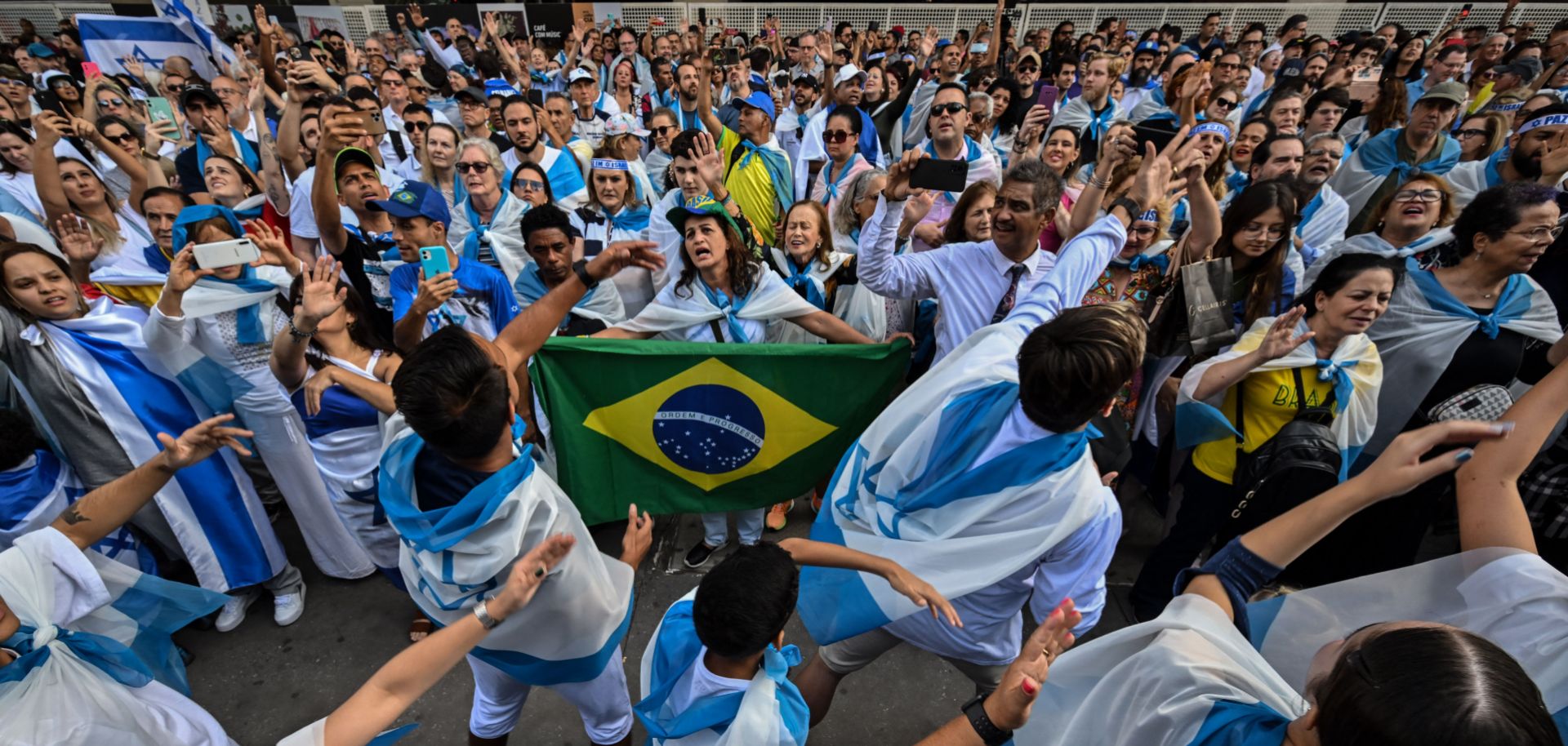
- Brazil's former far-right leader Jair Bolsonaro promised to move the country's embassy in Israel from Tel Aviv to Jerusalem in January 2019 (which was later downgraded to a ''Trade Mission''). 31% of Brazil's population identifies as evangelical Christian, a group that strongly supports Israel.
Most Latin American governments' moves to curb ties with Israel in response to the latest Gaza conflict will have few meaningful impacts. But should Israel's military campaign significantly expand, some governments could redirect their criticism toward the United States, which could impede the White House's regional initiatives. Spats between Latin American countries and Israel tend to be largely confined to diplomatic relations, as economic linkages between the region and Israel are fairly limited (only 4% of Latin America's exports went to Israel in 2021). This will probably continue to be the case with the ongoing war in Gaza. But if Israel's war efforts intensify — resulting in an outsized number of civilian casualties, highly publicized military strikes on humanitarian targets like the Al-Maghazi refugee camp — and/or if the conflict expands outside of Gaza, it is possible Latin American leaders will channel their frustration toward the United States, as U.S. President Joe Biden has remained a steadfast partner of Israel. Presidents in Latin America (in particular left-wing ones) could decide to boycott U.S summits dedicated to addressing regional issues — such as economic integration, irregular migration, and Venezuelan President Nicolas Maduro's autocratic regime — which would complicate Biden's initiatives in the hemisphere ahead of the 2024 U.S. election. But such protests would be mostly symbolic, as Latin American leaders will not dramatically alter their country's economic or security cooperation with the United States. During a Nov. 2 bilateral meeting with Biden, Chilean President Gabriel Boric, for example, took the opportunity to share his view that Israel's military operations were violating international humanitarian law. Latin America will likely also face a rise in anti-semitism as the Israel-Hamas war rages on, which could trigger security-related incidents in countries with large Jewish or Arab populations — especially if governments and social movements are openly critical of Israel's military campaign in Gaza. These incidents will likely manifest as protests that demonstrate support for either Israel or Palestinians, which would not only disrupt commerce and business activity, but could escalate to localized attacks on either Jewish or Arab citizens in Latin America.
- In the month following the Oct. 7 Hamas attack, the Delegation of Argentine Israelite Associations recorded more than 100 complaints of anti-semitism across Argentina, compared with the 427 complaints it recorded for all of 2022, according to a Buenos Aires Times report published on Nov. 3.
- On Nov. 8, Brazilian authorities arrested two members of the Iran-backed Lebanese militant group Hezbollah who were allegedly planning an attack on Jewish communities in Brazil.
