
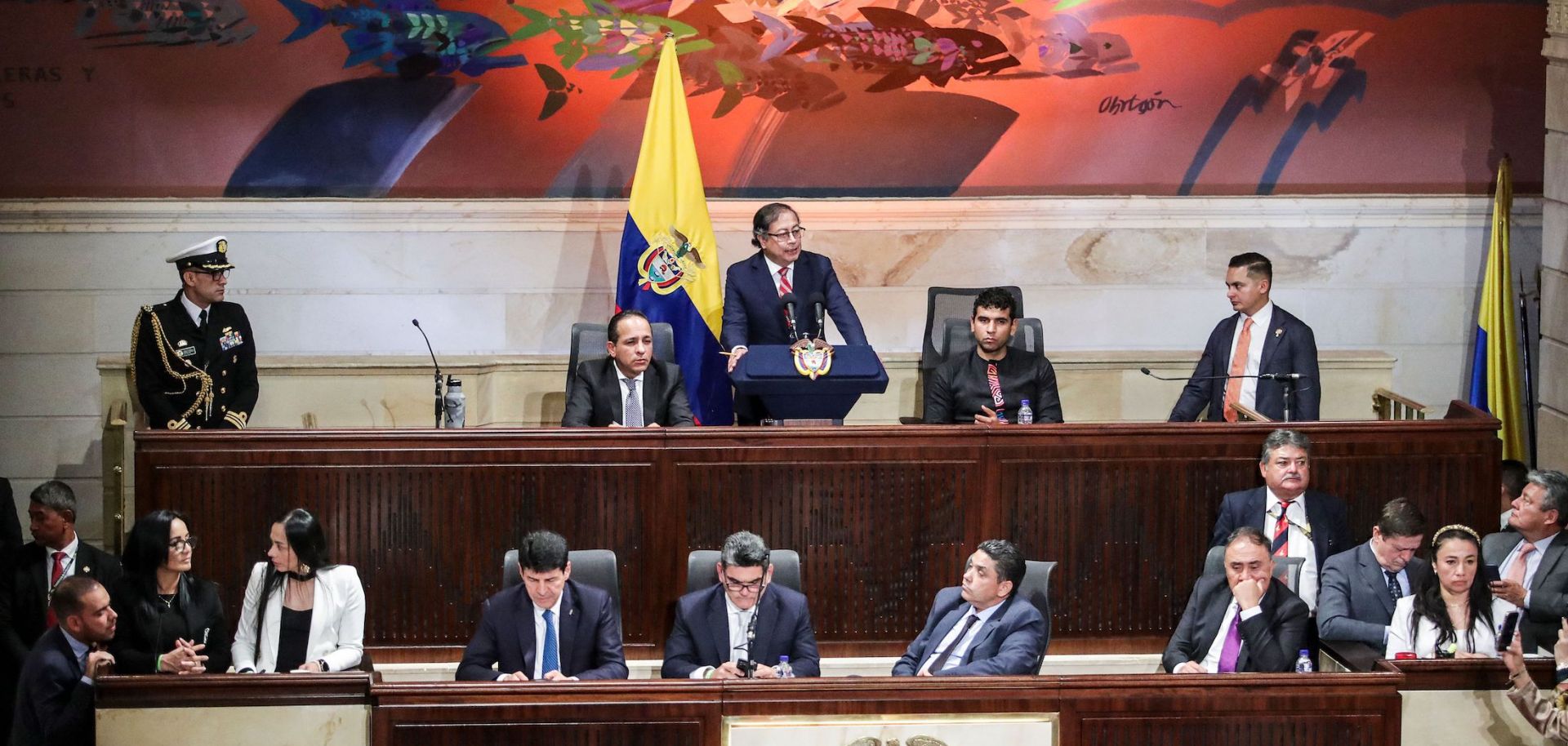
In Colombia, a campaign finance scandal could result in President Gustavo Petro's resignation or, if he manages to stay in power, could make it harder for his government to pass his reform agenda and garner support for his administration's peace talks with guerrilla groups. As Petro marked his first year in office on Aug. 7, a growing scandal involving his son is threatening to disrupt the remainder of his term. On July 29, Nicolas Petro was arrested as part of an investigation into a scheme in which he allegedly accepted illicit financing from guerrilla groups in exchange for promising to include those groups in his father's peace negotiation efforts. According to Colombian prosecutor Mario Andres Burgos, the president's son ''received large sums of money [that] exceeded legal limits'' from three criminal actors: Samuel Santander Lopesierra (who was extradited to the United States for drug trafficking charges in 2002), Gabriel Hilsaca (whose father is under investigation for homicide and links to paramilitary groups), and Oscar Camacho (a reportedly powerful businessman from the municipality of Cucuta). Burgos also said some of the funds were ''not reported to electoral authorities'' despite allegedly being used to help finance Petro's 2022 presidential campaign.
- Prior to his son's arrest, President Petro was already in the hot seat after a local newspaper leaked audio messages on June 4 in which his former campaign manager suggested the president's 2022 campaign received $3.4 million ''under questionable circumstances.''
- The Petro administration is currently conducting peace negotiations with Colombia's largest guerrilla group, the National Liberation Army (known by its Spanish abbreviation, ELN). It's also in talks with Estado Mayor Central, a dissident group composed of former members of the Revolutionary Armed Forces of Colombia (also known by its Spanish abbreviation, FARC). The government is ultimately hoping to reach an agreement in which these guerilla groups agree to disband in exchange for concessions such as political representation and reduced prison sentences.
The current evidence does not appear damning enough to threaten Petro's presidency.
But if more incriminating information emerges in the coming days or weeks, he could be impeached or forced to resign, in which case, his more left-wing Vice President would take over. At this point in the scandal, President Petro will likely be able to distance himself from his son's corruption charges, as multiple sources have already testified that the president was unaware of the illicit campaign financing. If, however, strong evidence comes out suggesting the Colombian president was involved in and aware of the scheme, his allies in Congress may partner with the opposition to gain the parliamentary majority needed to successfully impeach Petro. Alternatively, Petro's Pacto Historico coalition partners could also pressure him to resign before an impeachment vote takes place, in an effort to distance the coalition from corruption allegations against the Petro family. In either of these scenarios, Vice President Francia Marquez — who is one of the more leftist members of the Petro administration — would become president (assuming she is not also caught up in the scandal). Marquez has voiced support for more radical policies, particularly when it comes to the environment and reducing Colombia's reliance on fossil fuels. While the Petro administration has halted new oil and gas contracts and suspended further development of offshore oil and gas fields, Marquez has proposed enacting more drastic measures to expedite Colombia's transition to clean energy (such as halting permits for ongoing oil extraction projects), which she'd likely pursue if she assumes the presidency.
- In a March 2023 interview with local media, Nicolas Petro's ex-wife Daysuris del Carmen Vasquez claimed that Gustavo Petro was unaware of his son's money laundering and illicit campaign financing activities.
Even if they don't force Petro out of office, the allegations against his family will still make it difficult for the president to pass his reform agenda in Congress and potentially receive public approval for a potential final agreement in peace negotiations with guerrilla groups. Pacto Historico does not control a majority of seats in either of the two chambers of Colombia's parliament, which means that the government constantly relies on other political parties (most notably the center-left Liberal Party) to pass legislation. Nicolas Petro's arrest threatens to break this fragile congressional coalition, as lawmakers from those other parties will likely now be even more wary of supporting policies proposed by the president's coalition for fear of appearing aligned with corrupt actors — especially ahead of local elections in October. As a result, even if Petro remains president, it will be more difficult for him to pass his proposed healthcare, pension and labor reforms in the upcoming congressional session when they are slated to be debated. Should the scandal see Petro lose the support of his congressional coalition, he risks becoming a lame-duck president who fails to pass any significant reforms before the end of his term in 2026. Similarly, the corruption allegations could also taint how Colombian lawmakers and voters view Petro's push to bring ''paz total,'' or total peace, to the country by reopening negotiations with various guerrilla groups. The Petro administration's ongoing negotiations with the ELN and former FARC members have seen other guerrilla groups agree to multilateral cease-fires as a goodwill gesture predicting their own prospective talks with the government, which has temporarily improved the country's security climate. But the campaign finance scandal could make Colombians more skeptical of any agreement that comes from those talks, raising the risk of a Petro-led peace deal either being blocked by Congress or rejected in a potential public referendum. This could potentially lead to a breakdown of the current cease-fires, resulting in a resumption of violence in the rural areas of Colombia where guerrilla groups primarily operate.
- To pass policy, Petro's Pacto Historico relies on support from the center-left Liberal Party, which holds the most seats of any party in the lower house of Colombia's legislature and the third-most seats of any party in the upper house. While it leans toward the left, the Liberal Party supported conservative candidates over Petro in the 2022 presidential election, demonstrating the tenuous nature of Pacto Historico's alliance with the party.
- In response to the campaign finance scandal, former Colombian President and Liberal Party figure Cesar Gaviria said on Aug. 5 that Petro should be allowed to finish his term as president, though he failed to comment on whether his party would support the Petro administration's legislative initiatives.
