
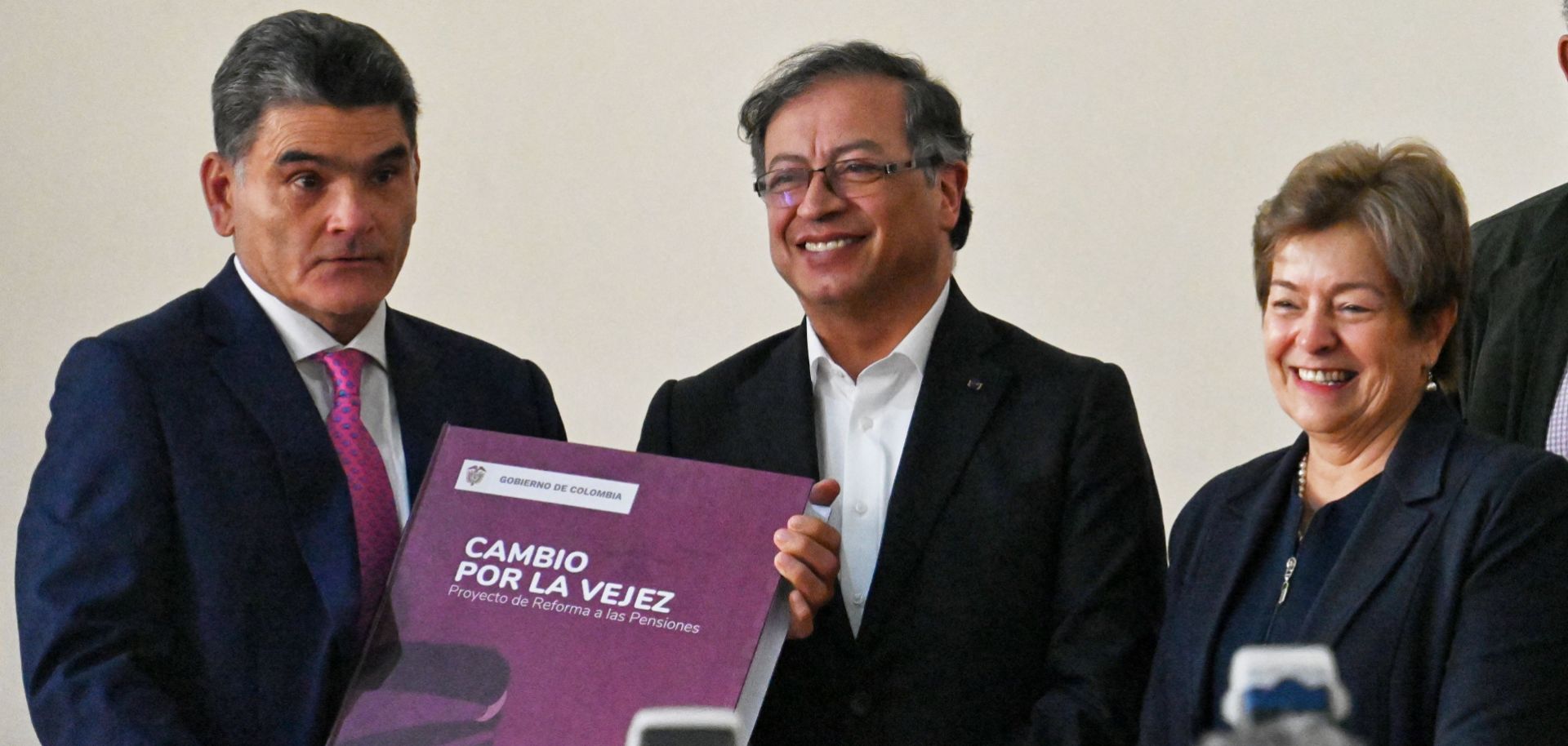
Colombian President Gustavo Petro (center) presents his government's pension reform bill to Congress in Bogota, Colombia, on March 22, 2023.
In Colombia, reforms to expand the country's social safety net will increase the state's role in the economy and potentially discourage private investment, even if conservative lawmakers push to water down the proposals. Since February, Colombian President Gustavo Petro has unveiled a series of sweeping social and economic reforms aimed at tackling poverty and other inequality issues in the country. The latest of these reforms was sent to Congress on March 22, with a bill that seeks to guarantee retirement for all Colombians by increasing the size of the country's state-owned pension provider. In addition to the pension reform bill, Colombia's new left-wing president (who took office on Aug. 7) has also recently proposed bills that seek to improve labor conditions and access to healthcare in the country. Lawmakers in Congress are currently debating all of Petro's reforms in a legislative session that will run through the end of May.
- Under Petro's pension reform, Colombians who retire without securing a pension would receive a basic income of $46 per month. Workers who earn three times the country's minimum wage (roughly $724 per month) would also be forced to contribute to Colombia's state pension fund. Currently, Colombia's pension system is only available to those who meet minimum wage requirements — a small portion of the population, given that 60% of Colombians work informally. Private pension providers coexist with public pension providers, though workers (and thus employers) often prefer private providers due to better payout conditions.
- On Feb. 13, Petro also presented a package of proposed healthcare reforms aimed at improving primary care, expanding access to treatment, and closing the healthcare coverage gap between urban and rural regions of the country. The main aspect of the reform is the creation of Primary Care Centers (CAPs) and the mandate that every Colombian citizen must be affiliated with a CAP, which can be either privately or publicly run.
- On March 16, Petro presented another bill that would strengthen labor rights in the country by reducing the normal work week from 48 hours to 42, thereby increasing the chance that workers receive overtime pay. The proposed labor reform bill also seeks to increase job security by reducing companies' ability to hire short-term contractors.
Petro's progressive reformist agenda aims to address Colombians' demands for better social services and living conditions following the mass protests that swept the country in 2021, though ideological differences in his coalition will likely force him to scale back the scope of his proposals. Starting in May 2021, Colombia saw two consecutive months of protests as various sectors of civil society aired their frustrations with then-President Ivan Duque's right-wing government, particularly over the lack of economic opportunity and rampant insecurity in the country. Colombians then expressed these frustrations at the ballot box in June 2022, when they elected leftist Petro as president. Petro campaigned on a promise to broaden Colombia's social safety net with a broad swath of reforms. While this is what Petro is currently trying to do, his bills need approval from both Congress and Colombia's constitutional courts to become laws. Currently, Petro's Pacto Historico coalition relies on the center-left Liberal Party and the center-right Union Party for the People to pass legislation. These parties will almost certainly seek to moderate some aspects of the three proposed reforms in an effort to appeal to the business community. Such changes will likely seek to reduce the increased cost of hiring workers and fairer competitive conditions between private and public healthcare providers. But even if watered down, Petro's proposals likely still be approved, as strong popular support for the measures will ultimately incentivize the coalition parties to vote in favor of the final reform text.
- The social unrest that engulfed Colombia in 2021 was initially triggered by a tax reform plan that sought to raise the country's value-added tax (VAT). The former Duque government's heavy-handed crackdown on those demonstrations then sparked criticism over police brutality, triggering mass rallies that quickly transformed into a broader social rights movement. For two months, thousands of Colombians — including students, union workers, Indigenous groups, Afro-Colombians, and pro-peace reformers — took to the streets to voice their anger with the country's current state of affairs. At their height, the protests severely disrupted transportation throughout major cities, blocked the flow of goods across the country, and saw intense clashes between police and protesters that left more than 70 civilians dead and several hundred injured.
- Petro, a former left-wing lawmaker and former Bogota mayor, won Colombia's June 19 presidential run-off election with 50.4% of the vote, beating out conservative candidate Rodolfo Hernandez's 47.3%.
- On Nov. 3, Colombia's Congress approved a tax reform seeking to raise an additional 20 trillion pesos ($4 billion) in tax revenue in 2023 to fund social spending, which levies progressive duties of up to 10% on coal and 15% on oil when international prices rise above a certain benchmark. To pass the tax reform, Petro enticed support from coalition parties by including provisions for increased spending on local public procurement projects. The president will likely pursue a similar approach in order to ensure his pension, labor and healthcare proposals gain enough support in Congress.
If implemented in their current form, the pensions and labor reforms, and to a lesser extent the healthcare reform, could result in higher costs for private companies and a defunding of private pension providers. Of Petro's three proposed reforms, the healthcare reform has the fewest potential implications for businesses. While the reform seeks to expand access to Primary Care Centers, it also stipulates that such healthcare facilities could either be privately or publicly run, meaning public-sector providers would not necessarily displace private healthcare companies. In fact, Petro's proposal falls short of creating the state-led healthcare system he initially promised on the campaign trail, which would have heavily impacted private healthcare insurers in the country — likely in a bid to secure support among the more pro-business centrist lawmakers in Congress. On the contrary, the president's proposed labor and pension reforms could prove particularly disruptive for businesses in Colombia by increasing operation costs and deterring investment. The two reforms could significantly increase the earning potential of lower-income workers and retirees, thereby increasing the consumption potential of those groups. This could eventually benefit businesses by expanding their market and consumer base. However, the broader employee protections under the labor reform would almost certainly (and immediately) add pressure on companies and start-ups in Colombia due to the increased overhead costs associated with the reduction in working hours and efforts to decrease informal work, potentially dissuading investors from considering new business ventures in the country. The pension reform, meanwhile, would also move a significant portion of pension funds from private providers to public ones. Private pension fund administrators are the second-largest holders of internal public debt securities, holding roughly 25% of internal debt. If the pension reform bill is approved in its current form, the subsequent large migration of debt to the country's state pension fund would thus risk devaluing local public debt.
- In a statement published on Feb. 24, the global investment bank Goldman Sachs noted that Petro's ''aggressive'' pension reform bill could ''divert considerable flows'' from private funds, ''constituting a significant fiscal risk for the [Colombian] government's local financing plan.''
