
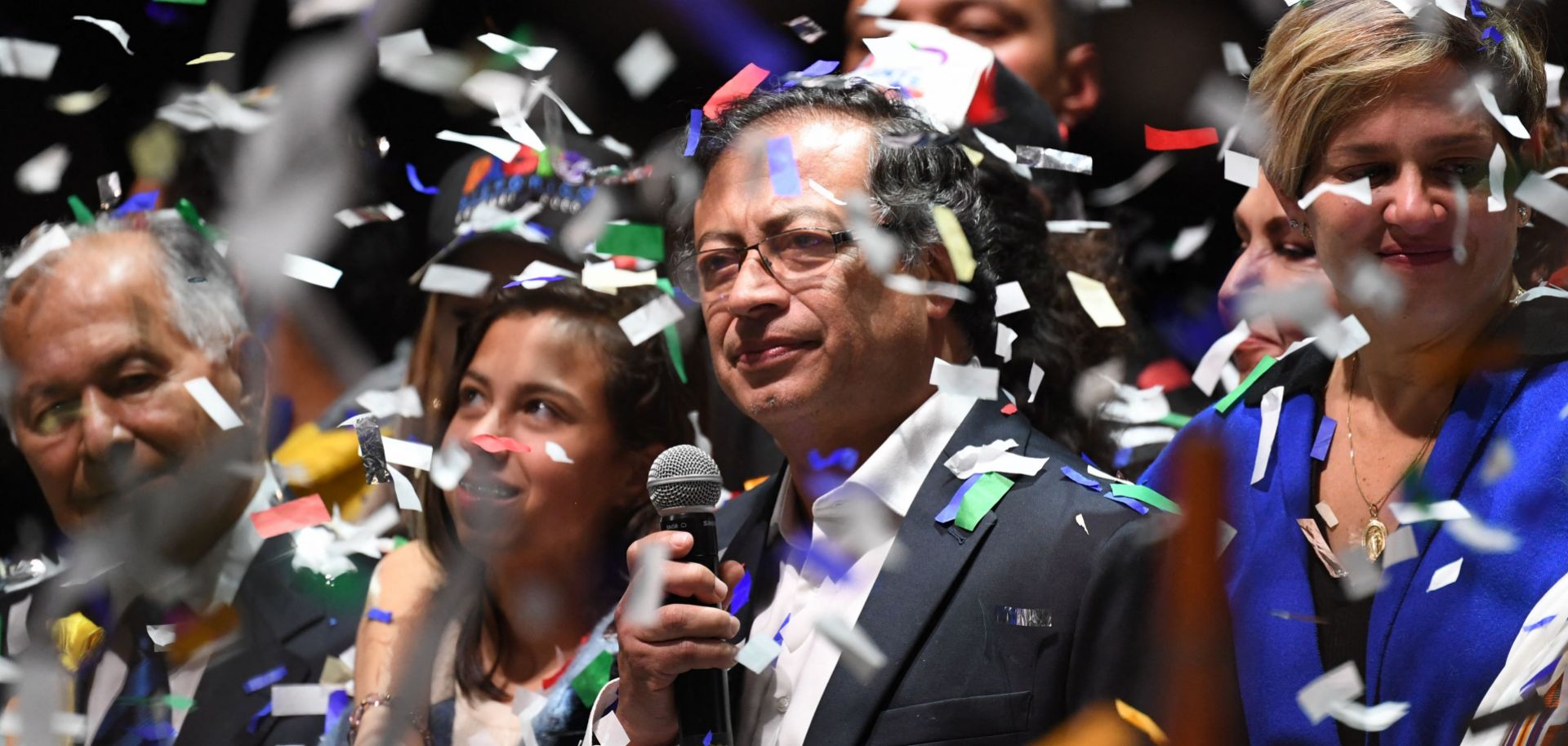
Gustavo Petro (center) celebrates with supporters in Bogota after winning Colombia’s presidential election on June 19, 2022.
The realities of a fractured legislature and a slowing economy will likely force Colombia's leftist president-elect Gustavo Petro to scale back aspects of his progressive policy agenda, though he may have some success in accelerating the country’s transition to clean energy. Colombia has elected its first leftist president in decades, a little more than a year after mass anti-government protests swept the country. Left-wing lawmaker and former Bogota mayor Gustavo Petro won Colombia’s June 19 presidential run-off election with 50.4% of the vote, beating out conservative candidate Rodolfo Hernandez’s 47.3%. Petro — who campaigned on tackling climate change, poverty and other inequality issues — will begin his four-year term on Aug. 7.
- Petro, an economist by training, was the main opposition politician in Colombia’s highly contentious presidential election. He served as mayor of Colombia’s capital city of Bogota from 2012-2015; he also served two terms in the Chamber of Representatives (the lower house of parliament), as well as one term in the Senate (the upper house of parliament). Petro is a former member of the left-wing M-19 guerrilla group who now advocates for disarmament.
- Petro campaigned on a progressive reformist agenda. He has pledged to move Colombia to a state-led health care system and enact sweeping social programs to alleviate rural poverty. He has also promised to halt all new oil and gas projects in Colombia in an effort to combat climate change and reduce the country’s economic reliance on extractive industries.
Constraints in Congress will force Petro to water down many of his ambitious policy proposals. Petro’s coalition, called the Historic Pact (or “Pacto Historico”), has the largest number of seats in Congress. But it does not have a majority and thus cannot pass legislation on its own, which will force the coalition to negotiate (and, in turn, likely weaken) its policy proposals to garner opposition support. This will probably lead to disagreements between Colombia’s executive and the legislative branches, which could stall significant policy decisions such as approving a national budget or the appointment of new supreme court judges. Continued pushback in Congress may tempt Petro to issue a state of emergency, which would grant him expanded executive powers to unilaterally enact temporary policies (though this would risk drawing the ire of the United States by running afoul with President Joe Biden’s push to strengthen democracy in Central America). But while Petro will struggle to pass much of his policy agenda through Congress, his pledge to enact the 2016 peace deal with the Revolutionary Armed Forces of Colombia (FARC) is still likely to receive support from the center-left Colombian Liberal Party. This would likely relaunch Bogota’s stalled peace process with the left-wing guerilla group. The successful implementation of the deal — in which the government promised to prioritize the economic development of Colombia’s long-neglected rural communities in exchange for FARC rebels laying down their arms — could also slow the country’s growing urbanization by helping mitigate the high levels of violence and lack of job opportunities that have long plagued Colombia’s rural towns.
- Petro is slated to nominate five new constitutional court judges for congressional approval between 2023 and 2025, which could significantly sway the ideological makeup of the country’s highest judicial body. This process will likely significantly increase tensions between Colombia’s executive and legislative branches, as lawmakers try to block Petro’s nominees for fear of skewing the court too far to the left.
- At the end of 2016, the Colombian government signed a controversial agreement with FARC commanders to end the armed insurgency in exchange for political representation and other guarantees. Both sides have since made very little progress on implementing the terms of the deal — including Bogota’s pledged reforms to boost government presence and economic development of rural areas, which are more susceptible to illicit activities. The government also previously sought a similar agreement with the country’s largest guerilla group, the National Liberation Army, but was unsuccessful.
A difficult global economic climate may lead to disenchantment and demonstrations from far-leftist groups. In addition to congressional opposition, Petro will also take office at a time of mounting global uncertainty that risks slowing Colombia’s economic growth. As a net importer of food, Colombia has been hit hard by the rising global cost of food imports. In addition, the global economic slowdown amid the ongoing war in Ukraine could negatively impact tourism inflows (which accounted for 4% of Colombia’s GDP in 2019) as consumers abroad will be less likely to prioritize the luxury of foreign travel. Poor economic conditions and a Congress that struggles to pass legislation may lead to public disenchantment with the Petro government — especially among extreme leftists that may view him as moving towards the center. This could, in turn, lead to anti-government demonstrations. Such protests are unlikely to garner the same turnout as the mass demonstrations that swept Colombia’s streets in the summer of 2021 due to the Petro administration’s more progressive policy platform and the government’s improved relations with the National Strike Committee. But another wave of anti-government could still be disruptive, especially if it involves truckers unions or grassroots movements.
- Colombia’s year-on-year inflation reached over 9% in May and is expected to keep rising in tandem with global food and fuel prices. The country’s central bank will likely continue to aggressively raise interest rates, though this strategy will likely prove ineffective since external factors appear to be largely driving the current spike in domestic prices.
Petro will likely seek to limit new activity in the oil and gas sector, potentially slowing economic growth in the long term. One of Petro’s core campaign promises was hastening Colombia's clean energy transition by suspending new exploration licenses and suspending further development of offshore fossil fuels. Passing legislation that fulfills that promise, however, will be difficult since most parties (including the center-left Liberal Party) are almost certain to oppose banning new oil and gas projects at a time of increasing economic instability. However, the Petro government may be able to block new oil and gas exploration licenses by restricting contracts through Colombia’s National Hydrocarbon Agency, which is a subsidiary of the Ministry of Mines and Energy. It could also let existing permits and contracts expire without renewing them, decreasing the output of companies with existing operations in Colombia. The Petro administration will almost certainly stall the implementation of a pilot fracking program on fracking conducted in tandem with U.S.-based ExxonMobil as well. Unlike legislation ratified by Congress, these unilateral measures could easily be reversed by the next administration. But Colombia’s economy is heavily reliant on fossil fuels, with the hydrocarbons sector accounting for 12% of the country’s GDP — meaning that the expiration of permits could trigger a prolonged economic slowdown that affects the government’s fiscal revenues for potentially years to come.
