
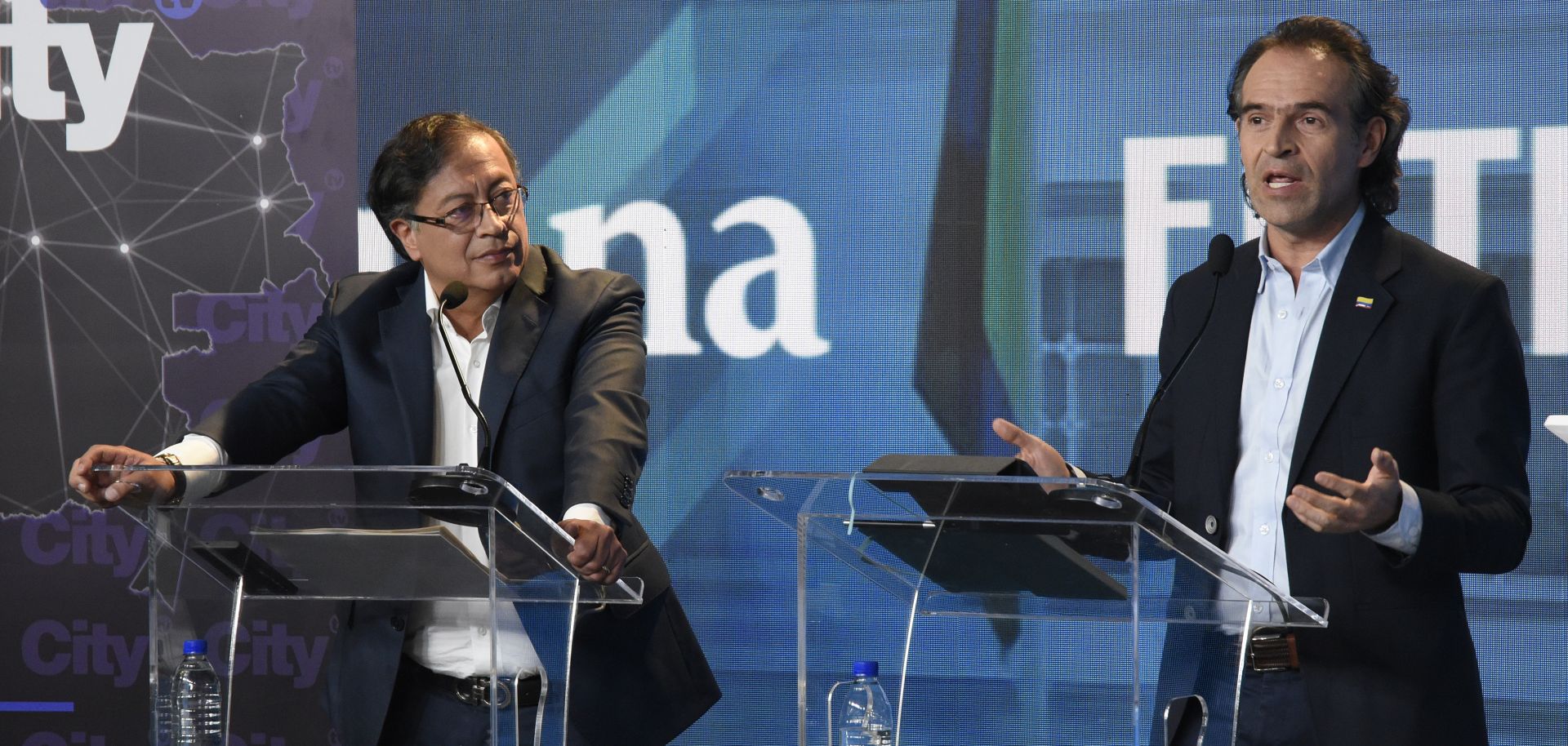
Centrist candidate Federico Gutierrez (right) speaks next to left-wing candidate Gustavo Petro (left) in Bogota on May 23, 2022, during the last presidential debate before Colombians begin casting ballots to elect their next leader.
Colombia's next president will face challenges including widespread calls for systemic change, a stalled peace deal with guerilla groups, complex tax reforms and the global energy transition. The country will hold the first round of presidential elections on May 29, followed by the second round on June 19. Left-wing senator and former Bogota mayor Gustavo Petro has led the polls throughout the campaign, building off the momentum from last year's mass anti-government protests with promises to enact sweeping reforms aimed at tackling climate change, poverty and other inequality issues. Petro's primary opponent is centrist candidate and former Medellin mayor Federico ''Fico'' Gutierrez, who has adhered to traditional conservative values but has distanced himself from the more established right-wing ideologies heralded by current President Ivan Duque and his like-minded predecessor Alvaro Uribe. In recent weeks, independent populist Rodolfo Hernandez has also risen in the polls as a third candidate, fueled by his campaign's strong anti-corruption message and savvy social media efforts. If elected, Petro would be Colombia's first leftist president. But Gutierrez and Hernandez's platforms would also mark a significant shift from the pro-business economic policies and heavy-handed security tactics that have dominated Colombian politics over the past 20 years — highlighting a growing desire for change in one of the most politically conservative societies in Latin America.
- A Guarumo EcoAnalítica poll published on May 20 showed Petro with 35% support, followed by Gutierrez with 20.8% and Hernandez with 19.1%. A runoff scenario between Pedro and Gutierrez shows a virtual tie, with both candidates drawing in roughly 40% of prospective votes with a significant portion of Colombia's electorate undecided.
- The passing of a controversial tax reform saw thousands of Colombians take to the streets between April and June 2021, with demonstrators arguing it raised the tax burden on citizens at a time economic conditions were already tough due to COVID-19. The widespread anti-government movement quickly morphed into calls for reducing the country's reliance on fossil fuels, creating more jobs, police reform and protecting Indigenous rights.
The Issues Facing Colombia's Next President
The four-year term of Colombia's next president will be defined by the following five key issues:
1) Legislative and Popular Pushback
A divided Congress and sporadic episodes of social unrest will likely constrain the next president's room to implement policy. Regardless of the outcome of the election, Colombia's new president will likely struggle to govern amid a fragmented Congress, making it difficult for the next administration to enact legislation. Colombia's center-left Liberal Party formally announced its support for Gutierrez on April 27. Lawmakers from the party would likely continue to support Gutierrez if he wins the presidency, giving his administration a simple majority in Congress. However, such an alliance would be fragile due to divergent ideologies. The Liberal Party's support of policies like a basic salary for poor Colombians and a stronger education system would also restrict the more conservative aspects of Gutierrez's platform. However, should Petro or Hernandez win, neither have the congressional support needed to pass legislation or constitutional amendments. Their policy platforms would thus likely be hindered, potentially pushing Petro or Hernandez to rely on presidential decrees or states of emergencies to govern, which would limit the administration's ability to effectively implement its policy agenda. Another barrier to an effective presidency is Colombians' growing discontent and overall frustration with their government, especially amid rising food and fuel prices. 80% of Colombians said they were dissatisfied with the direction of their country in a recent poll compared with the 59% who said so in a 2018 poll. This indicates a high risk for potentially disruptive demonstrations in the next year and a half.
2) Growing Calls for Political Change
While Petro is pledging to implement structural economic reforms, a Gutierrez victory is likely to result in significant policy continuity. During the May-June 2021 demonstrations, protesters aired a variety of grievances and advocated for systemic change to the current economic and societal models in Colombia. The presidential elections will test how far voters are willing to push for structural changes. Petro is campaigning for broad systemic change, with proposals to overhaul Colombia's agriculture and healthcare sectors in favor of the poor and middle class at the expense of the wealthy. However, a fragmented Congress will make it hard for Petro to implement the most radical of his reform proposals, which decreases the likelihood that Colombia would see substantial changes under a Petro government. While Hernandez is also campaigning on a promise of structural change, his track record as governor of the regional capital of Bucaramanga demonstrates that he would likely stray from initial campaign promises to address existing structural issues. Gutierrez, meanwhile, proposes some policy changes such as promoting private investment and strengthening the country's agriculture sector. But despite his best efforts to portray himself otherwise, Gutierrez's platform promises the most policy continuity with current President Duque compared with the other leading candidates. Still, Gutierrez's more moderate approach to reform increases the probability of some reforms being passed, especially those connected to creating job opportunities and implementing a 2016 peace deal with the Revolutionary Armed Forces of Colombia, the guerrilla movement better known as the FARC.
3) Reducing Militia Violence
All three candidates have promised to revitalize outreach to Colombia's rebel movements, which could improve the country's security climate in the short term. But the need for congressional approval and divisions within the armed groups like the FARC make long-term peace unlikely. Should Petro or Hernandez win the presidency by a large margin, the government would likely seek to restart the process of implementing the 2016 peace deal with the FARC, as well as secure a new peace deal with the National Liberation Army (ELN) — the country's largest rebel group. Doing so would likely lead to prolonged cease-fires but not necessarily long-term peace, as there would inevitably be armed factions in both the ELN and the dissident groups of the FARC that oppose negotiating with the government. Gutierrez would likely build upon Duque's security strategy of increasing the military's operational capacity and presence in rural areas where armed groups are active, leading to a similar or increased level of fighting between the military and armed groups. While Gutierrez's administration would likely implement some aspects of the 2016 peace deal, it would not likely spend political capital on enacting the more contentious aspects such as allocating resources for former guerrilla fighters.
- At the end of 2016, the Colombian government signed a controversial agreement with FARC commanders to end the armed insurgency in exchange for political representation and other guarantees. Since the deal was signed, there has been very little progress on the stipulations of the deal and roughly 2,500 former members have reignited their guerilla activities. The government also previously sought a similar agreement with the ELN, but was unsuccessful.
4) Redistributing the Tax Burden
Petro and Hernandez would likely increase taxes on corporations and wealthy individuals; Gutierrez, meanwhile, would likely seek to raise the value-added tax. Colombia's current taxation system places a significant burden on corporations and boasts the world's second-highest corporate taxes (30%) behind France. Conversely, the country places value-added tax (VAT) exemptions on a plethora of basic goods, which puts the effective tax rate well below most other countries in the Organization for Economic Coordination and Development (OECD). Colombia's tax-to-GDP ratio is, in turn, also well below the regional average. Though Duque attempted to reform the system, he watered down his tax proposal after widespread demonstrations. In addition, many Colombian companies are struggling to repay their foreign debt and their borrowing costs have increased after S&P Global Ratings and Fitch Ratings both downgraded the country's credit rating in mid-2021. This, in addition to a heavy tax burden, has put many companies in Colombia on the brink of default. As a result, the next president will almost certainly need to institute a second tax reform. Petro or Hernandez would likely raise the tax rate of wealthy individuals or further increase the corporate tax burden. However, in lieu of an economic boon, the added revenue from such a tax increase would not likely be enough to prevent already struggling firms from defaulting on foreign debt. If elected, Gutierrez has said he wouldn't seek another tax reform during his first two years in office. But the centrist candidate has also promised to prioritize efforts to regain investment-grade status with credit rating agencies on Colombia's sovereign debt, and would almost certainly face political backlash and demonstrations led by politically-active labor unions if he pursues a tax reform.
5) Transitioning to Clean Energy
While a Petro administration would seek to limit future hydrocarbon explorations, a Hernandez or Gutierrez government would likely support additional investment in the sector. The Colombian economy is heavily reliant on fossil fuels, with the hydrocarbons sector accounting for 12% of total GDP; oil and gas shipments also account for over half of the country's total exports. In the face of a slow but steady global push toward renewables, Colombia is in the midst of a public debate over whether to continue its oil and gas projects or forge a new path toward green energy and industrialization. Petro has pledged to halt new exploration in the oil and gas sector, including a pilot program on fracking, in favor of exploring investment incentives in clean energy projects. He has also suggested that existing projects should be approved by local Indigenous communities, which would likely disrupt operations and affect profitability if enacted. This could force oil majors to invest elsewhere in the near term and further drive up global gas prices in the long term. While both Hernandez and Gutierrez have been hesitant to take a position on the contentious fracking pilot program, they both have voiced support for the continuation of new investment in oil and gas, which could decrease the intensity with which Colombia lowers its emissions and, in turn, contribute to the country missing its goal of carbon neutrality by 2050.
