
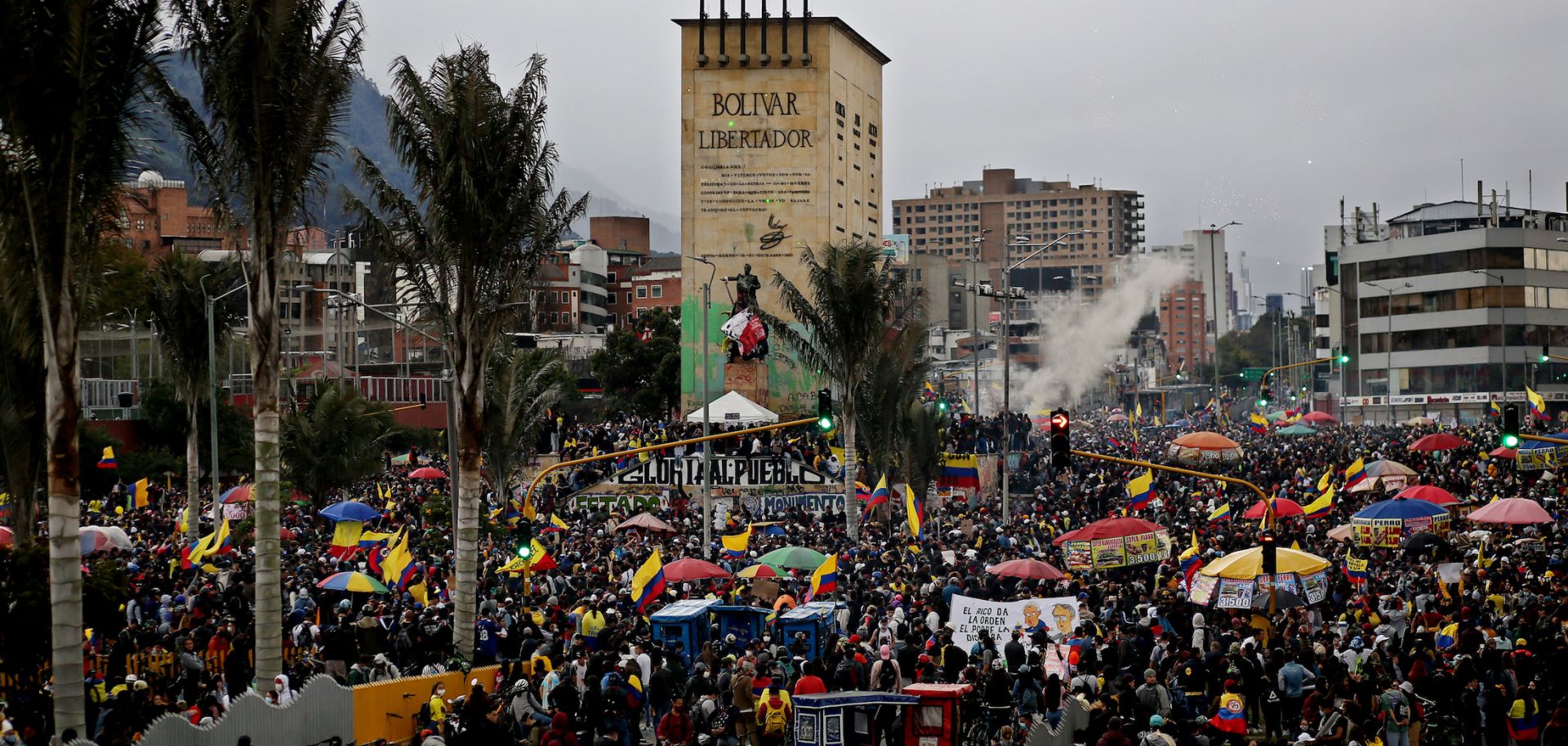
People gather in the streets of Bogota, Colombia, to participate in anti-government protests on May 15, 2021.
In Colombia, widespread protests and congressional hesitancy will likely either significantly scale back or completely stop the government’s proposed tax reform, threatening the economy’s post-pandemic recovery. Nationwide protests going into their third week threaten both the passage of tax reforms to make fiscal deficit more sustainable and the continuation of a nationwide cash-transfer program started during the pandemic. On April 15, President Ivan Duque announced his government’s tax reform proposal aimed at fixing a budget deficit of 1.2% of GDP and making permanent a nationwide cash transfer program to the poor. However, the reform faced widespread public backlash due to the unpopularity of an increased tax burden. Duque withdrew legislation for the current version of the tax reform on April 30, vowing to propose another version, likely narrower in scope, in the coming weeks.
- The initial tax reform included provisions to raise the value-added tax (VAT) to 19% on gasoline and other basic services in upper-income areas, as well as expand the tax base to those earning more than $656 dollars per month. The reform planned to bring in an additional 2% of GDP per year, with 74% coming from individuals and 26% from corporations.
- Colombia began sending monthly payments of $43 (160,000 Colombian pesos) to poor households, keeping the economy afloat during the pandemic. Payments began going out in April 2020 and are currently set to end in June of 2021 and would cost Bogata $9 billion annually. The government wanted to extend this payment plan to broaden the social safety net and help boost the economy out of the recession.
Even if Congress passes a modified version of the reform, Duque would still unlikely be able to fill the hole in the fiscal budget and raise enough taxes to continue the cash-transfer program. In order to get the fiscal reform through Congress, Duque will likely have to make significant concessions, including lowering the amount the government hopes to raise and putting an even higher amount of the tax burden onto corporations operating in Colombia, which already face one of the highest tax rates worldwide. The country’s labor unions have the upper hand in negotiations with the government as constant protests have forced Duque to rescind its initial tax proposal, fire Colombia’s finance minister, and call for a national dialogue with opposition political parties.
- The reform proposed by the government would have added 3% onto the 2022 and 2023 tax burden for businesses making over $139,000 annually. This temporary tax hike would have effectively postponed 2018 reforms that were aimed at slowly decreasing the corporate tax rate, under which firms would have expected their tax burden to decrease from 32% to 31% this year before going down to 30% in 2022.
More likely, Duque will fail to get a new proposal through Congress before 2022 election campaigns start in earnest, after which passing anything will become near impossible. Encroaching legislative and presidential elections will make it difficult to pass revised reforms through Congress, as members are less likely to support an unpopular tax overhaul during a campaign season, which is set to officially start midway through this summer.
- In 2022, Colombia will hold legislative elections on March 13, followed by presidential elections on May 29.
The threat to fiscal reform is already raising concerns among investors about Colombia’s ability to boost its economy out of a pandemic-induced recession. Duque’s tax reform proposal was meant to both boost investor confidence in Colombia’s long-term financial stability and domestic spending to recover from the COVID-19 crisis, which caused a 6.8% decrease in GDP in 2020. The lack of a fiscal reform would also amplify the effects of underlying issues in Colombia’s economy, namely the threat of private sector defaults. Should investors ultimately decide that the country’s financial situation is too precarious due to both immediate and long-term risks, the Colombian economy may have a difficult time lifting itself out of its current recession.
- Colombia’s dollar bonds are now trading at junk status. Borrowing costs on Colombia’s sovereign debt, meanwhile, are also currently trading around the same level as countries considered to be at junk status, including Brazil, Guatemala, Uzbekistan and Azerbaijan.
- The Colombian peso’s value has plummeted over the past month, seeing especially steep drops in the days following the onset of the protests.
- In March, the Finance Ministry said that the fiscal deficit would reach 8.6% of GDP if reforms aren’t passed.
Investor confidence is unlikely to quickly return, should it significantly dissipate. Colombia’s protracted economic struggles could lead to a potential debt crisis, slowing its economic recovery even further. Be it an official downgrade by all three credit rating agencies or loss of investor confidence amid the lack of tax reforms, Colombia’s sovereign debt will likely continue to trade at junk status. Continued difficulties repaying debt would also raise borrowing costs on bonds that Colombia hopes to issue in the coming year, making it less cost-effective for Colombia to overcome its economic downturn. Additionally, should Duque raise taxes on corporations, the added impact on companies’ profit margins could force those that are already struggling firms to default on foreign debt, including a very high amount of short-term trade credit. Similarly, should Colombia enter into an extended recession, many firm's external public debt would become more expensive due to increased investor risk premia. Combined with a depreciating peso, this would then increase expenses and could trigger a number of Colombian firms to default on their debt. Higher rates of private sector defaults increase import costs, which could deepen the recession and amplify the risk of a government default. At only 39% of GDP, Colombia’s public sector external debt is not particularly high. But overall debt service costs for the entire economy are equivalent to 88% of projected exports of goods and services, and either a sovereign default or widespread corporate defaults would affect imports and growth.
- The sovereign risks department at S&P Global downgraded Colombia’s sovereign rating to junk status to reflect the obstacles that stand in the way of comprehensive tax reform.
- Private sector in Colombia has a large amount of debt projected to be a total of $19.59 billion in 2021 by the International Monetary Fund.
