
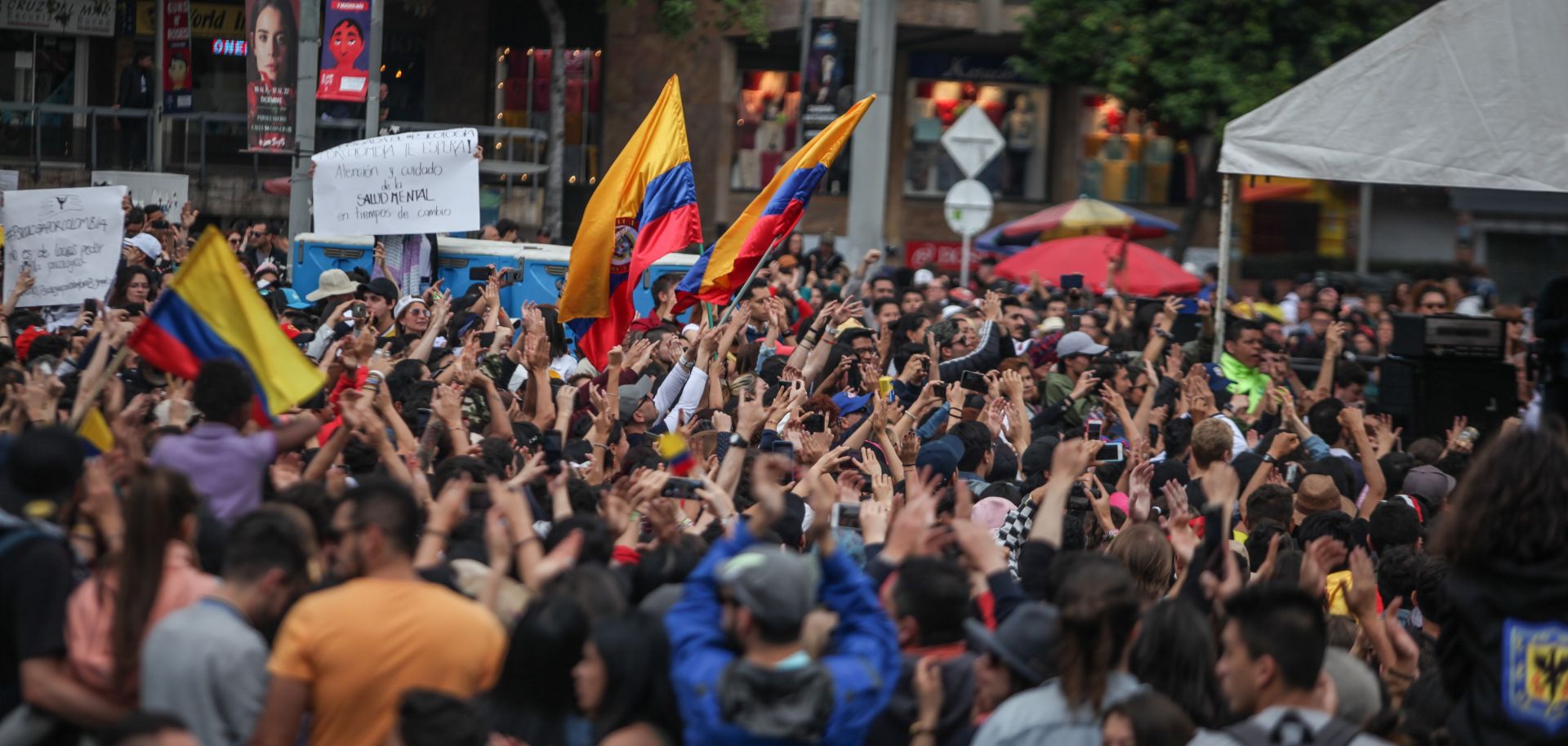
A protest against the government of President Ivan Duque on Dec. 8, 2019, in Bogota, Colombia.
Editor's Note: This assessment is part of a series of analyses supporting Stratfor's 2020 Annual Forecast. These assessments are designed to provide more context and in-depth analysis of key developments over the next quarter and throughout the year.
Major demonstrations that have racked Colombia since Nov. 21 will continue into 2020, but will largely remain peaceful. The government of Colombian President Ivan Duque will struggle to come to terms with the protesters, and will become less politically effective amid ongoing unrest and as the security situation worsens in rural areas prone to militancy.
The Nature of the Unrest
Though partially inspired by protests elsewhere in Latin America, including those in Bolivia, Chile and Ecuador, the unrest in Colombia is rooted in longstanding issues. Foremost among these is anger at income inequality, which many protesters see as facilitated by government corruption and failure to invest in economic development and education. Unlike elsewhere in Latin America, a lack of development in rural Colombia has allowed criminal gangs to flourish. The violence has spread into the political sphere, with nominally right-wing militias — though in reality, the militias are more interested in profiting from criminal operations than in ideology, like their left-wing militia counterparts — implicated in attacks on activists and union officials.
Indigenous communities, students and trade unions are the main forces behind the protest wave that began Nov. 21. Indigenous groups feel they have not received adequate economic development assistance or security assistance in the face of increasing violence targeting their communities. Student groups are incensed with Duque's proposed education reforms, which would ax popular programs such as one geared at educating children of the rural poor. And trade unions oppose Duque initiatives regarding tax and pension reform and various privatization proposals. The country's two main trade unions, the General Confederation of Labor and the Central Union of Workers, called the Nov. 21 strike, out of which emerged the National Strike Committee (NSC), an umbrella group of Duque opponents representing dozens of interest groups. The NSC has issued 13 demands on a wide array of issues.
The main demands call for a halt to major social or tax reforms and a promise to abide by existing deals with workers, students and indigenous groups. They also include calls to observe the peace deal with the Revolutionary Armed Forces of Colombia (FARC) and to increase funding to so-called demobilization zones for the group.
The Protests' — and Duque's — Prospects
Unlike previous unrest aimed at Duque, the coalition of groups behind the current nationwide protests will be difficult for him to satisfy. But while the protests will continue, they are unlikely to see the sort of sudden and violent escalation witnessed elsewhere in Latin America, such as in Chile. The NSC has clear leadership, meaning the coalition exercises significant control over those protesting in its name, something the largely peaceful nature of the unrest testifies to, despite sporadic looting and some violent clashes with authorities resulting in death and injury. NSC leaders have sought to block violence and disruptive tactics such as targeting airports since it does not want to lessen the broad public sympathy for its aims.
Duque does not enjoy such broad sympathy. The outbreak of unrest has coincided, and fueled, perceptions of corruption surrounding Duque and his circle. His political mentor, former Colombian President Alvaro Uribe — still a major figure in Duque's right-wing Democratic Centrist Party — and some of his former Cabinet members face investigations into allegations of nepotism, corruption and connection to right-wing militias. Duque also faces divisions within his own party, which is split on the protest question, with some advocating talks and others demanding a crackdown. Some center-right parties that nominally support Duque's economic agenda have also openly supported the NSC.
Duque has sought to defuse the protests by negotiations. The NSC, however, has responded warily to his overtures, since Duque has previously used such talks to get protesters to stop their demonstrations only to fail to make meaningful concessions. Protests are therefore likely to continue even with negotiations until Duque offers the protesters something that satisfies their aims. He may make some concessions, such as increased social spending and delaying reforms, but he will not offer them enough to quell the protests. Ongoing unrest will sap his ability to push significant initiatives through his country's legislature for the remainder of his term. He is also highly unlikely to accede to protesters' demands that he increase funding for programs related to the 2016 peace accord, and in fact, will maintain military and police pressure on former FARC elements — but not enough to halt their expansion in rural areas.
