
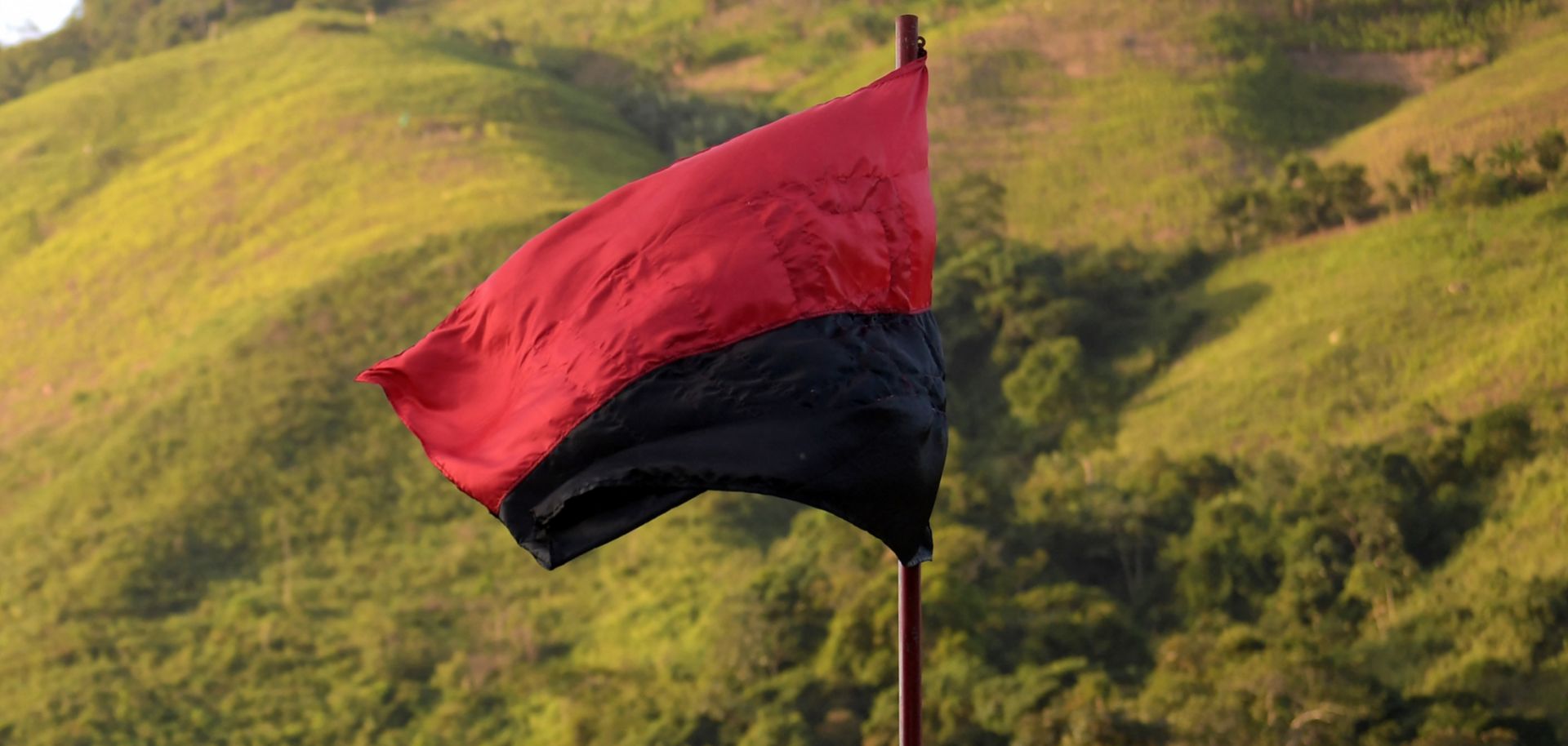
A flag of the National Liberation Army (ELN) guerrilla group flutters in the wind in Catatumbo, Colombia, on Aug. 18, 2022.
On the campaign trail and since taking office in August 2022, Colombia's new left-wing president, Gustavo Petro, has promised to bring ''paz total,'' or total peace, to the country. The most crucial part of this strategy has been reopening negotiations with a variety of guerrilla groups, the largest of which is the National Liberation Army (known by its Spanish abbreviation, ELN). After Congress passed legislation that cleared the way for such talks in October, Petro's government has launched negotiations with the ELN, as well as Estado Mayor Central, a dissident group composed of former members of the Revolutionary Armed Forces of Colombia (also known by its Spanish abbreviation, FARC).
In its talks with the ELN, in particular, the Petro administration is hoping to dismantle the powerful guerilla group, likely by offering current ELN fighters concessions like reduced jail sentences and political representation. The ongoing peace negotiations have prompted other guerrilla groups in the country to agree to multilateral cease-fires as well, as a goodwill gesture predicting their own prospective talks with the government, which have led to temporary improvements in the country's security climate.
But true peace in Colombia will remain elusive due to the many obstacles still standing in the way of the Petro administration reaching a comprehensive peace agreement with guerrilla groups and, more importantly, the country's geographic conditions that make drug production and trafficking financially lucrative for such groups.
A Brief History of Colombia's Criminal Groups
Guerrilla militant groups have controlled significant portions of Colombia since the end of the country's 1948-1958 civil war. In the aftermath of the decade-long war, limited security presence and government services in rural areas enabled ideologically-motivated groups, some of which had criminal components, to operate as the de facto state in large swaths of the country. The increased consumption of cocaine and other illicit drugs by North America and Europe in the late 1970s and 1980s only added further fuel to the power of these groups, as the production and export of narcotics became a lucrative business.
This led to the rise of urban-based narco militias like the Medellin Cartel and Cali Cartel, which together largely controlled Colombia's booming drug trade until internal disagreements and government crackdowns ultimately led to both groups' demise in the mid-1990s. The power vacuum left by the collapsed cartels then enabled pre-existing ideologically-motivated guerilla groups — such as the FARC, ELN and Popular Liberation Army (EPL) — to gain prominence in the late 1990s and the early 2000s. By the 2010s, the FARC had emerged as the preeminent guerrilla group in Colombia, with over 30,000 members.
In March 2011, the Colombian government launched peace talks with the FARC that saw several different crises and subsequent de-escalation, before the two sides eventually reached a final agreement in November 2016. Years later, several high-level former FARC commanders disavowed the peace deal and started their own dissident groups, stating that Bogota had failed to deliver on promises made during negotiations. These dissident groups are now estimated to have as many as 3,000 full-time armed fighters who were former FARC members. Today, these dissident FARC guerrillas, along with the ELN and the Gulf Clan, are the prominent players in organized crime in Colombia.
The Difficult Road to Peace
A former guerrilla fighter himself, current Colombian President Petro is hoping to finally put an end to the country's long history with guerrilla groups. But his efforts to achieve ''total peace'' have already suffered setbacks, as most recently evidenced by his administration's move to suspend a cease-fire with the Gulf Clan, on March 20 after the group allegedly violated the truce.
To successfully reach a peace agreement with Colombia's powerful guerrilla groups, Petro will have to navigate several roadblocks, including:
Intra-Group Disagreements
The factionalized nature of Colombia's guerrilla groups means internal disagreements are common and could potentially lead one faction to sabotage the negotiations being carried out by another faction, disrupting and potentially halting the negotiation process. Similar to some terrorist groups in other areas of the world, Colombian guerrilla groups are comprised of quasi-independent cells with distributed command. This structure has led to significant disagreements between different factions of guerrilla groups when their leaders seek to negotiate a peace agreement, as some factions may prefer to continue their operations.
One recent example of this was the March 6 announcement that the Gulf Clan sought to begin peace negotiations with Petro's government, just days after the group's second in command, Wilmar Antonio Giraldo, was assassinated — leading local media to allege that his death was a result of internal disputes within the group over the decision to negotiate peace with the government. Notably, the Petro government called off peace talks weeks later due to the Gulf Clan's noncompliance, further highlighting how internal disagreements within criminal groups can thwart peace negotiations.
Occasionally, factions within guerrilla groups can even resort to violence in their efforts to thwart negotiations, as exemplified by the 2019 ELN police academy bombing in Bogota that ended a previous round of talks between the government and the guerrilla group. The current negotiation process launched by the Petro administration could see similar sporadic incidents of high-impact violence as warring guerrilla groups factions vie for influence, which could increase security risks across the country — especially if the state institutes a strong response.
Negotiating With Multiple Different Groups
The government's efforts to negotiate with several guerrilla groups could also force the state to make significant concessions to accommodate the multitude of their demands or face the disintegration of peace talks. On Jan. 1, Bogota agreed to a cease-fire with the country's five largest guerrilla groups: the ELN, the Second Marquetalia, the Estado Mayor Centra, the Gulf Clan, and the Self-Defense Forces of the Sierra Nevada. Though negotiations are currently ongoing with just two — the ELN and the Estado Mayor Central — the government will likely seek peace negotiations with a variety of guerrilla groups in its efforts to achieve ''total peace.''
To avoid negotiating with groups individually, the Colombian government has indicated it would seek to implement one peace accord that could be signed by several guerrilla groups. However, the participation of a multitude of guerrilla groups, and their respective demands, could force the government to grant large concessions to accommodate the various guerrilla groups while ensuring that there is a uniform accord. As such, the government is in the position of either granting significant concessions — highly unpopular among Colombians who want to see guerrilla fighters brought to justice — or risking some guerrilla groups dropping the final agreement.
External Influence
Governments outside Colombia may also seek to influence the outcome of the peace negotiations to advance their own agendas. Mexico, for example, has already taken on the role of mediator by hosting the Petro administration's talks with the ELN. But to protect their own interests in Colombia, the United States and Venezuela could also seek to influence negotiations by pressuring Colombia's government and guerilla groups, respectively.
As the main recipient of the drugs trafficked from Colombia, the United States has historically taken a hard-line approach to Colombia's guerrilla groups. As such, Washington will likely push Bogota to grant fewer concessions, specifically pushing to resume aerial spraying in efforts to eradicate coca crops. The Venezuelan government, meanwhile, may attempt to undermine the Colombian peace process. A portion of Venezuela's government revenue under President Nicolas Maduro likely comes from partnerships with Colombian groups that illegally mine various natural resources and have a presence in Venezuela. Though the contribution of illegal mining to Venezuela's revenue remains unknown, the Maduro government may seek to influence guerrilla groups that operate in Venezuela to continue doing so in an effort to maintain those revenue streams, potentially sabotaging negotiations should they threaten illegal mining operations.
Congressional Approval
Petro has maintained a fair popularity rate since coming into office, with a 52% approval rating as of the end of March. But his Pacto Historico coalition is made up of ideologically different parties that could impede his ''total peace'' initiative. Two key members of the ruling coalition — the center-left Liberal Party and the center-right Union Party for the People — have historically been against peace agreements, but have tentatively signaled that they would support legislation to implement the deals agreed to in the Petro administration's negotiations with guerilla groups. This support, however, could easily be revoked if the public disapproves of the final draft of the peace accords, or if Petro's overall approval rating drops due to other reasons.
A Geographic Disadvantage
But the greatest barrier Petro faces in achieving his ''total peace'' dream is rooted in Colombia's optimal geography for cocaine production and its close proximity to one of the largest markets for that product: the United States.
The strip of the Andean mountains that runs through Colombia provides the necessary conditions for the cultivation of the coca plant, which is used to make cocaine and other narcotics. The coca plant produces the most useful leaves for drug production at over 2,000 feet above sea level in cool, dry areas, making the Andean mountains the perfect location for cultivation. The easy growth of the coca plant in Colombia provides an accessible (and lucrative) source of revenue that enables even small guerrilla groups to scale quickly. Furthermore, undocumented migrants from Cuba, Haiti and Venezuela often come to Colombia — either on their own accord or under the threat of cartels — to work in coca plantations, providing low-cost labor that translates into even greater profits for the cartels operating those plantations.
As the coca plant does not thrive in Mexico or Central America, Colombia is the country closest to the largest consumer market for narcotics: the United States. Traffickers primarily use undetectable homemade submarines, dubbed narco submarines, to transport illicit goods from Colombia to the United States. This makes it relatively easy for traffickers to reliably transport illicit products directly from Colombia to the United States or Mexico — giving Colombian cocaine producers an edge over their competitors in Bolivia and Peru, who have to first transport their products by land.
Temporary, Not Total, Peace
Colombia has a few treacherous years ahead as the Petro administration continues to pursue peace negotiations with the country's powerful guerrilla groups. During this time, Colombia will likely see periods of improved security conditions and high tensions as trust-building mechanisms are tested.
But as long as there is demand for narcotics in the United States, there will be an incentive to continue cultivating and exporting those drugs. And this reality will make it difficult for Colombia to avoid the resurgence of guerrilla groups, even if the country's major guerrilla groups agree to peace agreements. In fact, the disarmament of guerrilla groups could immediately increase levels of violence in the country by leaving a power vacuum in Colombia's lucrative drug trade, as various smaller groups fight over control of cultivation plots and trafficking routes.
Petro's negotiations with guerilla groups are unlikely to ever yield 'total peace' without changes to the underlying drivers of the drug trade in Colombia: optimal coca production conditions and U.S. demand. But his efforts to achieve that ambitious dream could nonetheless bring a short period of stability for his country.
