
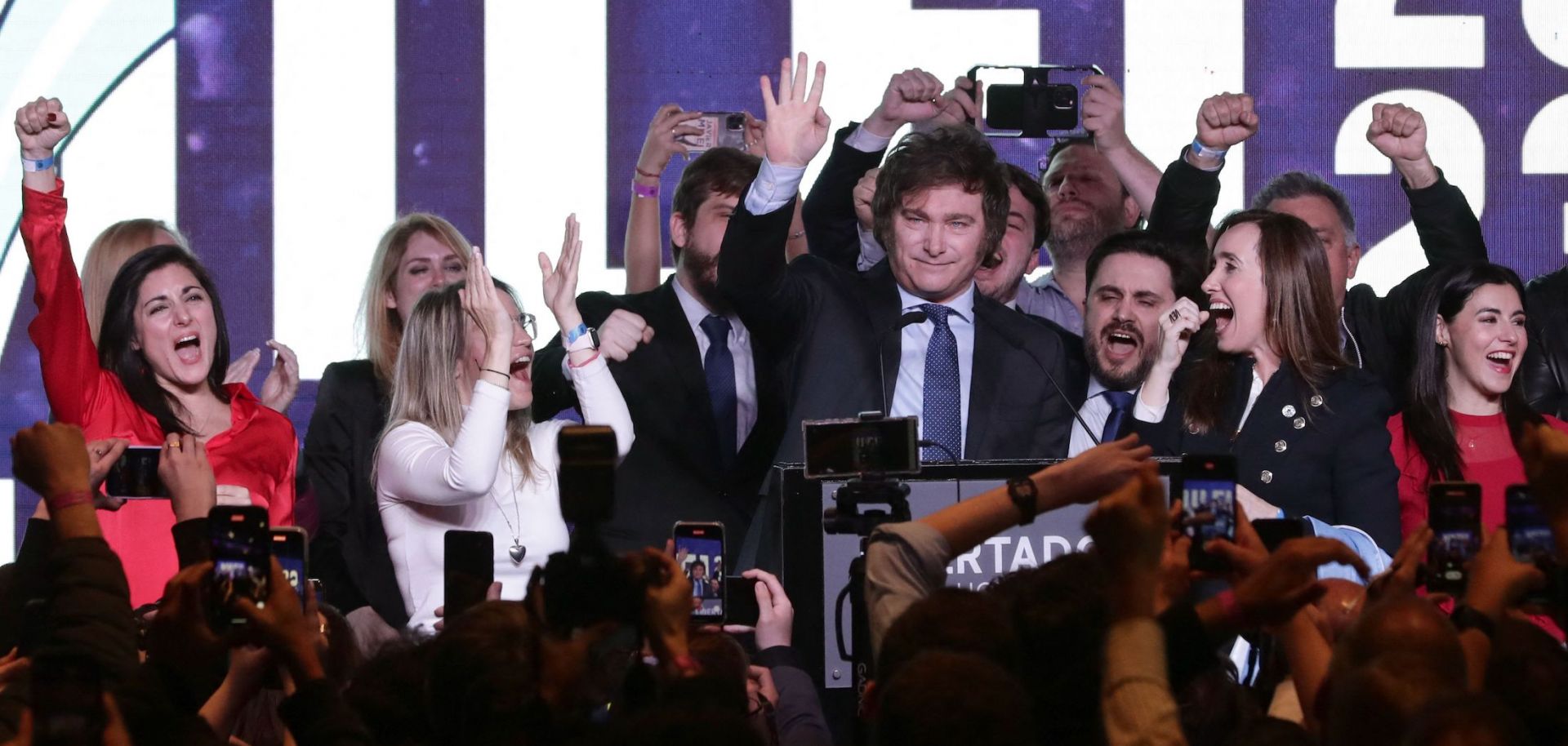
In Argentina, far-right libertarian candidate Javier Milei's surprisingly strong performance in the presidential primary will increase financial volatility in the coming weeks, deterring investment while raising the risk of a panic-induced bank run. The anti-establishment candidate who has promised to overhaul Argentina's economic and political systems unexpectedly came out on top in the country's open presidential primary on Aug. 13. With 96% of the ballots counted, Milei from the Libertarian Party came away 30.6% of the vote, beating out the candidates from the conservative Juntos por el Cambio coalition (who secured a combined 28.7% of the vote) and the candidates from the ruling leftist Union por la Patria coalition (who secured a combined 27%). Milei, who ran uncontested for his Libertarian Party's presidential nomination, will compete against the Juntos por el Cambio (JxC) nominee Patricia Bullrich and the Union por la Patria (UP) nominee Sergio Massa in Argentina's Oct. 22 presidential election. The outcome of the primary vote portends a close, three-way race that will likely go to a runoff in November, as no candidate appears set to reach the threshold needed to win the presidency outright in October.
- A political newcomer, Javier Milei is the wildcard candidate who was only elected to the lower house of Argentina's Congress in 2021. He has attracted voters disenchanted with the mainstream political parties by denouncing the ''political caste,'' and has also proposed radical changes like shuttering the country's central bank, replacing the Argentine peso with the U.S. dollar, and drastically cutting public spending.
- Argentina's former security minister Patricia Bullrich won JxC's nomination after defeating Buenos Aires Mayor Horacio Rodriguez Larreta in the coalition's primary. Bullrich has promised to cut public spending, make labor laws more flexible, and reduce taxes and regulations within the first 100 days of her tenure, seeking to quickly implement her pro-business reforms.
- As polls had predicted, leftist Economy Minister Sergio Massa cinched UP's nomination after winning the ruling bloc's primary by a wide margin. A career politician, Massa was appointed Economy Minister in August 2022 with the main promise of reducing Argentina's inflation and avoiding a worsening of the country's economic crisis. Despite these promises, inflation in the country has continued to rise during his tenure.
- Since voting in primary elections is mandatory in Argentina, the results of primaries have historically served as a strong indicator of the outcome of general elections. In both 2011 and 2019, the candidate who obtained the most votes in the presidential primary went on to win the presidency. However, in 2015, the candidate who secured the most votes in the primary won the most votes in the first round of the presidential election, though lost in the second round.
- According to Argentina's electoral rules, if no presidential candidate obtains at least 45% of the vote in the Oct. 22 election (or 40% of the vote with a 10-point lead over the next candidate), the presidential race will advance to a run-off between the top two candidates on Nov. 19.
Milei's surprise lead in the primary reflects voters' strong anti-establishment sentiment amid Argentina's worsening economic crisis. Argentina's headline inflation is expected to reach 145% by the end of 2023. The ongoing cost of living crisis has hit Argentine households particularly hard, with food inflation set to reach 110% in the same timeframe. Meanwhile, the peso's unofficial exchange rate is nearly double the official exchange rate, which has drained the country's chronically-low foreign currency reserves since Argentina's central bank sells millions of dollars every day. In the wake of the Aug. 13 primary, the government also devalued Argentina's currency by 18%, which will further eat into households' peso-denominated savings. Against this backdrop, Milei's promises of sweeping change appear to have resonated among the growing number of Argentines struggling to make ends meet, with roughly 40% of the country's population estimated to be living in poverty.
- The International Monetary Fund now expects Argentina's economy to expand by a mere 0.2% in 2023 amid the country's weakening currency, falling foreign currency reserves, increasing poverty rate, and struggle to tamp down on rampant inflation.
- In the second half of 2022, 39.2% of Argentina's population was living in poverty, up from 36.5% in the first six months of the year. That figure is believed to have only increased since then due to the country's growing economic crisis.
- On Aug. 14, the government devalued Argentina's currency to 350 pesos per U.S. dollar. But the official exchange rate has since further dropped to 365 pesos per dollar, signaling that the central bank has few other options to defend the country's currency. The peso's unofficial valuation, meanwhile, is much lower, with the currency trading at 685 pesos per dollar on the black market as of Aug. 14 (the black market is a key source of U.S. dollars for millions of Argentinians and is thus often viewed as a more accurate representation of the peso's true value).
The shock primary election will likely amplify concerns about the economic implications of a potential Milei presidency, which could slow new investment into the country and, in an escalatory scenario, trigger a run on Argentine banks. Conservative JxC candidate Bullrich and leftist UP candidate Rodriguez still have a decent chance of winning the presidency. But Milei's stronger-than-expected performance in the primary will nonetheless stir more anxiety among investors, citizens and businesses by suggesting that he and his radical policy agenda stand a serious chance of being elected later this year, which will increase financial volatility in the coming weeks. Even if Milei wins, his Libertarian Party is all but certain to secure only a small minority in Congress in concurrent legislative elections on Oct. 22, which would leave him unable to carry out most of his agenda unless he reaches a deal with UP or JxC (though such a deal would likely force him to scale back his proposals). But while this legislative check would likely keep Milei from following through on the bulk of his campaign promises, concerns about what such a presidency would mean for the economy would still almost certainly see investors press pause on starting new projects in Argentina. This would likely slow growth in the country's crucial mining and hydrocarbon industries (especially as the country pushes for new investment in its shale fields), along with its budding start-up culture. Given Milei's support for dollarization, such uncertainty also risks eventually triggering a run on Argentine banks, as households and companies may scramble to swap their pesos for U.S. dollars to avoid being potentially forced to do so when the exchange rate is less favorable. While such a mass manic remains unlikely for now, if the outcome of the Oct. 22 election confirms that Milei is indeed poised to become Argentina's next president, it will increase the risk of a full bank run that forces the outgoing government to further devalue the peso and impose even stricter capital controls (including a prolonged bank holiday to prevent savers from withdrawing their money).
- In the aftermath of the primary election, Argentina's dollar bonds were trading about 10% lower on Aug. 14, highlighting investors' concerns about a potential Milei presidency.
