
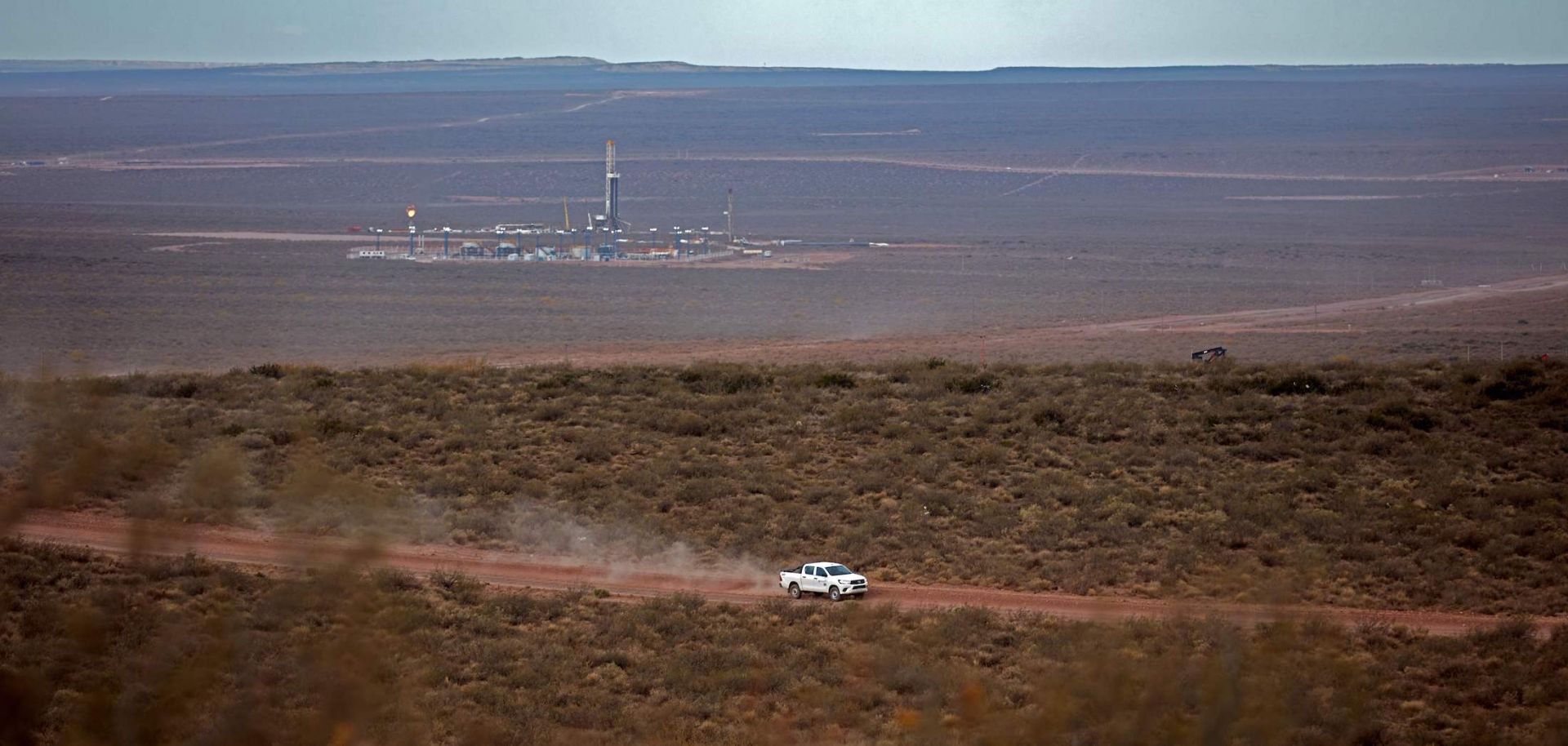
Anelo, Neuquen province, Argentina, on Nov. 26, 2019, in the Vaca Muerta formation.
Oil and gas producers in Argentina's Vaca Muerta shale formation are finally seeing rapid growth, but Argentina's political, infrastructure and economic challenges will probably hamper them from reaching Buenos Aires' lofty goals. In October, shale oil production from the Vaca Muerta, shale formation reached 269,000 barrels per day, a 42% year-over-year increase, according to the country's energy secretariat. Similarly, Argentina's production of unconventional natural gas (aka shale gas) reached 76 million cubic meters per day in September, an 11% increase from a year earlier and 46% increase from two years earlier. For Argentina, the rise in shale oil and natural gas production has reversed the country's declining oil and gas production, leading government officials to target production reaching 1 million bpd nationally 2026. Meanwhile, authorities in the Neuquen province, home to the Vaca Muerta formation, are targeting 700,000 bpd and 140 million cubic meters of natural gas production from the province by 2030. Reaching such goals will require substantial investment and increased infrastructure in a country that has notoriously often missed its production targets.
- Nationally, the growth in shale oil production has helped oil production to reach 580,000 bpd in October, its highest level since 2011. Natural gas production reached 136 million cubic meters per day in September, near an all-time high. (Monthly gas production fluctuates more significantly during the winter months due to demand for heating.)
- Argentina has frequently failed to hit its ambitious production targets in the past. The 2018 Argentina Energy Plan targeted reaching 1 million bpd of oil production by 2023 and 1.5 million bpd by 2030, still unattainable goals.
Although the government has struggled to reach previous shale production targets, the Vaca Muerta formation remains the most attractive shale patch outside of North America and its production costs, as well as other technical hurdles, are being overcome. This makes it more realistic, at least from a technical point of view, for Argentina to come closer to its goals. Argentina's potential production is immense. The 2013 U.S. Energy Information Administration's World Shale Resources Assessment estimated the country had 27 billion barrels of technologically recoverable shale oil and 23 trillion cubic meters of technologically recoverable shale gas reserves, respectively, the fourth- and second-largest such cache globally. And unlike most other non-U.S. countries with large shale reserves, Argentina's geology has always been attractive as the Vaca Muerta formation is. It is relatively thick (making it easier to exploit on a smaller above-ground footprint); liquids-rich (increasing the percent of production that is oil or natural gas condensate, which is typically more valuable than natural gas); shallow (decreasing drilling complexity); and high pressure (increasing production rates). While Argentina's below-ground characteristics have been attractive for the last decade, the country's economic and political challenges over the same period — starting with the 2012 renationalization of the YPF oil and gas firm that spooked investors in the country — have hindered growth. To overcome this checkered past, over the last five years, Argentina's federal government, as well as Neuquen's provincial government, have instituted several reforms and incentive programs aimed to help improve investment terms and reduce bureaucratic hurdles. Collectively, these improvements make Argentina's ambitious goals far more achievable, even if they represent a delay to its previous goals, from a technical below-ground standpoint.
- In August 2022, the Argentine government announced new plans to give oil exploration and production companies tax and customs benefits in order to expedite the import of equipment and machinery (such as frac pumps and rigs) needed to meet growing demand from oil and gas producers operating in the Vaca Muerta formation. The government is also debating changes to the country's hydrocarbon law that would, among other things, ease capital controls on oil and gas producers to free up foreign currency to help ramp up investment.
- To help boost production in 2021, the Neuquen provincial government introduced tax incentives to help boost aging conventional production, or at least stem the decline, in a move that could also help shale producers that hold the same acreage.
- In addition to government incentives, companies active in Argentina's shale patch are increasing their efficiency as they accrue experience. For example, the largest producer in the Vaca Muerta formation, YPF, has reported significant increases in its drilling speed and frac speed that have helped reduce development, completion and drilling costs.
- Overall, technical break-even prices for oil and natural gas production have declined to under $40 per barrel and $2 per mmBtu, respectively, comparable to break-even prices in the United States.
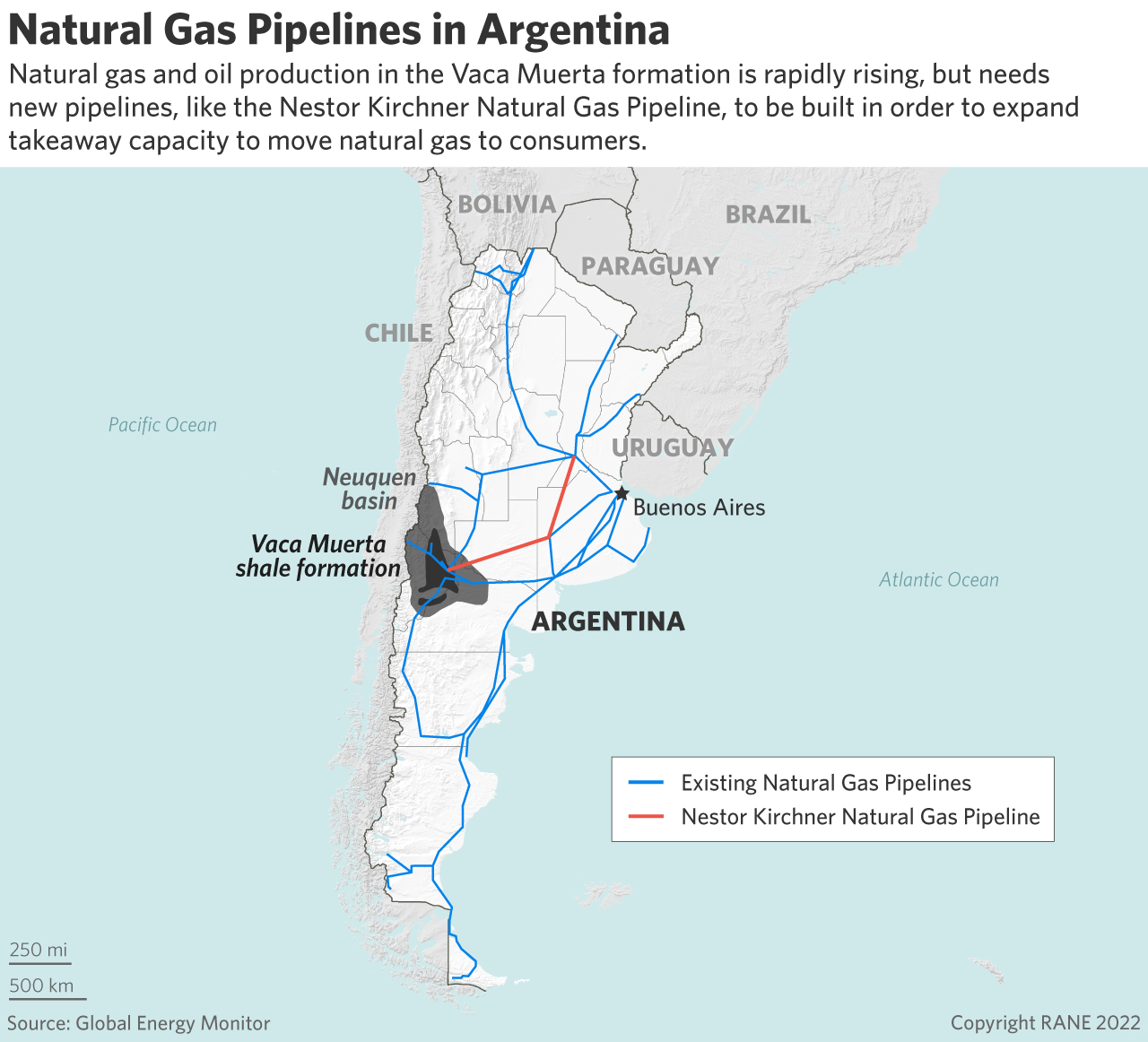
Despite Argentina's potential, midstream limitations, corruption, economic and political challenges will probably keep it from realizing its goals — even if production continues to increase. In the short-term, oil and gas production increases will be highly contingent on midstream infrastructure development. The quick growth in production in Neuquen province is starting to hit takeaway pipeline capacity constraints. Simply put, to roughly double its oil and gas production as intended, Argentina needs to do roughly the same in terms of expanding midstream capacity (e.g., pipelines). Argentina has alleviated some of the pressure for oil production with its plans to export up to 100,000 bpd of crude oil to Chile through the rehabilitated Trans-Andean pipeline, but growth in natural gas takeaway capacity is less certain. The three main pipelines exporting gas from the Vaca Muerta formation have a collective capacity of about 90 million cubic meters per day. To expand capacity, Argentina is aiming to build the massive $3.4 billion Nestor Kirchner Gas Pipeline that connects Neuquen province to Buenos Aires province and other northern provinces in two phases. Argentina aims to have the first phase of the pipeline built in time for Argentina's 2023 winter; that phase would have the capacity to deliver 20 million cubic meters of gas per day to Buenos Aires province. (The second phase would double the capacity to 44 million cubic meters and extend the route.) The government launched the process to do so in April, but Argentina's political and bureaucratic challenges may result in the pipeline's being delayed. In June, the then-production minister alleged corruption in one of the tenders for the pipeline and was subsequently fired by President Alberto Fernandez. Corruption allegations can derail or delay midstream infrastructure construction, and even relatively short delays can significantly impact production given the ambitious capacity requirements in Neuquen province.
- Without new oil and gas pipelines being built quickly, Argentina risks a situation akin to the mid-2010s in Texas' Permian basin in which insufficient pipeline capacity forces producers to slow production growth because there is nowhere to send production. In North America, this sometimes has resulted in negative natural gas prices, illustrating the risks for Argentina.
The country's overall economic and political struggles also risk adding more aboveground risk that could disrupt operations. A full-blown economic crisis could hit economic activity that reduces demand for oil and gas, and could add more concerns among oil and gas producers about insufficient domestic capital, equipment and other things they need for development. Political turmoil also creates high levels of turnover in government bodies that can lead to regulatory delays, changes in policies and anti-corruption investigations that lead to courts freezing projects. Even in the absence of a full-blown crisis, it remains unclear if Argentina's overly complicated bureaucratic process can operate quickly and effectively enough to support the rapid growth of production.
- Beyond political and midstream challenges, other logistical hurdles will also be a challenge for oil and gas producers in Argentina. E&P companies have warned about the availability of frac crews, proppants, water recycling and advanced rigs necessary to continue ramping up production. To double production, there would (roughly speaking) be a comparable need to scale up upstream oil and gas capacity to meet the expanded footprint needed to meet those goals.
- Moving forward, Argentina's debt and financial crisis risks creating a foreign currency risk that could among other things limit domestic producers from being able to import materials. While many foreign oil and gas companies operate largely in dollars (so that a cheaper peso reduces production costs), many suppliers and domestic producers operate largely in Argentine pesos and are paid in Argentine peso. This is due to Argentina having limited exports of natural gas and oil, thus exposing suppliers and domestic producers to a weaker currency when it comes to needing to import equipment to build out production.
