
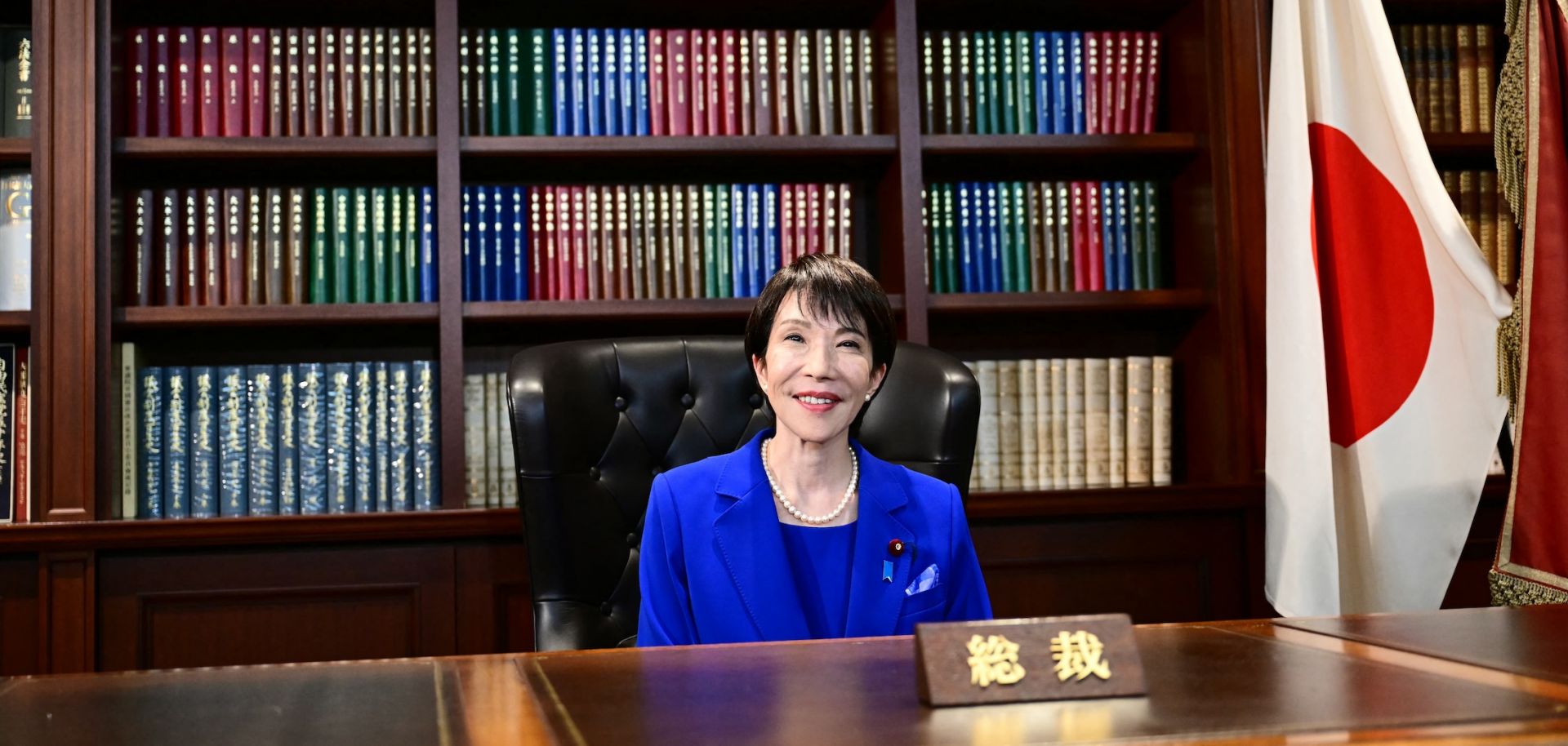
In Japan, soon-to-be Prime Minister Sanae Takaichi will lean into populism, spurring near-term growth but exacerbating long-term economic challenges, while her nationalism will bolster Japan's military and boost U.S. ties even as it strains those with Japan's neighbors. On Oct. 4, Japan's ruling Liberal Democratic Party held a party leadership election, with conservative candidate and former economic security minister Sanae Takaichi beating LDP reformer and Agriculture Minister Shinjiro Koizumi in a runoff vote. The election clears the way for Takaichi to become Japan's next prime minister after a Diet vote tentatively scheduled for Oct. 15. Following the election, there have been interparty talks about the LDP expanding its current minority coalition with center-left Komeito to form a majority government, while Takaichi has revealed her very conservative Cabinet lineup. This election comes after former LDP President and current Japanese Prime Minister Shigeru Ishiba announced in early September that he was resigning to make way for new leadership following the LDP's loss of its majority in the October 2024 lower house and July 2025 upper house elections. It also comes as the conservative LDP struggles to maintain its long-standing dominant position in Japanese politics as its electoral base ages and the party faces right-wing political challenges from opposition parties like Sanseito, the Democratic Party for the People and the Conservative Party of Japan.
- Though the reformer camp of the LDP performed better in the election when combining Diet and rank-and-file support for both Koizumi and fellow reformer candidate Yoshimasa Hayashi, their two strong campaigns appear to have split the reformer vote, while Takaichi's conservative competitors performed poorly, giving her greater conservative support and the overall advantage in the runoff.
- Takaichi's Cabinet is set to be filled with conservative leaders, with Aso tapped to become LDP vice president, Aso ally Shun'ichi Suzuki as LDP secretary-general, and close ally of conservative firebrand and former Prime Minister Shinzo Abe Koichi Hagiuda as deputy secretary general. Takaichi is reportedly considering former LDP Secretary-General Toshimitsu Motegi as foreign minister.
- In the run-up to the election, the leadership of the nativist, right-wing Sanseito party was in talks with LDP leadership, presumably about a coalition. But following Takaichi's victory, Sanseito leader Sohei Kamiya said he had "no intentions" of joining an LDP coalition. Meanwhile, the head of the center-right, populist DPFP met with LDP elder Taso Aso over the weekend to discuss political cooperation. The head of LDP coalition partner Komeito also met with Takaichi to discuss his concerns about a shift in immigration policy, Takaichi's nationalism and coalition partners, as Komeito and Sanseito clash on many areas of policy.
On domestic issues, Takaichi will pursue loose fiscal and monetary policy, pushing short-term growth at the risk of fueling long-term debt and trade tensions, as well as populist policies that raise inflation and tighten Japan's labor market, especially if the LDP allies with the DPFP. Takaichi will pursue loose fiscal policy — including greater social spending, e.g. via tax cuts and wage hikes — as well as loose monetary policy to the extent she is able to pressure the mostly independent Bank of Japan to abandon its recent turn away from low interest rates. But even without rate cuts, if enacted, Takaichi's fiscal policies would likely spur short-term economic growth, as evidenced by the stock market's positive response to Takaichi's victory. In the long term, however, her policies portend greater Japanese debt, higher inflation and a weaker yen, sustaining cost-of-living concerns as an electoral issue and raising concerns about currency manipulation from key trade partners, like the United States. On energy policy, Takaichi will prioritize energy security, bolstering nuclear power and maintaining most fossil fuel imports in the interim while slowing the build-out of renewables like offshore wind relative to Ishiba. Takaichi's ability to follow through on her agenda will be partly shaped by complex, high-stakes coalition negotiations. If she can keep Komeito in her coalition and expand it to include the populist DPFP — whose spending policies overlap better with Komeito — she would gain a majority government and DPFP would exacerbate Takaichi's already strong predilection for boosting social spending. In a less likely deal with nativist Sanseito, the LDP would risk Komeito leaving the LDP coalition, which would keep the LDP as a minority government. Either way, the new coalition partner will push for greater immigration restrictions — a foundational electoral issue in the July 2025 upper house elections — compounding Japan's already immigration-averse policies (compared to much of the West) and its aging domestic workforce to make its labor market even tighter. Regardless of the makeup of the new ruling government, her polarizing rhetoric and Cabinet selections (which fail to address intra-LDP rifts) will inhibit her ability to serve an entire three-year term as premier, like many Japanese premiers.
- Japan's Nikkei 225 stock index jumped 4.75% to a record 47,944.76 on Oct. 6, the first day of open trading after Takaichi's victory. Meanwhile, the Japanese yen weakened 1.81% to 150 yen per dollar.
Takaichi's strong national security stance and her Cabinet makeup portend generally positive U.S. ties, but her nationalism will prompt trade tensions with China and jeopardize security ties with Seoul, while the Ukraine war will remain a major impediment to relations with Moscow. As a national security hawk, Takaichi will seek to strengthen Japan's military, including by attempting to amend the Japanese Constitution to remove pacifist limitations dating back to World War II, with a more conservative-leaning political opposition giving her better odds than her predecessors had of facilitating this still difficult constitutional reform process. But even if she does not accomplish that, she will still bolster defense spending and deepen Japan's military partnership with the United States, for example, via shipbuilding cooperation and joint command coordination on Indo-Pacific contingency planning. She will also seek to bolster Japan's regional defense partnerships, including its unofficial and modest defense cooperation (e.g., recent joint coast guard drills) with Taiwan. These moves, plus her nationalist rhetoric, will stoke tensions with China, portending greater maritime deployments by China and Japan to disputed territories and, potentially, Chinese economic coercion (via anti-dumping duties, tariffs or export curbs). Likewise, her nationalism could see reductions in, or an end to, defense cooperation with South Korea facilitated by the United States to track North Korean missile threats. Regarding U.S.-Japan trade talks, Takaichi will largely seek to maintain the current trade deal, which offers lower tariffs on Japanese automobiles. Her potential appointment of Motegi, who led bilateral trade talks during U.S. President Donald Trump's first term, to a Cabinet position would help them agree on the terms of Japan's $500 billion in pledged investments in the United States. But she may be less willing than outgoing premier Shigeru Ishiba to offer concessions on U.S. agricultural and automobile imports, a politically sensitive issue for the LDP. If her administration reneges on such sectoral pledges made under Ishiba, this would pose a small risk of the White House escalating tariffs on Japan, which would likely see Takaichi back down in the interests of preserving the deal. Finally, the trajectory of Japan's tense relationship with Russia under Takaichi is unclear. Though Takaichi aligns with many of the policies of former premier Abe, who sought to improve Japan-Russia ties to balance against China, Takaichi has also espoused strong support for Ukraine against Russia's invasion on the campaign trail. So while the war continues, she will likely maintain Japan's sanctions regime as a pressure tactic on the Kremlin.
- As a politician, Takaichi has long championed Japanese nationalism, including the preservation of Japanese traditional culture, a stronger role for the Japanese military and a less apologetic stance about Japan's World War II actions, a stance that tends to irk China and South Korea, which Japan occupied during World War II. In the last year, moreover, she has developed stronger rhetoric on rooting out foreign espionage, particularly highlighting Chinese threats. And in the last few months, she has escalated her rhetoric about curbing immigration, a key issue in the July 2025 upper house elections and a sore subject for China and South Korea, which are the No. 1 and No. 2 sources of tourism to Japan, respectively.
