
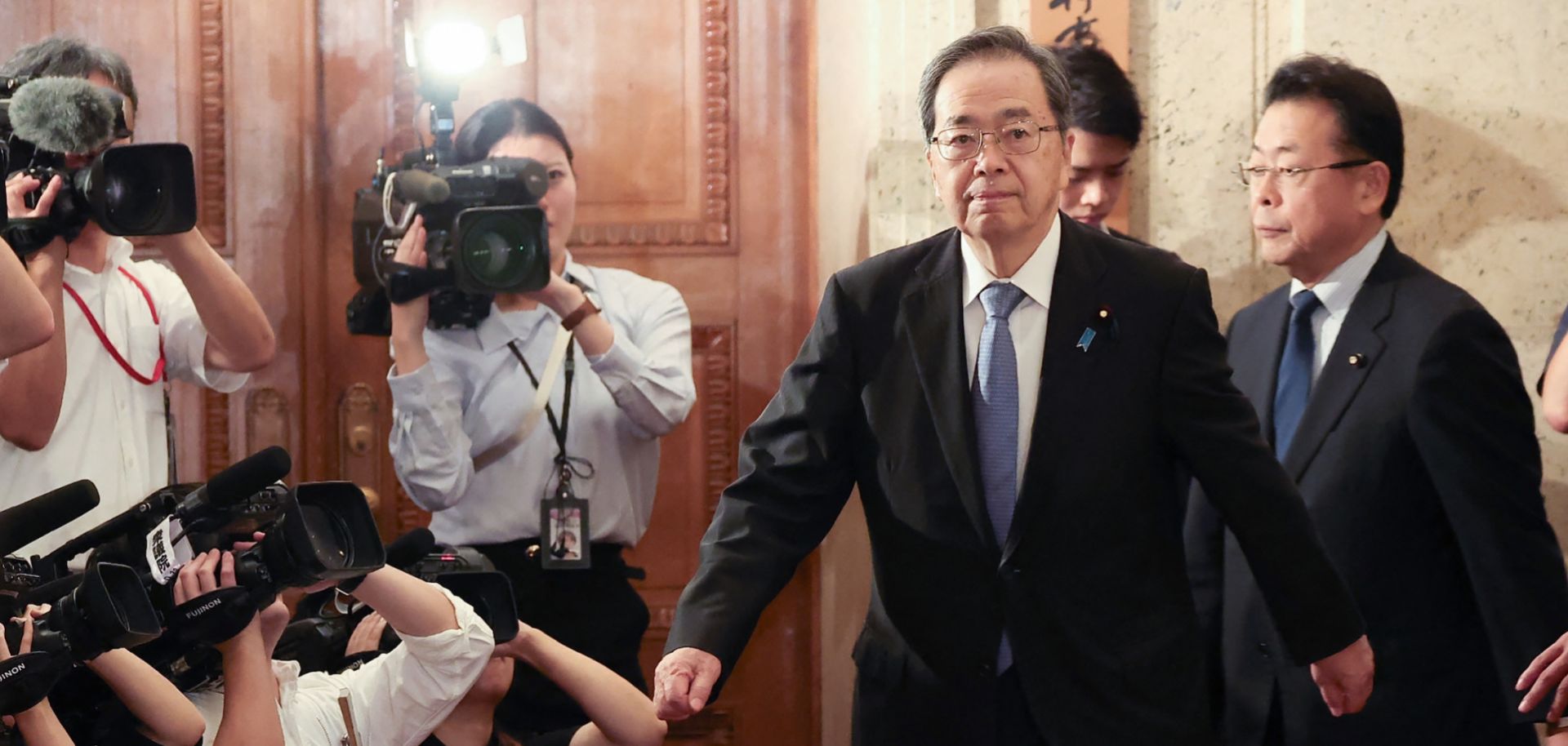
The apparent end of Japan's longstanding conservative ruling coalition increases the likelihood of a fragile opposition government taking power, which would lead to greater political instability and uncertainty in U.S.-Japan trade ties, but would also improve prospects for Japan's regional relations. On Oct. 10, Tetsuo Saito, the leader of Japan's center-left Komeito party, the minor coalition partner of the ruling conservative Liberal Democratic Party, announced he was ending their 26-year-old coalition agreement. The announcement followed Saito's meeting with new LDP President Sanae Takaichi earlier that day — the third such meeting since Oct. 4, when the LDP elected Takaichi as party leader. During the Oct. 10 meeting, Saito again requested concrete pledges on political finance reform and corruption investigations, but Takaichi said such moves would take time and require consideration. Saito's announcement has cast uncertainty over the outcome of the LDP's plans to convene an extraordinary Diet session on Oct. 20 to hold a vote for the next prime minister, which would normally result in Takaichi, as leader of the ruling party, being installed as premier. Komeito's departure also leaves the LDP with an even more fragile minority government, opening the path for opposition parties to try to pitch other candidates for prime minister. To this end, the main opposition, center-left Constitutional Democratic Party (CDP) held a joint meeting on Oct. 7 with members of the right-wing Japan Innovation Party (JIP) and the center-right populist opposition Democratic Party for the People (DPFP). During the meeting, JIP leadership floated DPFP leader Yuichiro Tamaki for the premiership. The CDP then announced it was open to a non-CDP premier, including Tamaki. In response, Tamaki said in an Oct. 10 post on X that he was ''deeply honored'' to earn the CDP's support and was ''prepared to serve as prime minister.'' However, Tamaki conditioned this cooperation on the CDP's support for expanding nuclear power and strengthening Japan's military.
- At the press conference after their Oct. 10 meeting, Saito called Takaichi's response regarding political reform ''extremely insufficient,'' adding, ''If we cannot get clear and concrete cooperation from the LDP in response to our requests…then there is no way we can write 'Takaichi Sanae' in the nomination for prime minister.'' He concluded with ''Therefore, I would like to start from scratch regarding the LDP-Komeito coalition government and put an end to our relationship to date.''
- Komeito, the political arm of the lay Buddhist organization Soka Gakkai, has been in a coalition government with the conservative umbrella party LDP since 1999. However, its electoral performance, like that of the LDP, has been wilting for years, and its supporters have increasingly complained that this coalition led Komeito leadership to abandon Soka Gakkai's foundational beliefs, especially its pacifism and support of social welfare spending.
- After former LDP head and current Japanese Prime Minister Shigeru Ishiba announced his resignation on Sept. 7, the LDP on Oct. 4 elected Takaichi as the party's next president and Japan's presumptive next prime minister. However, Takaichi proceeded to announce a deeply conservative LDP leadership team, including at least three LDP lawmakers implicated in the November 2023 slush fund scandal — an issue that drove voters in October 2024 lower house and July 2025 upper house elections to vote the LDP out of the majority and ultimately led to Ishiba's resignation.
- To designate a new premier, the Japanese Diet typically convenes within a few weeks following the ruling party's election of a new party president, with the Diet convening either at the direction of the ruling party or by request from at least 50 Diet lawmakers. Both the lower and upper houses vote on a premier. A simple majority is required for victory, with a runoff election between the top two candidates if no one secures a majority in the first round. According to Japan's constitution, if the lower and upper houses disagree on who to select as prime minister, the lower house's choice prevails.
Komeito's departure makes it slightly more likely than not that a new opposition government will come to power, but coalition talks among the main political parties will be intense. The days leading up to the Oct. 20 Diet vote for prime minister will involve rapid-fire and fraught coalition negotiations by the competing LDP and opposition parties. The LDP will attempt to regain Komeito's support, while the CDP-DPFP-JIP grouping will try to settle policy disagreements on nominating Tamaki for premier. This period could last even longer if the LDP opts to further delay the premier vote by several days, originally scheduled for Oct. 15. As of Oct. 10, an opposition government seems more likely given the difficulty of a LDP-Komeito reunion, as evidenced by Komeito's rare departure from the coalition, its longstanding concerns about the direction of LDP policy (which are unlikely to be resolved in 10 days) and leader Saito's remarks about current Prime Minister Takaichi's reluctance to change. While the opposition parties will struggle to reach policy agreements, Tamaki's two demands — defense strengthening and nuclear power — are both quite popular among voters and so could benefit the CDP. Moreover, the CDP-DPFP-JIP grouping could agree to a much shorter-term policy of cooperating only on a premier vote but not on a government, which would allow Tamaki to call snap elections in the subsequent weeks and revisit coalition talks afterward.
Whatever government emerges is likely to be unstable, slowing policymaking amid a potentially permanent political shift to a ''multi-party system.'' Japan has only had two opposition governments since the LDP was formed in 1955: once from 1994-1996 and again from 2009-2012. If the current upheaval results in another opposition government, it would likely be dysfunctional, with policymaking impeded by ideological differences, including on the CDP's fiscal responsibility versus DPFP profligacy. Should the LDP-Komeito split persist, a CDP-DPFP-JIP government could secure a majority in snap elections, which would reduce the coalition's need to negotiate with a bevy of Diet opposition parties. However, this majority government's ideological diversity would still make it fragile. An opposition minority government is also possible, as a trilateral agreement on a policy platform would be difficult to manage due to the parties' competing electoral goals. In the less likely event that Komeito returns to the LDP coalition, its rare departure would highlight the fragility of an LDP government under Takaichi. In this scenario, the DPFP would also be hesitant to sully its rising public support by supporting a Takaichi premiership, especially since Takaichi's controversial cabinet picks could tie the DPFP's image to the slush fund scandal. Thus, as premier, Takaichi would most likely only be able to form only a minority government, making for slow policymaking on efforts to raise social spending (e.g., via gasoline consumption tax cuts and wage hikes). Moreover, Saito's Oct. 10 decision to leave the ruling coalition indicates his party will likely reduce cooperation with the LDP in future elections (e.g., coordinating candidates to not compete in single-member districts), as Komeito faces pressure to prioritize its own policy agenda over the LDP's. Thus, as Saito said at his Oct. 10 press conference, Japan is now entering a new ''multi-party system'' whereby changes of government are more frequent and policy platforms less stable.
- In the October 2024 elections, the DPFP rose from 11 seats to 28 seats on a platform of raising social spending and opposing the ''do nothing'' LDP government. Meanwhile, the LDP lost 68 seats and became a minority government, the CDP's seat count rose from 96 to 148, and the JIP dropped from 41 to 38 seats. Exit polls showed the LDP's slush fund scandal was a consideration for 74% of voters. Moreover, an Oct. 10 analysis of the 2024 lower house elections showed that, without Komeito support, the LDP would have lost 25 more seats and the CDP would have gained another 20.
The sudden rupture in the LDP-Komeito partnership and resulting uncertainty about Japan's next prime minister threatens to impede trade talks with the United States. This high-level political rupture comes at an inopportune diplomatic time for the Japanese government, as U.S. President Donald Trump is due to visit Japan from Oct. 27-29. Japan's next premier is also due to attend the ASEAN Summit in Malaysia from Oct. 26-28 and the APEC Summit in South Korea from Oct. 31 - Nov. 1, where sideline meetings with the U.S., South Korean and Chinese delegations are possible. Moreover, Tokyo is trying to resolve interpretative differences surrounding the terms of Japanese investment in its July trade deal with the United States, signed under outgoing Prime Minister Ishiba, leaving Washington uncertain about Tokyo's stance on the agreement or who to meet with to discuss its finalization.
Compared with a renewed LDP-Komeito coalition led by Takaichi, an opposition government led by Tamaki would be less likely to erode ties with China and South Korea, though both would still seek to curb immigration. If Tamaki becomes Japan's next premier, relations with China and South Korea would be less likely to deteriorate than under Takaichi, whose nationalist rhetoric and revisionist views of Japan's wartime history threatened to impede Japan-China trade ties (e.g., prompting more frequent Chinese import barriers) and Japan-South Korea-U.S. security cooperation, particularly on tracking and responding to North Korean missile threats. In the case of either government, however, policies further restricting immigration are likely, given that this was a top voter issue in July 2025 and a campaign pledge of the DPFP, JIP and LDP. That said, a renewed LDP-Komeito coalition could see Takaichi moderate her stance on immigration, which he pledged to do in meetings with Saito over the last week. Still, even moderate immigration restrictions would further tighten Japan's labor pool amid a declining population and threaten to worsen ties with China and South Korea, both of which are top sources of labor migration and tourism for Japan.
