
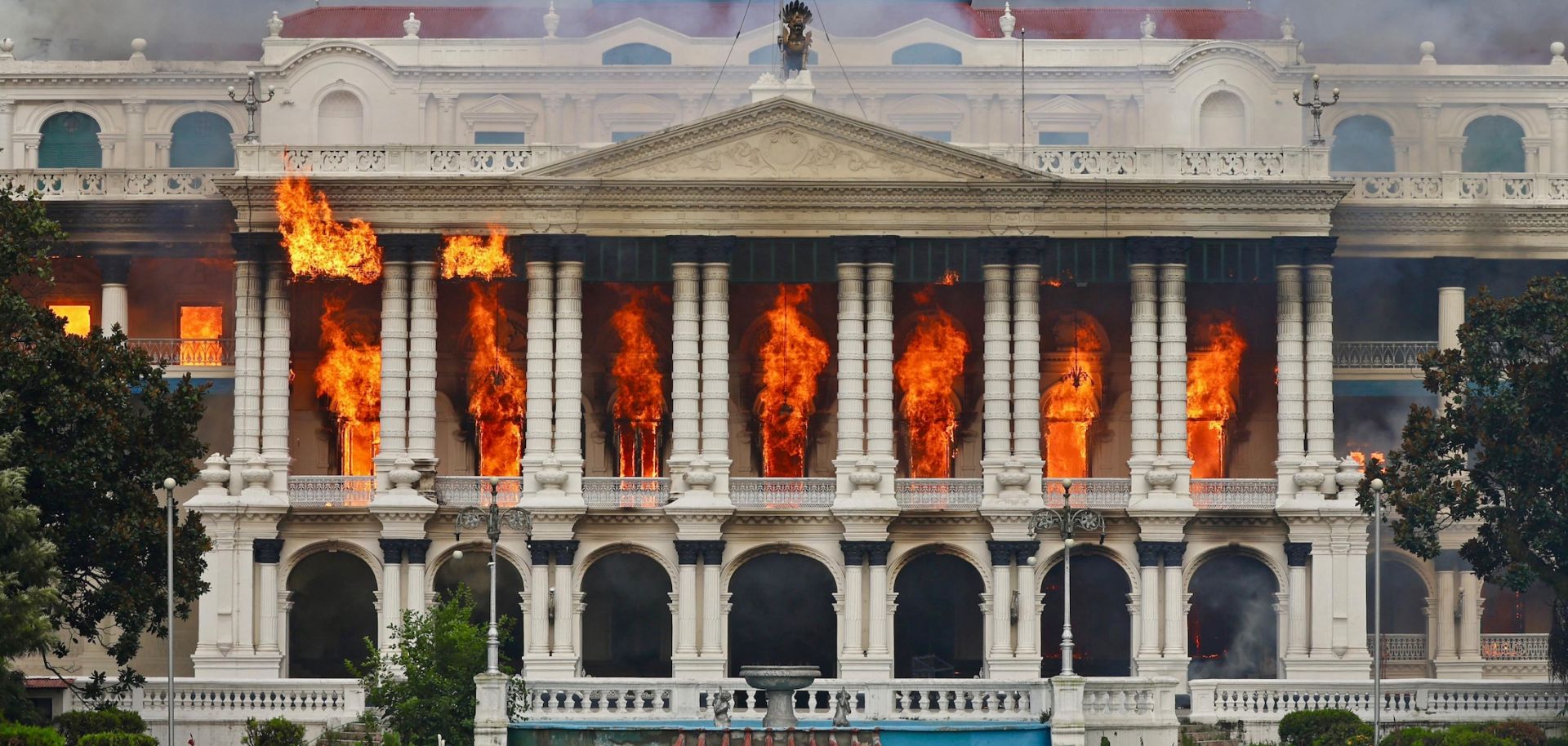
In recent weeks, a flurry of youth-led mass protests, often given the moniker ''Gen Z,'' has swept across countries in Africa and Asia. Most recently, after three weeks of popular unrest in Madagascar, the military sided with protesters and forced the president to flee the country. In Nepal, the process was faster, with the government falling after less than a week of mass unrest in September. After a temporary lull, mass protests in Morocco have resumed. In Indonesia, after an escalation in late August and early September, the scale of unrest has declined but youth grievances very much remain. Elsewhere in the world, youth-driven mass protests have also occurred in places like Turkey, where they have been temporarily curbed but threaten to reemerge; Serbia, where they are ongoing; and Peru, where in early October they helped push lawmakers to remove a deeply unpopular president from office and are now protesting her successor. And those are only this year's protests. In 2024, mass youth-led unrest shook countries like Bangladesh, forcing its long-serving leader to flee the country, and Kenya, leading the government to retreat on a controversial tax bill.
Despite each protest movement having its own unique features, there are signs that they have been inspiring, if not significantly coordinating with each other. They share a common frustration with the ruling elite and a belief that poor governance — due to the rising cost of living, high-level corruption, social injustice, worsening authoritarianism or otherwise — is mortgaging their futures. These movements not only have generated empathy from outsiders but also resulted in changes, from regime change or changes to unpopular legislation, that open the door to reforms to countries' political structures, economic systems and security apparatuses. But these uprisings also entail numerous risks beyond the obvious potential for near-term violence. These dangers are often overlooked, yet Gen Z protesters will have to confront the same fundamental question that has bedeviled prior protest movements: what happens the day after they succeed?
Hashtag Revolutions
The common currents running through the current wave of Gen Z protests are that they are largely led by young people, have generally leaderless structures and leverage digital tools. None of these three qualities is unique. The two most recent large-scale protest waves — the 2010-2012 Arab Spring across the Middle East and protests that occurred across the globe in 2019, dubbed by some as the ''year of protests'' — also saw heavy youth participation, were often decentralized and took advantage of social media. In this respect, the current Gen Z protesters are more like the natural successors to these movements than wholly unique, yet they have taken each of these three characteristics to a different level.
Start with the Gen Z aspect. Broadly, this term refers to people born from approximately the mid-1990s to early 2010s. This is the first cohort of people to grow up fully in the internet era. The current wave of protesters largely has embraced this moniker, with movements promoting names like Gen Z Nepal, Gen Z Madagascar and GenZ 212 (a reference to Morocco's country code). This appears like a natural progression: Arab Spring protests often started as youth movements but eventually incorporated older demographics, while, going a step further, 2019 protest movements comparatively were even more youth-led but did not frame themselves explicitly in those terms. This is what makes the current protests distinctive: they are not merely overwhelmingly led by young people, but they also publicly embrace this idea — in some cases to the exclusion of other ways of portraying themselves.
Next is organization, or rather, a lack thereof. The current Gen Z protests do have some recognizable figures, like Sudan Gurung, the founder of the Nepalese NGO Hami Nepa,l who became one of the leading faces of the uprising against the government. But by and large, in no country is there a clearly defined leader or coordinating organization. Instead, the protests are highly decentralized and largely organized online. From Madagascar to Morocco to Nepal, fluid grassroots online collectives have emerged, representing the closest thing to an organizing force. The Arab Spring and 2019 protest movements were also mainly decentralized, but in many cases, especially in the former, they eventually incorporated organized entities like labor unions, professional associations and similar groups. The current Gen Z protests build on these trends by being almost entirely without clear organization on the ground in favor of coordination online.
This leads to the final point: the embrace of digital tools. Nepal — where protests first emerged under the banner of hashtags like #nepokids, a reference to popular frustration with elites — exemplifies this trend the most, but it is merely the most extreme example of the way in which Gen Z protesters across countries have heavily relied on social media, encrypted apps, gaming sites, virtual private networks and other digital tools to organize and evade detection. The Arab Spring, which occurred during the early days of social media, began this trend, which accelerated during 2019 protest movements, but the current wave of Gen Z, as their moniker attests, is fully online. Whereas the prior movements progressively integrated more digital tools, the current Gen Z protests have fully synced digital capabilities with real-world action.
The Next Viral Outburst
Significant research has been done into the factors that provide fertile ground for mass protests. These generally include the presence of long-term systemic popular grievances like corruption or inequality, a triggering event such as a controversial government action, and people's willingness and ability to take to the streets.
With these factors in mind, and despite the inevitable outliers, it is possible to forecast which countries appear to be at higher risk of next seeing large youth-led protests. These may not necessarily be fully ''Gen Z'' in that protesters may have ideological or other grievances beyond the traditional concerns of young people that have united the current bout of Gen Z unrest. However, they all stand out as locations where there is recent precedent and/or strong rationale for large youth-dominated unrest. These include places with a large youth population (especially with high rates of un- or underemployment), longstanding popular grievances against corruption, inequality and general economic challenges, sufficient digital connectivity free from government interference and repression that is soft enough to stoke grievances but not complete enough to fully enforce order. Some are obvious because they have already endured Gen Z protest waves and thus are highly vulnerable to more. These include places like Kenya, Indonesia and Turkey, where protests have quieted but hardly gone away. Aside from these, a sampling of other countries at higher risk would likely include:
- Chile was one of the countries that helped earn 2019 the moniker ''the year of protests'' when predominantly youth-led protesters took to the streets, only to be diminished by the onset of the COVID-19 pandemic the following year. Although it does not fit the above factors as precisely as does Peru, where Gen Z-style protests are ongoing, Chile certainly has precedent and the expected election of a controversial far-right president later this year could easily help re-catalyze Gen Z-style unrest thereafter. Ecuador, which shares many of the same risk factors as Chile, is also a contender in South America.
- Also part of the 2019 protest wave, Lebanon has a recent history of mass youth-led mobilizations and fits into many of the high-risk categories above. Its unique sectarian dynamics and the influence of Hezbollah somewhat curb the likelihood of Gen Z-style unrest, but it would also fall into the higher risk category. Nearby Jordan, where authorities appear to have banned Discord (one of the primary apps Gen Z protesters in other countries have used) out of fear, also possesses many qualities that increase its risk likelihood. Elsewhere, Tunisia, the birthplace of the Arab Spring and a strong culture of activism, is another potential candidate for Gen Z-style unrest, as an increasingly authoritarian government that thus far has prevented a cohesive opposition may eventually prove more brittle than it currently suggests.
- Nigeria has already seen large-scale protest waves in recent years that dovetail with many Gen Z grievances, setting the stage for a potential Gen Z movement. Though significant ethnic divisions somewhat undermine the potential for youth cohesion, a similar dynamic did not hobble Gen Z protesters in Kenya, and Nigeria ticks all of the above boxes nearly perfectly.
- The Philippines also has the right ingredients for an explicit Gen Z protest movement to emerge, given the country's ongoing anti-corruption protests and long history of youth activism against various structural grievances. Perhaps what is missing is some sort of high-profile triggering event like the police killing of a young protester. Elsewhere in Southeast Asia, Thailand, which also has a recent history of youth-led protests and shares some of the same factors described above, could also be at future risk, but comparatively less so than in the Philippines, where anti-government sentiment is currently much higher.
- By some estimates, South Africa is the ''protest capital of the world'' that routinely sees large mobilizations that open the door for Gen Z-specific unrest. Despite its relatively democratic governance and institutions, it also features a similarly potent mix of the same aforementioned factors that could easily combust in the future, especially as the ruling African National Congress loses legitimacy and support — and younger South Africans no longer see it as a party of hope but rather one of the corrupt elites.
No matter where they next occur, as with any protest movement, there are generally four main ways in which Gen Z protests can end. First, they can be repressed. In this scenario, authorities crack down hard, arresting, deterring, killing and otherwise stopping people from taking to the streets. Second, they can be co-opted. In this case, a movement's influence is diminished and ultimately crumbles as factions are absorbed into the very system they had pledged to fight by accepting concessions like (usually token) government positions. Third, they can burn out. This can happen due to internal fracturing among different factions, general protest fatigue, loss of popular support or other reasons. Finally, they can succeed, achieving their aims, be they as narrow as a policy shift or as extreme as complete regime change.
The Day After
Success can bring change. In Morocco, Gen Z protesters succeeded in forcing the government to adjust its 2026 budget to include dramatic increases in spending on education and healthcare, the movement's leading demands. In other places, success is more dramatic, getting rid of a hated government and opening the door for new elections, as seen in Nepal.
And yet, as Gen Z protesters are discovering in these and other countries, success also brings numerous new risks and challenges. The largest is what comes next. When a government is fully toppled, as in Bangladesh, the question is extremely acute. While the period since the mid-2024 revolution has been comparatively calmer, it has been far from stable. Old rivalries have re-emerged, new disputes have arisen, retribution has taken place and interim authorities have been accused of many of the same failings as the old guard that was run out of power. After all, it is much easier to tear down a system than it is to build a new one that will satisfy all constituencies. Elections scheduled for early 2026 will thus be a risky test of whether the polls put the country on a stabler course or whether they merely set the stage for future unrest. The same goes for a country like Nepal, where Gen Z protesters are already complaining that the interim government has cut them since taking power, meaning next year's elections will also be a high-stakes affair. But whether it is later next year or years down the line, disillusionment with a revolution opens the door for a potential new one.
An even more dramatic example is in Madagascar, where protesters succeeded in toppling the government, but at the cost of bringing the military to power. While the junta has pledged to only rule for a limited period before transitioning back to civilian control, historical precedent in numerous countries suggests this is unlikely to happen on time and/or in full. For many protesters who dreamed of a freer future, a junta, even if it actually gives back power as promised, is not necessarily better than the old regime. And this also points to a potentially dangerous effect: do other militaries more quickly intervene when Gen Z protests show signs of succeeding? While there is not yet sufficient evidence to point to a trend, it is possible to conceive of a scenario in which — especially as Western (and, particularly, U.S.) pressure for good governance declines amid strategic competition with China and Russia, and more pressing domestic issues — military forces become more willing to join protesters in bringing down a government, but with a tradeoff that soldiers, not civilians, then take power.
Numerous nefarious actors, domestic and foreign, will seek to exploit fragile post-revolutionary periods. Whether it is extremists like insurgent or terrorist groups, disgruntled factions of the military or intelligence services, criminal syndicates or adversarial countries which seek to stir up tensions or other threat actors, the precarious environment of many countries after one government is overthrown but before another consolidates power can be a dangerous period in which the wishes and agendas of Gen Z activists may not be respected. As just one example, there is evidence that the wave of arson during Nepal's unrest was not spontaneous but actually a coordinated, preplanned effort by still unclear factions with still unclear motives.
Finally, there are also scenarios in which success breeds more demands. In Morocco, Gen Z protesters do not appear to have been satisfied by the government's concessions on education and healthcare spending and instead have expanded their demands to include the removal of the prime minister. This raises the stakes — even more so if they start to criticize the monarchy — thereby increasing the likelihood for a more intense future faceoff in which the state more aggressively uses its varying means of power (physical, legal and otherwise) to crack down. A similar dynamic can be seen in Peru, where protesters succeeded in pressuring for the removal of their loathed president, yet are still in the streets railing against her successor, who has just imposed a state of emergency, ostensibly to combat violent crime, but which opens the door for street violence and risks further alienating, rather than satisfying, Gen Z protesters.
History Is Unkind
While it is never prudent to assume that history is guaranteed to repeat, it is also foolish not to look back at recent events for context on what the most likely outcome for Gen Z protests will be. But surveying the Arab Spring and the 2019 protests does not augur well for Gen Z protesters. Outside of narrow examples, the Arab Spring largely failed to promote significant sustainable reforms across the region. Multiple countries, like Syria, ended up in civil war; others, like Egypt, saw the military assume control; certain places, like Tunisia, had temporary liberalization but have since fallen back into authoritarianism; and others, like Jordan, saw protests repressed or co-opted. Much the same could be said of countries that were part of the 2019 protest wave. Despite some outliers, places like Hong Kong saw protests repressed and even harsher control subsequently enforced; Sudan has descended into a brutal civil war; Algeria's movement forced the president to resign, but nothing structural to change; and Chile has failed to significantly bridge its divides after two failed attempts to rewrite its constitution.
This is not an argument for historical determinism so much as it is a reminder that, for all the risks activists take when they take to the streets against a hated government, those are in many ways easier compared to the much more difficult task of building a new society. While Gen Z protests are still in their infancy and much could change their trajectory, the expansive societal transformations many young people yearn for appear at high risk of not only failing to materialize, but in some cases actually leading to even greater challenges they will have to face.
