
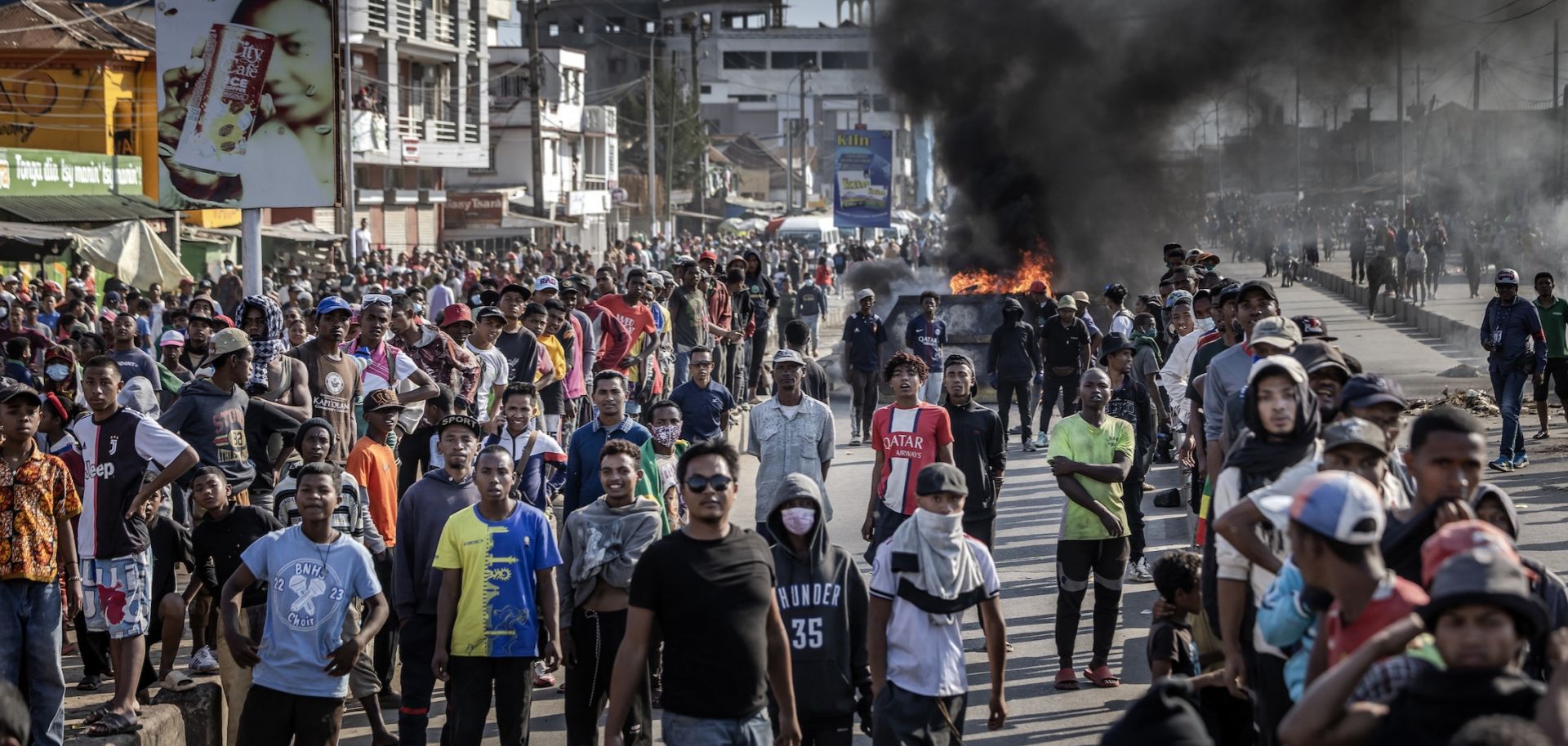
Protesters face police from a distance near burning barricades in Antananarivo, Madagascar, on Oct. 9, 2025.
(LUIS TATO/AFP via Getty Images)
Protesters face police from a distance near burning barricades in Antananarivo, Madagascar, on Oct. 9, 2025.

In Madagascar, President Andry Rajoelina's ousting in a military coup on the back of widespread Gen Z protests will likely inspire demonstrators elsewhere in Africa and de-escalate political tensions in the near term, though protests risk resurging thereafter due to disagreements over the transition period. On Oct. 14, Col. Michael Randrianirina of the Personnel and Services Administration Corps unit of the army, or CAPSAT, announced that the military would take over government affairs, suspend the constitution and dissolve most state institutions with the exception of the National Assembly, the country's lower house. Randrianirina's announcement, which effectively marked a coup in the island nation, came just after the National Assembly impeached Rajoelina, who was exfiltrated by the French military from the country on Oct. 12. Despite its announced dissolution, Madagascar's High Constitutional Court subsequently called on Randrianirina to serve as head of state on an interim basis and for presidential elections to be held in 60 days, even though Randrianirina announced plans for a two-year transition period. These events followed the eruption of Gen Z protests in the country in late September, which initially called for the government to tackle crippling water and power shortages but swiftly turned into large-scale anti-Rajoelina demonstrations.

  • Reuters reported that the National Assembly impeached Rajoelina by 130 votes in favor to one blank ballot with 30 lawmakers absent, despite Rajoelina's Young Malagasy Determined movement holding 84 of 161 seats in the lower house. Rajoelina issued a decree dissolving the National Assembly on Oct. 14 in a bid to prevent his impeachment, which lawmakers deemed invalid.
  • Randrianirina served as governor of Madagascar's southern Androy region between 2016 and 2018. He was reportedly imprisoned from November 2023 to February 2024 on grounds of ''inciting military mutiny with a view to a coup d'etat'' after criticizing Rajoelina.
  • Gen Z protests have taken place globally and are driven by young adults between the ages of around 13 and 28 who leverage social media and decentralized organizational structures to organize demonstrations. While the drivers behind the protests are varied, they are often driven by discontent with poor governance and service delivery and the denunciation of corruption and perceived injustices. Gen Z protests have notably occurred in Bangladesh, Kenya, Turkey and Nepal, and remain ongoing in Morocco. While they often use a pirate flag as a rallying symbol, coordination between protesters in different countries appears limited.

Rajoelina's ousting comes as Madagascar has been shaken by widespread Gen Z protests since late September, which eventually prompted CAPSAT to call on security forces to disobey government orders to shoot at demonstrators. Rajoelina first ascended to power in 2009 after CAPSAT appointed him as president after it led a mutiny against his predecessor, Marc Ravalomanana, following widespread anti-government demonstrations. Rajoelina agreed not to run for reelection in 2013 as part of a deal brokered by the international community, but he was reelected president in 2018 and secured a new term in November 2023. Rajoelina subsequently continued advancing efforts to consolidate power and secured a parliamentary majority for his ruling coalition in the May 2024 legislative elections, in spite of a steady worsening of water and electricity shortages on the island in recent years. While these challenges are partly driven by rapidly growing water and electricity demand linked to Madagascar's surging population, shortages were worsened by underinvestment in critical infrastructure from the state-owned utility Jirama, which has faced widespread allegations of mismanagement and corruption. It is against this backdrop that Gen Z protests first erupted, which forced Rajoelina's hand into sacking the entirety of his government on Sept. 29. Despite Rajoelina's calls for dialogue and appointment of Gen. Ruphin Fortunat Zafisambo as prime minister on Oct. 6, large-scale protests continued, eventually prompting CAPSAT to announce its defection from the Rajoelina regime and call on security forces to not follow orders to shoot at demonstrators on Oct. 11. CAPSAT's defection heralded the end of Rajoelina's presidency, leaving him little choice but to step down or flee the country.

  • Madagascar's population has rapidly risen in recent decades and stands at an estimated 32.7 million people in 2025, up from 22.8 million in 2010 and 16.5 million in 2000.
  • Madagascar is one of the poorest countries in the world, with a per capita GDP of $616 in 2025 according to the International Monetary Fund. It ranks fifth lowest among ranked countries, ahead of South Sudan, Yemen, the Central African Republic and Burundi.

The military's takeover will de-escalate political tensions in the immediate future, but these could resurface due to disagreements surrounding governance during the transition period and the organization of new elections, while Rajoelina's ousting could inspire more Gen Z protests elsewhere in Africa. Despite the extrajudicial nature of the military's takeover of power, Randrianirina's announcement has been celebrated by most Gen Z demonstrators, which portends easing political tensions on the island over the coming weeks. Political debates are now likely to shift toward emergency measures to improve the delivery of critical services, which is set to prove challenging. A failure to deliver a quick turnaround could potentially act as a new catalyst for protests. Meanwhile, the question of the military-led transition period's governance framework and the organization of new elections is also set to take center stage, with tensions facing a significant risk of emerging regarding the length of the transition period. While provisions for a two-year transition period, as hinted at by Randrianirina, may not necessarily be opposed by all Gen Zs, some could call for the respect of the High Constitutional Court's call for presidential elections to be held within 60 days, which could trigger a new round of protests. Moreover, Western countries and the Southern African Development Community may press for a shorter transition, which could eventually lead to sanctions on military rulers. Rajoelina's refusal to step down following his exfiltration suggests that he will likely seek to make a political comeback in the coming years. In a low-likelihood, high-impact scenario, tensions between different factions within security forces could escalate into armed clashes. However, former colonial power France appears highly unlikely to lead a military intervention on the island for the foreseeable future amid its departure from a policy of proactive interventions in Africa and domestic political instability. Rajoelina's eviction from power will likely inspire Gen Z demonstrators elsewhere in Africa to protest against governments perceived as authoritarian and corrupt. While this arguably raises the risk of protests in over a dozen African countries, this will especially be the case in Cameroon, Cote d'Ivoire and Tanzania — all of which are holding general elections in October that have been denounced as not free and fair by opposition groups. Kenya, Uganda and Nigeria will also see protests risk rising on the back of persisting socioeconomic grievances and discontent at corruption, authoritarianism and the poor delivery of key services, such as water, electricity and education. 

RANE
SUBSCRIBERS ONLY

Expert analysis when it matters most.

Get access to RANE's decision-grade geopolitical intelligence.