
Editor's Note: This is the second installment of a two-part column on the future of Franco-African relations. The first part discusses the reasons driving France's changing approach to Africa, while the second focuses on how these shifts could affect West and Central Africa's geopolitical landscape in the years ahead.
As France steps back from West and Central Africa, regional actors are expected to play a greater role in shaping the future of both regions' politics. However, no single country or organization appears ready to step up and assume regional leadership. The Economic Community of West African States, or ECOWAS, has faced a marked erosion of its credibility since the start of the 2020s, as it has repeatedly failed to respond to a wave of military and constitutional coups across the region. The departure of Mali, Niger and Burkina Faso from ECOWAS in January has further weakened the bloc, while diverging views and interests between its member states will likely keep ECOWAS indecisive in the years ahead. As for the Economic Community of Central African States, it remains primarily focused on economic coordination between its member states and is unlikely to become more politically active anytime soon, as Central African governments agree to minimize regional oversight over each other's domestic affairs. This leaves the question of Nigeria's regional leadership. With the second-largest economy on the continent and a population poised to exceed 250 million inhabitants by the end of the decade, Nigeria has many attributes needed to emerge as a regional hegemon. However, Abuja will likely be reluctant to single-handedly step up its responsibilities vis-a-vis its neighbors as it battles lingering economic challenges — which could soon worsen amid sliding oil prices — and several security crises across large swathes of the country.
Adapting to a Multipolar World
In practice, the end of France's preeminence over its former colonial domain thus threatens to create a leadership vacuum, with future crises in West and Central Africa facing a higher risk of escalating. These mounting risks to regional stability and the absence of a clear regional security guarantor will likely prompt West and Central African states to seek stopgap measures to ensure their security, opening up new opportunities for external powers to expand their influence.
Russia will likely stand first in line to exploit this opportunity, as securing closer ties with coastal West African states would help the Kremlin strengthen its logistical supply routes to support ongoing military deployments in the Sahel. Moscow's outreach will likely continue to involve a blend of economic and military partnerships by offering military training and equipment, as well as cooperation in sectors such as mining, energy and agriculture. Turkey also stands to gain. Ankara has steadily ramped up its outreach to Africa for over a decade, and its advanced drone technology positions it well to meet African states' need for affordable air power. Closer ties with Turkey would also enable African states to diversify their partnerships without alienating European countries and the United States, in contrast to pursuing closer ties with Russia and China, respectively. However, African states will likely cultivate multifaceted partnerships with several outside powers at once to increase their autonomy and minimize their reliance on any single foreign patron. As French-speaking African countries realign their foreign policy, their divergence in interests could grow, threatening to further undermine ECOWAS' cohesion and pave the way for more states to exit the regional bloc.
Power dynamics in francophone Africa are thus set to dramatically shift through the end of the decade in a way that threatens to render the region less stable. But while France's influence is set to wane, Paris retains strategic and commercial interests across West and Central Africa, including maintaining regional stability, countering the expansion of jihadist groups, and safeguarding oil and gas operations in the Gulf of Guinea — which are key to Europe's energy security. To preserve these interests, France will likely compensate for its loss of influence by stepping up multilateral cooperation with the European Union, as well as by advancing joint initiatives with local actors.
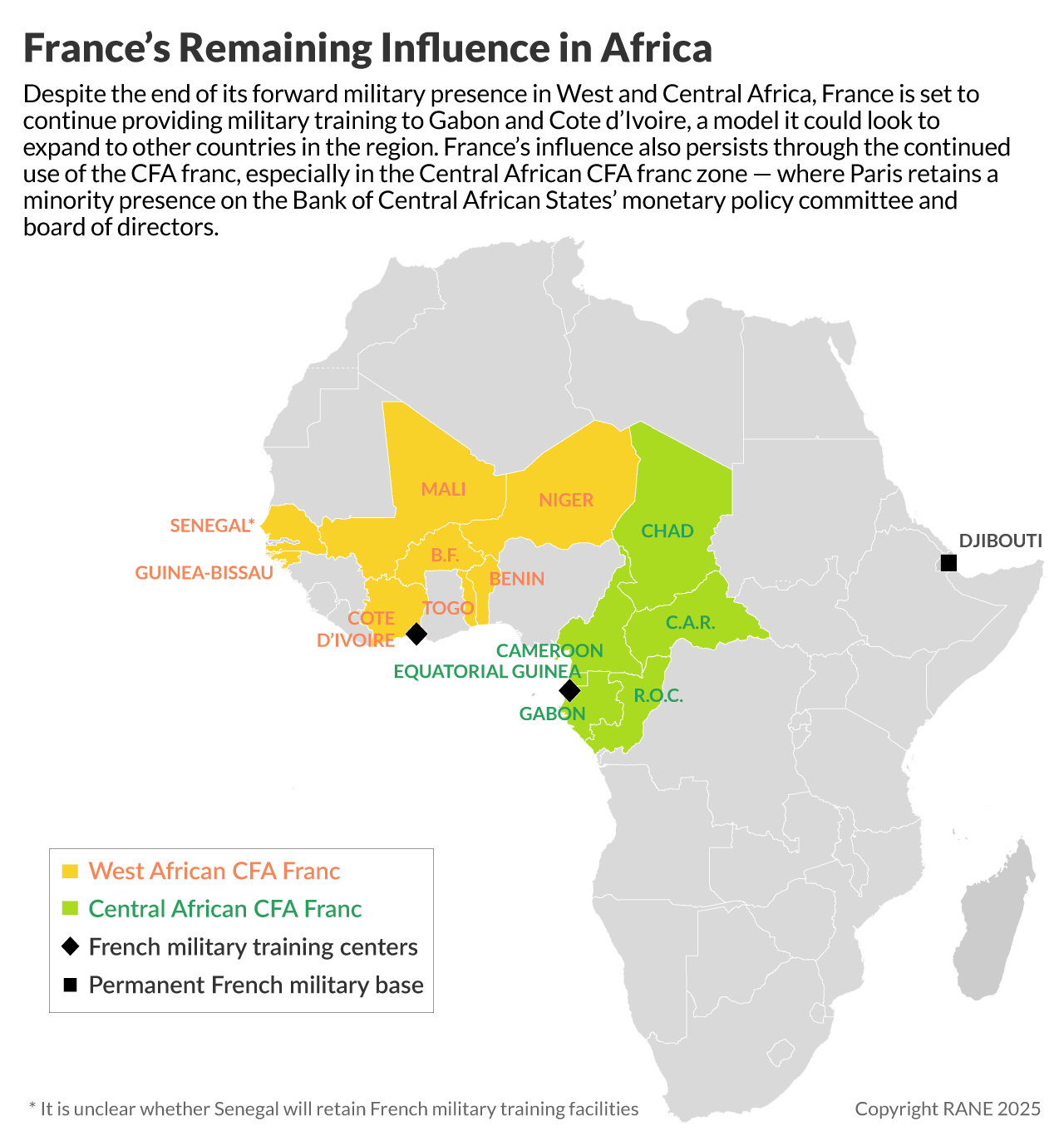
Nigeria is a case in point. Abuja has long approached Paris with deep mistrust due to the support of former French President Charles de Gaulle and his Africa adviser Jacques Foccart for Biafran separatists in the late 1960s and its hegemony over francophone Africa, which Nigeria saw as a direct challenge to its bid for regional leadership. However, the end of France's forward military presence in West and Central Africa removes a major constraint to closer bilateral ties. Relations between the two countries have steadily improved since Nigerian President Bola Tinubu took office in May 2023, for example, through a critical minerals deal and a 300 million euro ($340 million) investment plan in late 2024. Growing bilateral ties could pave the way for joint Franco-Nigerian initiatives to advance their shared interests and mediate crises in West Africa. In doing so, Abuja would be able to leverage France's remaining influence in the region to bridge the gap between itself and some of its francophone neighbors, while allowing Paris to soften perceptions of neocolonial overreach and nudge Nigeria into gradually taking comparatively greater regional leadership, despite Abuja's domestic constraints, in a way that aligns with its interests. However, this partnership still faces uncertainty in the medium term, as a right-wing pivot in France or Tinubu's failure to secure reelection in 2027 could pause, if not reverse, an expansion of cooperation between the two countries.
Beyond Nigeria, French President Emmanuel Macron has also stated France's ambition to advance joint projects with Morocco in sub-Saharan Africa after the two countries revitalized bilateral ties in October 2024 following Paris' expression of support for Moroccan sovereignty over Western Sahara. Franco-Moroccan initiatives are likely to focus on issues such as infrastructure, energy and agriculture, and such plans align with many African countries' ambitions to diversify their partnerships and not overly rely on a single foreign power. But while cooperation with Morocco will provide Paris with an additional lever to counteract potential rivals' outreach to the region, it will likely fuel tensions between France and Algeria, Morocco's longstanding rival.
Rising From the Ashes?
Despite France's likely continuation of mediation efforts in francophone Africa in coordination with multilateral organizations and local players, the region's transition away from a French-led order leaves an unstable security architecture, even with greater Russian and Turkish involvement. Nowhere is this truer than in the Sahel. While France's exit from the region has fulfilled public aspirations for an end to Paris' perceived neocolonial oversight, it has also left a major security vacuum. Russia's partnerships with the juntas in Mali, Nigeria and Burkina Faso have proven unable to fill this gap, and the Sahel has seen a severe deterioration of its security environment in the last few years as al Qaeda affiliate Jamaat Nusrat al-Islam wal-Muslimin, or JNIM, and the Islamic State Sahel Province, or ISSP, have rapidly expanded the pace and scale of attacks, as well as their geographical reach. Worse, the Sahelian juntas' weakness means JNIM or ISSP could seize one of the three Sahelian states' capitals by the end of the decade. This would send shockwaves throughout West Africa and raise the question of a military intervention to roll back jihadist gains.
The Sahel's geographic proximity to Europe means that a jihadist takeover of a Sahelian capital would pose a direct threat to European security and thrust the region back to the top of France's geostrategic agenda. However, a military intervention, either from European or African states, would not be inevitable. For example, JNIM could moderate itself prior to a hypothetical capture of Bamako by cutting ties with al Qaeda, forestalling the need for direct action.
But should a military intervention be deemed necessary, France would have several options. Paris would likely prefer to support an African-led mission with either Nigeria, ECOWAS or the African Union at the helm through intelligence sharing, logistical assistance and potentially by dispatching a limited number of special forces. However, ECOWAS may by that point be fully dysfunctional, while Nigeria's military could be overextended due to a further degradation of the country's security environment. Under these circumstances, France may feel compelled to depart from its freshly instated policy of nonintervention and lead a coalition of its own to dislodge jihadists from Bamako, Niamey or Ouagadougou with a handful of its African and European allies. Such an intervention would likely prove more lengthy and costly than the 2013 intervention in Mali should jihadists decide to retrench themselves in the capital.
Nonetheless, this French-led coalition would likely be able to muster superior firepower to ultimately expunge jihadist groups from the seized capital. Such a turn of events would mark a clear defeat for anti-French actors in the region, as Sahelian states would not only have failed to repel jihadist advances — something the juntas pledged to do upon their seizure of power — but also relied on France to prevent jihadist rule. Together with Russia's failure to prevent a jihadist takeover in this scenario, Paris' success would likely reduce anti-French sentiment in the region, at least in the short to medium term. While much of what comes next would depend on the French government of the day, France would still need to account for public aspirations for greater African sovereignty, as a full-blown return to French hegemony over its former colonies would only fuel a resurgence of anti-French sentiment in the medium term. Instead, Paris would likely emphasize co-construction, with France's military footprint in the region remaining minimal, a greater role for multilateral organizations, and Franco-African security cooperation focused on supporting local militaries' capacity-building efforts to ensure greater African ownership over the region's security architecture.
Drifting Apart
While a number of scenarios could see France rekindle ties with Mali, Niger and Burkina Faso in the medium to long term, the Sahelian juntas' ability to consolidate power and avert a jihadist takeover would portend a long-term drift of the region beyond France's reach. The military regimes in all three countries have made cutting ties with France a central theme of their political platforms, and a rapprochement with Paris appears unlikely for the foreseeable future without a change in political leadership. While all three countries remain exposed to fresh military coups, coup leaders would not necessarily seek to rekindle ties with France — and would, in any case, be unlikely to seek to reestablish the tight-knit relationship that previously existed due to recent shifts in political sentiment among the public.
Barring successful coups or a jihadist takeover, the three juntas will likely keep advancing trilateral integration through their Alliance of Sahel States, which raises the prospect of Mali, Niger and Burkina Faso forming a federation in the medium to long term. While trilateral efforts will improve coordination between the three countries' militaries, government authority is set to remain weak amid limited state resources and the sheer territorial expanse of the western Sahel. Against this backdrop, the region is poised to remain a hotspot for militant activity, even if jihadists do not seize one of the three Sahelian states' capitals in the years to come. This will leave the Sahel in continued need of external military assistance, which, given the rupture of ties with Paris, will likely see Russia and/or Turkey entrenching their status as the region's leading security partners.
Algeria and Morocco will also likely expand their outreach to the region as part of efforts to stabilize their southern flank and prevent an expansion of jihadist activity into North Africa. Given their rivalry, Algiers and Rabat will continue to compete for influence in the region, but Morocco appears likely to take the lead given recurring spats between Algeria and Mali over the management of their shared border and growing solidarity among the three Sahelian states on the issue. Morocco's growing influence in the Sahel showcases the reemergence of pre-colonial dynamics, as Rabat played a leading role in shaping the region's politics and economy for centuries through trans-Saharan trade routes. In a scenario where the juntas remain in power, the resurgence of pre-colonial trends will also likely materialize culturally, with Sahelian countries affirming their own national identity in a departure from models inherited from French-educated elites. These shifts have already begun, with Mali, Niger and Burkina Faso all removing French as an official state language in recent years and replacing it with local languages. The Sahelian juntas' and their political allies' abilities to consolidate power would thus not only signal France's fading influence in the region, but also portend a profound realignment of the Sahel's political trajectory — one increasingly looking to the north and east, shaped by historical partners and the influence of non-Western powers. In contrast, coastal West African states appear likely to retain closer ties with France and other Western countries through military and economic cooperation in the coming years, thereby opening the door to growing divergences with their Sahelian neighbors.
The End of an Era
The first half of the 2020s has marked a pivotal turn in the history of Franco-African relations. Military coups in the Sahel have resulted in a profound and potentially long-lasting rupture in ties between France and its once close allies of Mali, Niger and Burkina Faso. Political sentiment has also dramatically shifted across francophone Africa, with an emerging consensus on the need for greater national sovereignty and a rejection of perceived neocolonial influence, especially among younger generations.
While abrupt, was such a shift avoidable? Perhaps not. France's population was broadly equal to that of all of its former sub-Saharan African colonies in 1960, but is now four times smaller. The economic gap is also narrowing, a trend that appears likely to continue in tandem with Africa's rapid population growth in the coming decades. These shifting power dynamics suggest that France's hegemonic position over its former African colonies was not sustainable for the long term. However, France's economic and political ties to Africa have not suddenly evaporated, and Paris will remain a key player in the continent's affairs, albeit with significantly less influence than in the second half of the 20th century.
Rather than signalling a complete breakdown in Franco-African relations, these changes may mark the start of maturing ties between France and its former colonies, with the relations characterized more by economic cooperation and joint initiatives, as opposed to patronage and gung-ho military interventions. However, it remains to be seen if West and Central African states will be capable of averting further regional instability by themselves, or if escalating crises will compel France or other outside powers to step (back) in.
