
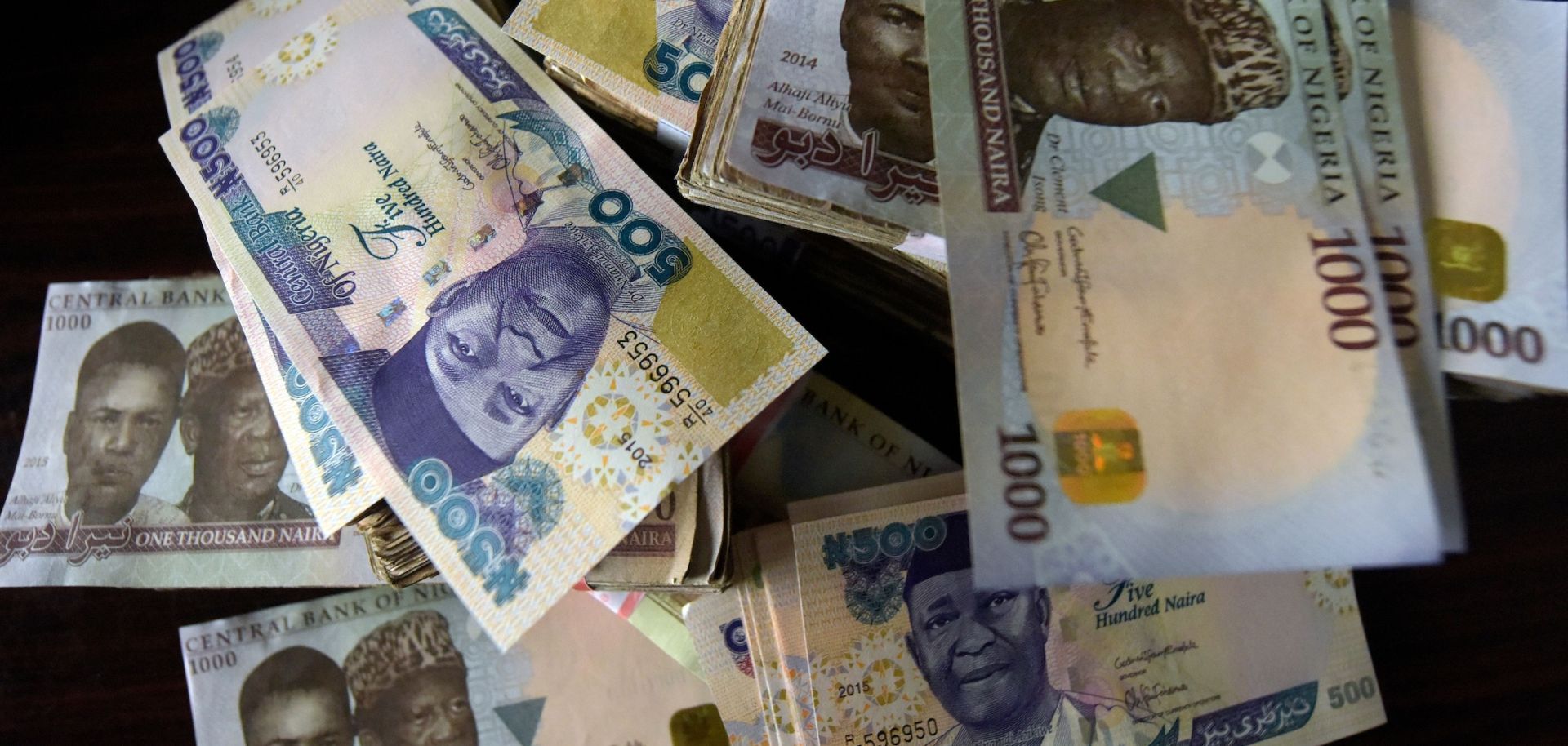
Despite the government's commitment to fiscal prudence and macroeconomic and currency reforms, economic conditions in Nigeria will remain challenging in 2024 and 2025 amid modest economic growth and high inflation, keeping the risk of socioeconomic unrest and policy slippage elevated. On April 3, Nigeria's electricity regulator announced that it would increase electricity prices by 240% for power consumers in the Band A category, which represents customers receiving electricity supply for more than 20 hours daily. The move came as President Bola Tinubu's government announced the removal of electricity subsidies for Band A customers as it pressed ahead with reforms aimed at reinforcing the country's macroeconomic fundamentals. The price hike comes as Tinubu's economic policies and foreign exchange policy changes for the national currency, the naira, have seen the currency decline by more than 65% percent over the past year, causing per capita income in nominal dollars to fall substantially. Meanwhile, continued high inflation has heightened food insecurity and increased the poverty rate. This, in turn, has led to increasing demands from the public for government assistance, forcing the government to increase social spending after sharp cuts to a number of subsidies at the start of his term, including on fuel, in an attempt to soften the negative effect on real income levels. To offset the fiscal impact of increased social spending for poorer citizens, Nigeria is being forced to raise prices for businesses and wealthier Nigerians, as the decision to hike electricity tariffs for Band A power consumers demonstrates.
- Measured at market exchange rates, Nigeria is the world's 39th-largest economy, smaller than Denmark's. Measured at purchasing-power-adjusted exchange rates, it was ranked 27. By this measure, Nigeria's economy is smaller than Poland's. In per capita income terms, Nigeria ranks 140 in the world, just below Kyrgyzstan. Nigeria is the largest economy in sub-Saharan Africa.
- According to the International Monetary Fund, the Nigerian economy will grow 3% per year in 2024 and 2025, which is only marginally higher than the population growth rate. This translates into only a very modest improvement in per capita income. Real GDP slowed to 2.7% in 2023 after registering 3.1% in 2022. Inflation averaged 25% in 2023 and accelerated to a 30-year high of 31.7% in February, following the removal of fuel price subsidies in May 2023, exchange rate depreciation and disappointing agricultural output. The IMF forecasts that annual average inflation will remain unchanged in 2024 at about 25% before declining to the midteens in 2025.
Since coming to office in May 2023, Tinubu has pursued macroeconomic policy reform with the aim of putting the economy on a sounder financial footing. Tinubu's government has pursued a tighter fiscal policy to reduce the budget deficit, most notably by removing popular yet costly fuel subsidies soon after taking office. The fiscal adjustment is essential if the government is to reduce its reliance on central bank financing, which contributes to endemic inflation. Pushback against the government's fiscal tightening forced Tinubu to partially restore fuel subsidies, with Nigeria's state-owned NNPC not raising fuel prices in spite of a second devaluation in January. As regards monetary policy, the Central Bank of Nigeria has begun to prioritize price stability through interest rate hikes and disengaged from some quasi-fiscal activities, such as the provision of loans and guarantees to domestic financial institutions. While it has increased its policy rate several times, the bank's monetary tightening program is likely to be insufficient to stem high inflation amid the significant nominal exchange rate depreciation of the naira and the reduction of subsidies, even though inflation is set to slow on a year-on-year basis over the course of this year. Nominal interest rates are not much higher than inflation, thus contributing to high inflation. With its exchange rate policy, the CBN has moved toward greater liberalization of the foreign exchange regime and a unified, more market-determined exchange rate with the aim of limiting the risk of present and future balance-of-payments pressure. In this context, the CBN cleared its overdue dollar obligations to domestic banks to ease the pressure on the naira and reestablish stability in the foreign exchange market. At the same time, it has successfully addressed the backlog of dollar demand from foreign companies eager to repatriate their funds in the face of dollar scarcity and tight foreign exchange controls by allowing them to repatriate most of their locally generated profits.
- The government opted for a politically risky but economically important fiscal adjustment by phasing out fuel subsidies, which saved 0.6% of gross domestic product in terms of fiscal expenditure in 2023. A supplementary budget partially reversed the cuts through targeted social safety net spending that provides cash transfers to poorer households. Nevertheless, fuel subsidies have decreased from more than 2% of GDP in 2022 to 1% in 2023. This is equivalent to a 10% cut in government spending.
- The naira has depreciated sharply since the new government came to power. It is now trading much closer to the black market rate in a sign that depreciation pressures have eased somewhat and that the central bank has regained some market confidence. The CBN policy rate stands at 24.75% following several rate hikes, but remains in negative territory in real terms, which is conducive to inflation. In June 2023, the government devalued the official exchange rate from 460/dollar to about 750/dollar. After depreciating further to around 1,600/dollar, it has since appreciated somewhat to currently 1,300/dollar. This should help support the balance of payments, but inflation is set to remain high in spite of the recent rally.
Tight fiscal and monetary policies — but still elevated inflation — coupled with only modest economic growth will fuel popular demand for increased subsidies and social spending to offset stagnant living standards. With the presidential elections more than three years away, the government is likely to stick with politically painful macroeconomic adjustment over the next two years in the hope of stabilizing the economy and creating the conditions for accelerated growth ahead of the 2027 presidential election. Nevertheless, the fiscal consolidation measures and limited tax generation capacity will make it difficult to generate the necessary resources to support growth-enhancing investment or social spending to help offset the welfare losses due to high inflation and modest growth. Structural fiscal reform aims to nearly double government revenues by 2026 as a share of GDP, which is currently a very low 10% of GDP. This is ambitious, and even if it does happen, it will only do so gradually. This is likely to result in a continuation of socioeconomic protests over the coming months, especially as the government presses ahead with the removal of additional subsidies. While the continuation of Nigeria's cost-of-living crisis will likely see protests continue in the medium term, their intensity may progressively ebb as the naira becomes more stable compared to the past 12 months and inflation declines. On the flipside, a roughly balanced current account will help limit the drain on Nigeria's foreign exchange rate reserves, and the IMF projects a gradual recovery of FX reserves in the context of limited dollar inflows. This will limit the risk of sovereign default in the next 12-24 months and even if it nears that point Nigeria retains the option of requesting an IMF program, which should help it avoid a broader balance-of-payments and debt crisis.
- Although public debt amounts to less than 50% of GDP, which is high but not dramatically so, a massive 80% of government expenditures go toward interest service. This explains why the government has little fiscal flexibility to address social grievances without jeopardizing macroeconomic stabilization and being forced to resort to (inflationary) central bank financing.
- After falling from $40 billion 2021 to about $33 billion, foreign exchange reserves are set to increase over the next few years, if only gradually, provided the government stays on the path toward macroeconomic adjustment and oil prices remain above $80 per barrel, or the level that prevailed at the beginning of the years. Foreign exchange reserves currently cover more than six months of imports, limiting near-term default risks.
- Nigeria is rated B- by both Fitch and S&P, and Caa1 by Moody's, indicating a no-negligible risk of a sovereign default. Nigeria is unlikely, however, to default in the next 12-24 months, as the IMF assesses Nigeria's capacity to repay its loans as adequate. Loan repayments disbursed under the 2020 Rapid Financing Instrument deal with the IMF will peak at less than 8% of foreign exchange reserves in 2024. The RFI provides rapid but low-access financial support in case of urgent balance-of-payments needs without a need for a full-fledged program due to its transitory nature. Nigeria's international bonds out to 2023 are trading at more than 90 cents on the dollar, similarly suggesting that default risk is low.
Barring a significant increase in oil prices, the government will fail to put the economy on a sustainable longer term path, as structural expenditure and revenue reforms are likely to be delayed, scaled back or reversed, leaving it vulnerable to future energy price shocks. Nigeria faces significant constraints to implementing long-term sustainable fiscal policy reforms, particularly as the short window to make painful adjustments begins to close in early 2026 when the Tinubu government is likely to pause painful structural reforms ahead of elections the following year. Nigeria's government revenue remains low, which represents a major financial vulnerability. Politically, it will be next to impossible to significantly raise the government revenue-to-GDP ratio due to the negative impact it will have on many Nigerians and Nigerian businesses marginally benefiting from evading tax collection or paying low taxes and endemic corruption and inefficiency that plagues tax collection. Designing and implementing significant tax revenue and tax collection reform will take time and it is likely to run into significant political opposition against Tinubu, particularly in the context of high, if declining inflation, and struggle to be institutionalized to the point where tax evasion and fraud declines substantially. Economically, a significant increase in government revenue — even if it could be successfully implemented in administrative terms — might weigh on the short-term growth outlook. Given Nigeria's heavy reliance on crude oil exports, the country's economic outlook — including with regard to structural reforms — will be highly dependent on the future evolution of oil prices, as those will largely condition the government's ability to raise additional revenue. The government is also likely to continue making gradual progress in terms of moving toward a more market-based exchange rate regime to continue easing pressure on foreign exchange reserves and buffer against oil price fluctuations, even if it may fail to move toward a largely market-determined regime by 2027 given limited foreign exchange reserves. Nevertheless, substantial and sustainable progress on structural macroeconomic reform will remain limited and Nigeria will continue to be characterized by significant economic and financial vulnerabilities when Tinubu's presidential term ends in 2027, even if a sovereign default remains unlikely.
- Oil-related revenues account for around two-thirds of government revenues and 90% of foreign exchange revenues, making oil prices critical to Nigeria's economic growth and financial stability. Such a high degree of oil dependence makes Nigeria very vulnerable to oil price fluctuations, with a decline in oil prices forcing it into a fiscal policy that reduces spending during economic slowdowns and exacerbates economic swings. Low non-oil revenues provide Nigeria with very limited scope to counteract adverse terms of trade and related revenue shocks. Conversely, another sustained increase in oil prices would lead to a temporary stabilization of the economy.
- The government will continue to move toward a unified, more market-based exchange rate regime. Higher oil prices would help get there faster. Weaker oil prices would slow its process toward this goal, which would allow foreign companies to repatriate their earnings and translate into a broader improvement of the business environment.
