
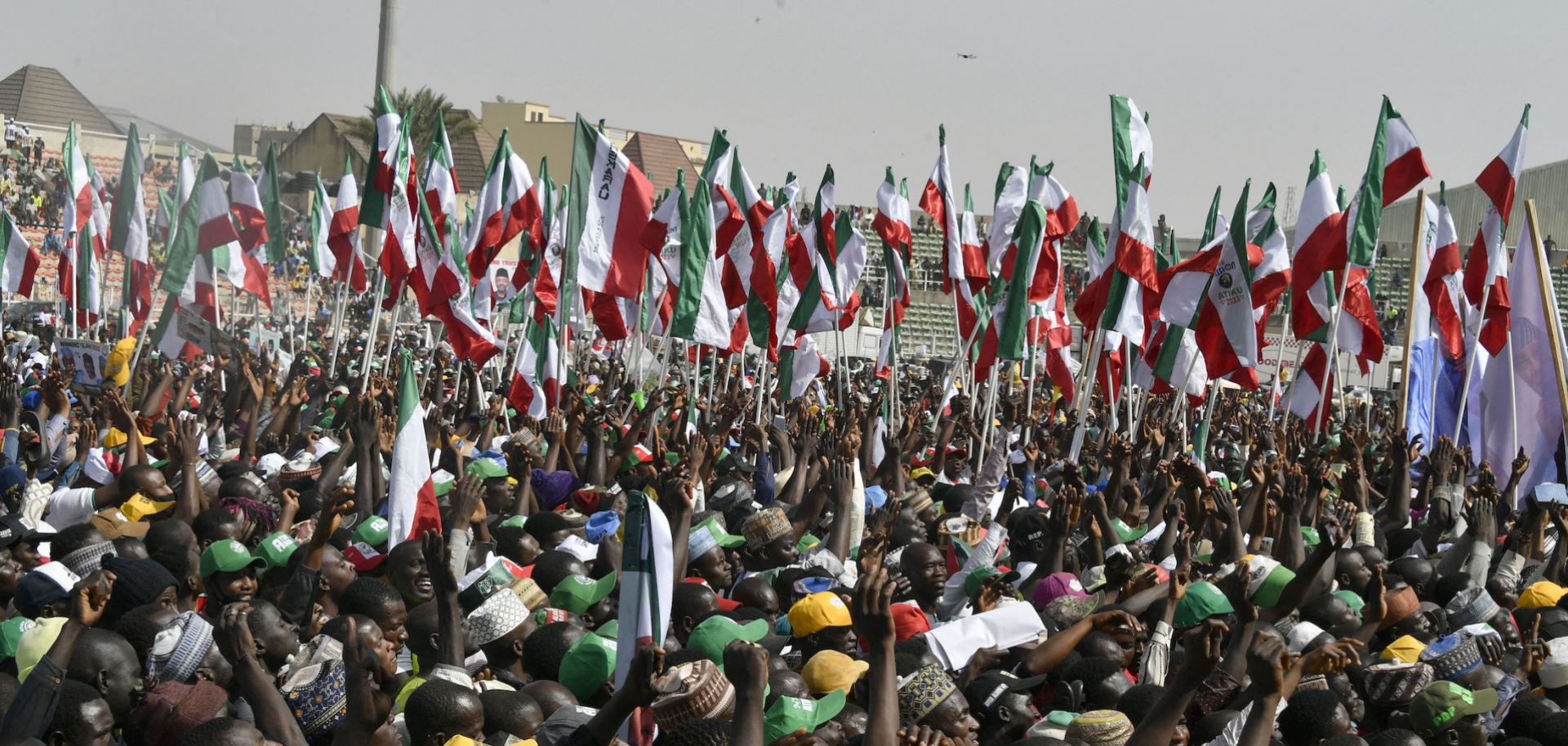
Supporters hold flags to support opposition PDP candidate Atiku Abubakar during a campaign rally in Kano state in northwestern Nigeria on Feb. 9, 2023.
Despite a surge in support for the Nigerian Labour Party's presidential aspirant, an establishment candidate is more likely to win the country's February election, which will likely sustain status-quo policies through embedded corruption and regional divisions. On Feb. 25, Nigerians will go to the polls to elect the country's next president at the apex of a highly contentious electoral season. Amid rampant insecurity, falling oil revenues, a currency crisis and fuel shortages, three frontrunners have emerged, each promising to shepherd Nigeria into a new era of prosperity. Regional and religious divides, however, are stirring heightened animosity among Nigerians themselves, particularly as two of the three frontrunners are Muslim and from outside the southeast, breaking from the country's informal power-sharing system that would make Nigeria's next president a Christian southeasterner. This — on top of candidates' willingness to utilize vote buying, voter intimidation, violence, political corruption and bribery to improve their odds of success — means that this round of polling may be particularly violent, while the result will likely exacerbate divisions along multiple fault lines.
Nigeria's next president will take over as debt sustainability worsens, criminal gangs and jihadist groups gain traction in the north, and a separatist group continues to shut down economic activity in the southeast. Regardless of who wins the election, the next president will inherit a host of problems that will shape — and likely constrain — their presidential mandate. While Nigeria's external debt is currently sustainable — meaning the government can afford to pay upcoming debt servicing costs — its external debt trajectory is unsustainable. Therefore, the next president will be forced to weigh runaway spending (including the wildly popular but increasingly unaffordable fuel subsidy) against reduced state revenue due to falling oil and gas exports and a worsening long-term debt outlook. Additionally, rampant inflation, a currency crisis and a shaky regulatory environment are likely to further complicate the next president's economic growth goals. Concurrently, insecurity plagues nearly every region of the country. In the north, criminal groups known locally as bandits have made certain areas unpassable, as kidnapping, assaults and killings are commonplace. In the northeast, the Islamic State West Africa Province (ISWAP) controls territory in the Lake Chad basin and frequently carries out attacks against civilian populations. In the southeast, the Indigenous People of Biafra (IPOB) — a group founded in 2012 that aims to secede to establish an independent Republic of Biafra — has shut down the majority of economic activity in the southeast through mandatory stay-at-home days and attacks on non-compliant businesses.
- Crude oil exports accounted for 41% of federal government revenue in 2021. In September 2022, the Nigerian National Petroleum Co. (NNPC) said that it lost an average of 470,000 barrels per day of crude oil to theft and pipeline vandalism, amounting to about $700 million each month.
- In 2022, Nigeria's debt service-to-revenue ratio was 80.6% (the World Bank suggests a 22.5% ratio for countries in Nigeria's revenue band). Minister of Finance, Budget and National Planning Zainab Ahmed said in January that Nigeria plans to bring down this ratio to 60% in 2023. However, it is not clear how the government will do this.
- ISWAP claimed to have attacked Ohinoyi of Ebiraland Palace in the Okene Local Government Area of Kogi state with a vehicle-borne improvised explosive device just hours before current Nigerian President Muhammadu Buhari was scheduled to visit the area on Dec. 29, 2022, illustrating the group's growing threat to federal officials.
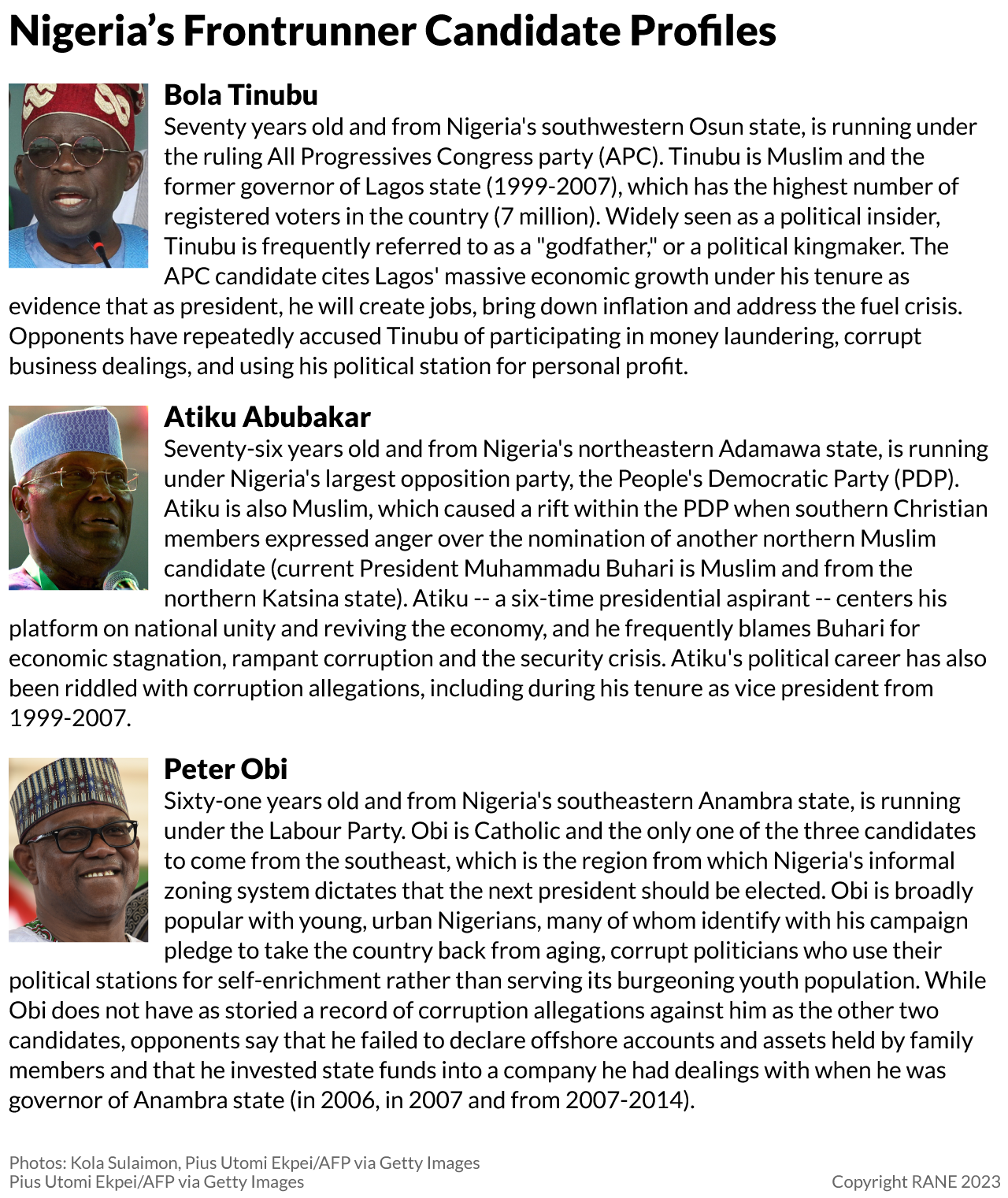
Despite the disrupted informal power-sharing system and the strong presence of a third-party candidate, an establishment candidate is most likely to win. Although Obi is ahead of Tinubu and Atiku in most opinion polls, the Labour Party candidate lacks the grassroots political networks and financial resources possessed by both of his rivals. This means that Obi is less likely to win the election than his high popularity with young voters would make it seem. While a Labour Party victory is not impossible, it would require more voters to turn out than appear to have registered thus far or that have voted in past elections. Therefore, an Atiku or Tinubu victory appears more likely, either of which would break Nigeria's informal power rotational system, as both candidates are Muslim and neither is from the southeast. While much of the country appears unconcerned by the shift away from the traditional system, some southern Christians are likely to rebel against the central government in such a scenario. The scale of unrest in Nigeria's southern states brought on by a Tinubu or Atiku presidency could range from sporadic demonstrations to widespread unrest, violence and looting. Additionally, the response is likely to coincide with an uptick in vandalism against oil and gas infrastructure, although the risk would be higher with a Tinubu presidency, as Atiku's vice president is from the south.
- To win the presidency, a candidate must receive a majority of votes cast and more than 25% of the votes in 24 of 36 states (and the Federal Capital Territory).
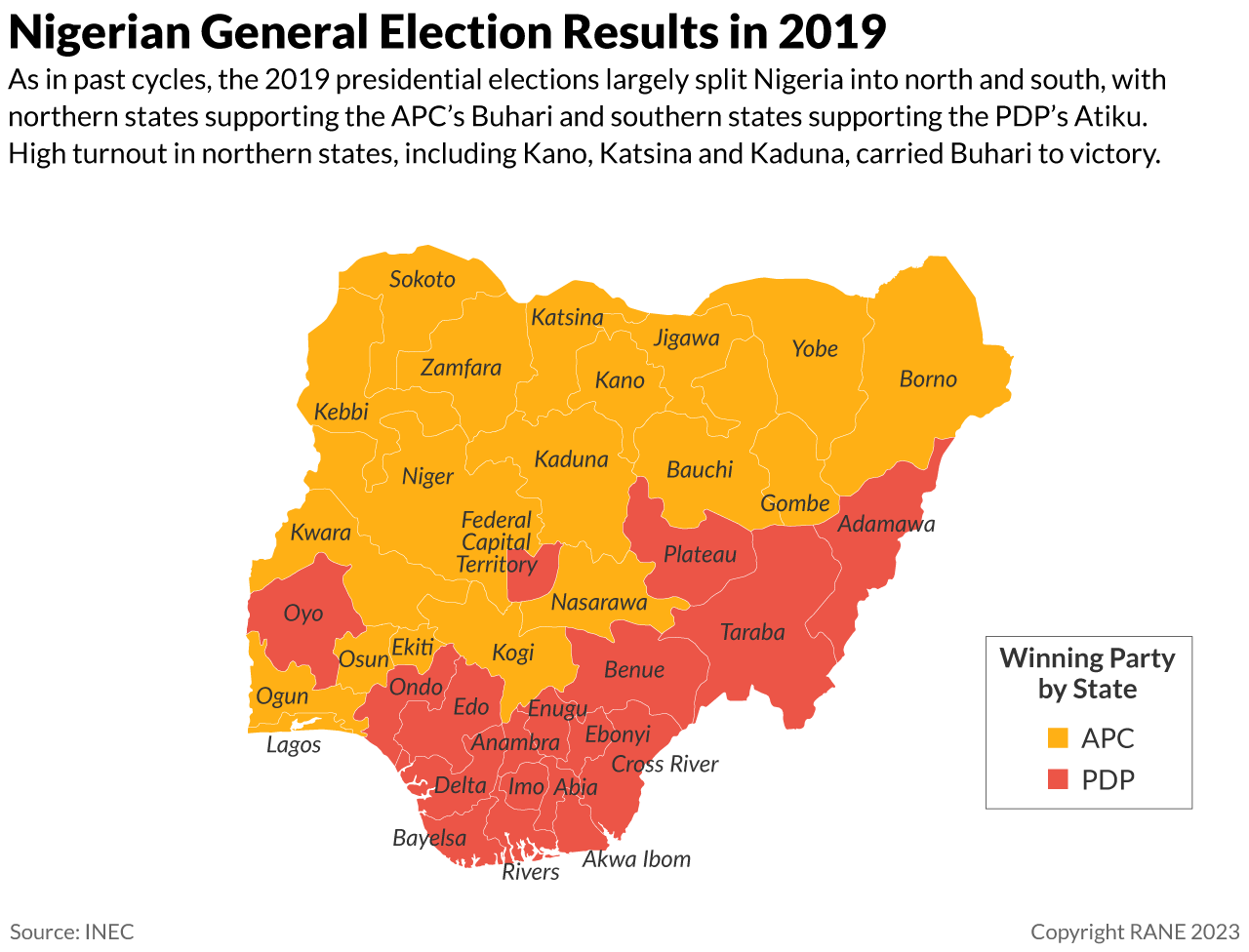
While Obi appears unlikely to win the election, his candidacy may make a run-off between Tinubu and Atiku more likely if he diverts enough southern votes away from the establishment candidates. Although the PDP has historically benefitted from widespread support across the south, Obi's candidacy could prompt some voters to favor the Labour Party. Additionally, the northern states that constitute APC President Buhari's support base may not be as amenable to a Tinubu presidency, which could cost the APC in abstentions. If Tinubu and/or Atiku do not receive high levels of support in historic party strongholds, the likelihood of a runoff will increase, which would extend the timeline for potential election-related unrest.
- One example of waning support for the PDP in the south is in Rivers state, located in the southern Niger Delta region and historically a shoo-in for the PDP. After being denied Atiku's vice presidential nomination, Rivers state Gov. Nyesome Wike vowed to make sure that the PDP loses the state. Wike has since taken several extreme measures, including sacking Rivers state officials who supported Atiku, denying permission for political rallies, sealing Atiku's campaign office and barring the hanging of posters. Wike has also reportedly appointed 200,000 polling aids to ensure that his will is carried out. While Wike may not be successful in keeping Rivers state from going to the PDP, his efforts will likely siphon some of Rivers state's 1.7 million votes from the party.
- Northwestern Kano state — which rallied behind Buhari in the 2015 and 2019 elections with 1.9 million and 1.4 million votes, respectively — may not bolster this year's APC candidate in the same way. While Tinubu is Muslim, which helps his popularity in the majority Muslim north, he is also ethnically Yoruba, which dominates the southwest, while Hausa and Fulani ethnic groups — to which Buhari belongs — dominate the northwest.
In the high-likelihood event that one of Nigeria's major party candidates wins, the next president will likely carry out marginal changes to defense policy and the energy sector based on political networks and regional connections, although national disunity and corruption will remain obstacles to effective governance. Many of the three frontrunners' campaign promises have overlapped: all three contenders have promised to do away with the costly but widely popular fuel subsidy, crack down on banditry and jihadism, and revamp Nigeria's economy. In practice, however, the two most likely winners — Tinubu and Atiku — will probably govern as past presidents have: by tapping into patronage networks and devoting more significant resources to areas of the country with high support bases. This means that as president, Tinubu could be expected to continue to develop Lagos' port, shipping and transportation infrastructure while cracking down on pipeline vandalism and oil theft by devoting more security forces to the Niger Delta region. Tinubu has not announced a concrete plan to combat banditry and jihadism in the north, but it is likely that he would pursue a containment strategy in continuity with Buhari rather than engage in direct negotiations with armed groups. Atiku, meanwhile, would likely devote greater time and attention to the conflicts in the north given his direct personal ties to the region, likely by augmenting the police force and increasing defense spending. Meanwhile, Atiku has long been in favor of privatizing the NNPC, which is already underway as part of the Petroleum Industry Bill approved in July 2021. Atiku has said little about his plans to revitalize the oil and gas economy amid rampant insecurity, but it appears likely that his commitment to recruiting additional police would extend to the Niger Delta region. The election of either candidate — although more so with Tinubu than Atiku — will likely preempt a flare-up in violence in the south, and both candidates are likely to be heavy-handed in their attempt to quash dissent. Given both Atiku's and Tinubu's track records in government, it is likely that pervasive corruption will remain a barrier to effective governance, while their strong respective regional ties and willingness to employ patronage may exacerbate national divides due to perceptions of unfair federal resource allocation.
- Nigeria's fuel subsidy will likely be a defining issue for the next president, as the cost of maintaining the subsidy ($10 billion) surpassed oil revenue in 2022. If the subsidy is kept in place for all of 2023, it is expected to cost approximately $16.2 billion. Canceling the subsidy, however, is likely to lead to widespread unrest, as took place when former presidents attempted to remove it.
In a less likely scenario, a massive increase in voter turnout could propel Obi to the presidency, undermining the political establishments of the APC and PDP and potentially leading to a limited government shake-up. In the low-likelihood event that widespread popular support for Obi and a marked increase in voter turnout coalesce to result in a Labour Party victory, Obi's presidency and the Labour Party's lack of institutional support would likely cause a shake-up of the political system. Many lawmakers, including governors, senators and local officials, could defect to the Labour Party to achieve greater political influence, but it is unclear whether the Labour Party would receive sufficient defections to govern with a majority in the National Assembly. If not, Obi's legislative priorities would be constrained in the Senate and/or House of Representatives. On the other hand, if the Labour Party achieves a majority through defections or coalition governance, Obi's priorities would reportedly include economic rejuvenation and sustainability, national reconciliation and enhanced security. While many of Obi's policy commitments are similar to those of Tinubu and Atiku, the Labour Party does not have the same patronage networks as the APC or PDP. While Obi's lack of patronage networks may give him some room to maneuver, it also means that Obi would be forced to build political relationships in order to achieve objectives within Nigeria's highly corrupt system, which would still likely require pay-offs and backroom deals. Therefore, an Obi presidency would be unlikely to alter Nigeria's political landscape by banishing corruption, patronage and state capture from politics, despite his declarations to the contrary.
- On the campaign trail, Obi said that as president, he would prioritize setting Nigeria on an economically sustainable path by canceling the fuel subsidy, renegotiating external debt and working with southern states to address pipeline theft and vandalism. Unlike the other two frontrunners, Obi said he is open to negotiations with many armed groups operating in the country, including bandit groups and the IPOB.
