
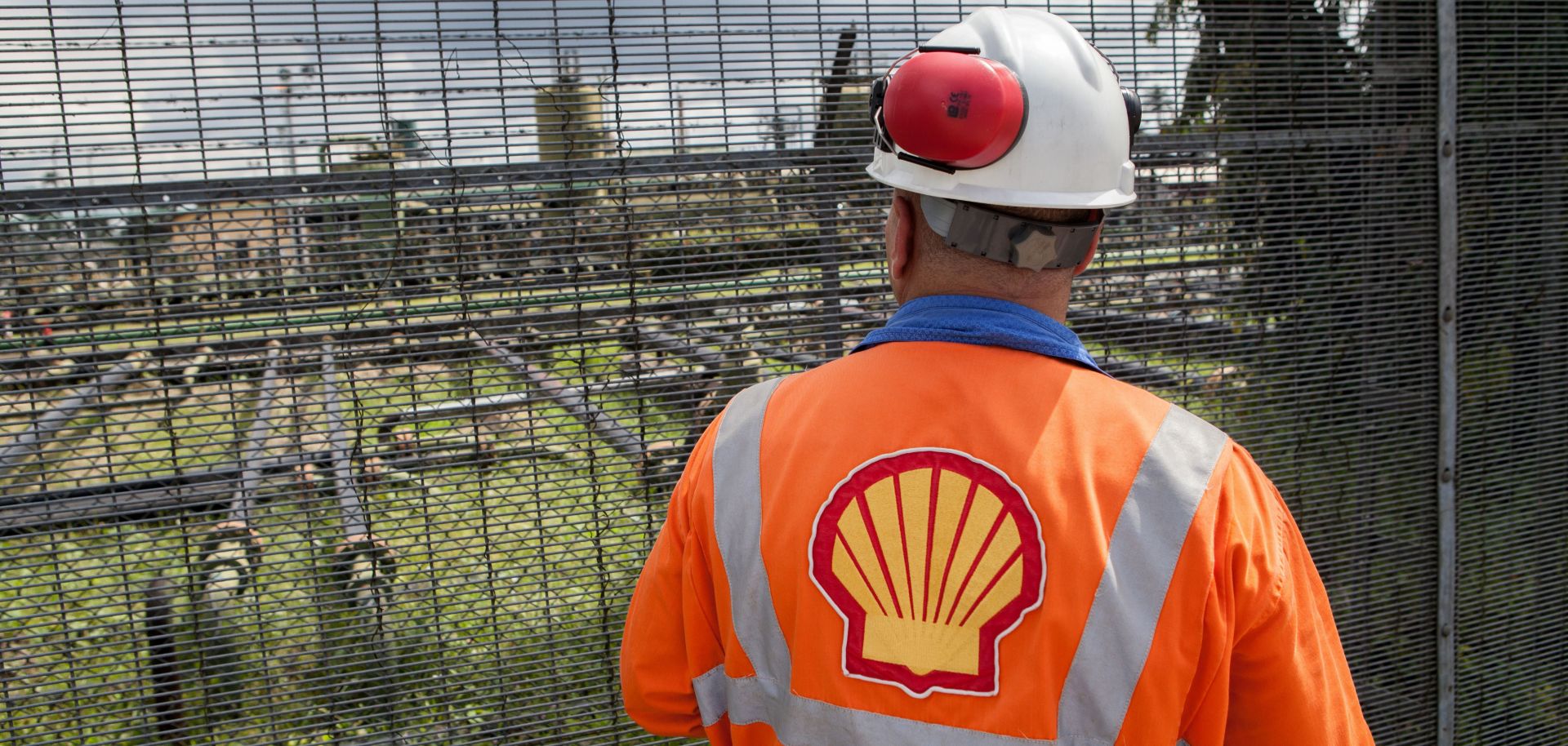
A Shell employee looks at the Agbada 2 oil flow station in Port Harcourt, Nigeria, in September 2015.
Nigeria’s new Petroleum Industry Bill (PIB) will modernize its regulatory environment for the oil and gas industry, reduce uncertainty and open the door for majors to expand their presence in the country. The current global push to cut emissions, however, could still limit future investment in the sector. On July 1, both houses of Nigeria’s National Assembly passed the Petroleum Industry Bill, with markups, and will soon begin talks on merging their respective bills in order to send a unified text to President Muhammadu Buhari. The bill is the culmination of a nearly 15-year process to reform Nigeria’s oil and gas sector that has been bogged down by political infighting over contentious issues like revenue sharing. Buhari vetoed a version of the reforms in 2018 before submitting a new proposal, which formed the basis of the current version.
Key measures in the PIB:
- Two new regulatory bodies will be created to oversee Nigeria’s oil and gas sector — one for the upstream sector and another for the midstream and downstream sector. Today, those responsibilities are carried out by the Department of Petroleum Resources and the Nigerian National Petroleum Corporation (NNPC).
- The NNPC will be restructured through the incorporation of a new NNPC Ltd, which will turn it into a commercial entity.
- Oil companies operating in Nigeria will be required to set up a Host Community Development Trust Fund to support the socio-economic development of the communities hosting oil and gas production. Oil companies will also need to deposit 5% of their annual operating expenditure into the fund.
- The bill introduces a new hydrocarbon tax regime, replacing an older tax regime with lower headline rates than the previous tax regime.
The combination of falling oil prices and lower state revenue because of a decline in production has spurred the Nigerian government to finally make progress on the sector’s reform. Oil production represents around two-thirds of state revenue, which explains the sector’s importance for the Nigerian government. Nigeria’s delay in passing the PIB prompted a decline in oil and gas investments in the country, as majors were concerned about possible regulatory changes that could drastically affect their profitability. Due in part to the drop in investments, Nigeria’s oil production declining to about 1.4 million barrels per day (bpd) in April 2021, down from a peak of about 2.5 million bpd a decade earlier. The aging of Nigeria’s oil sector alone does not explain the decline in production, because a number of majors (including Shell, ExxonMobil and Eni) have several pre-final investment decision (FID) projects that have not progressed in part due to the uncertainty about issues like exact royalties for deepwater projects and changes to the tax code for oil companies. The final PIB also included a raft of changes to royalty and tax rates for oil companies to incentivize investment after negotiations between the government and companies. A clause that would have forced a review of fiscal terms every seven years was also removed.
- Between 2015 and 2019, just 4% of the investment into newly sanctioned upstream oil and gas projects in Africa was in Nigeria, despite Nigeria's status as the continent’s largest oil and gas producer.
The implementation of the PIB will unlock more investment in Nigeria’s oil and gas sector, particularly offshore, but challenges will persist onshore where the difficulties go beyond just fiscal terms and regulatory certainty. Projects including Shell’s Bonga Southwest Aparo, TotalEnergies’ Preowei and ExxonMobil’s Owowo may now finally be sanctioned. But despite Nigeria introducing modified fiscal terms at the behest of oil companies, its offshore industry may still be a high-cost environment relative to other countries. In addition, both TotalEnergies and Shell are looking at substantially reducing their carbon emissions, which could shape their investment decisions moving forward. In any case, even if the projects are sanctioned, Nigeria won’t see the revenue for years, given the long development time for offshore projects – and by then, the investment may only slow the decline in Nigeria’s production, instead of giving it an outright boost in production. At the same time, onshore oil companies will have to deal with tense relations with locals. Even with the new trust funds, disputes between oil companies and workers will likely still arise, and unions will likely continue to stage strikes. Moreover, the siphoning of oil from pipelines will remain attractive to criminal groups, providing a constant headache for operators in the Niger Delta.
