
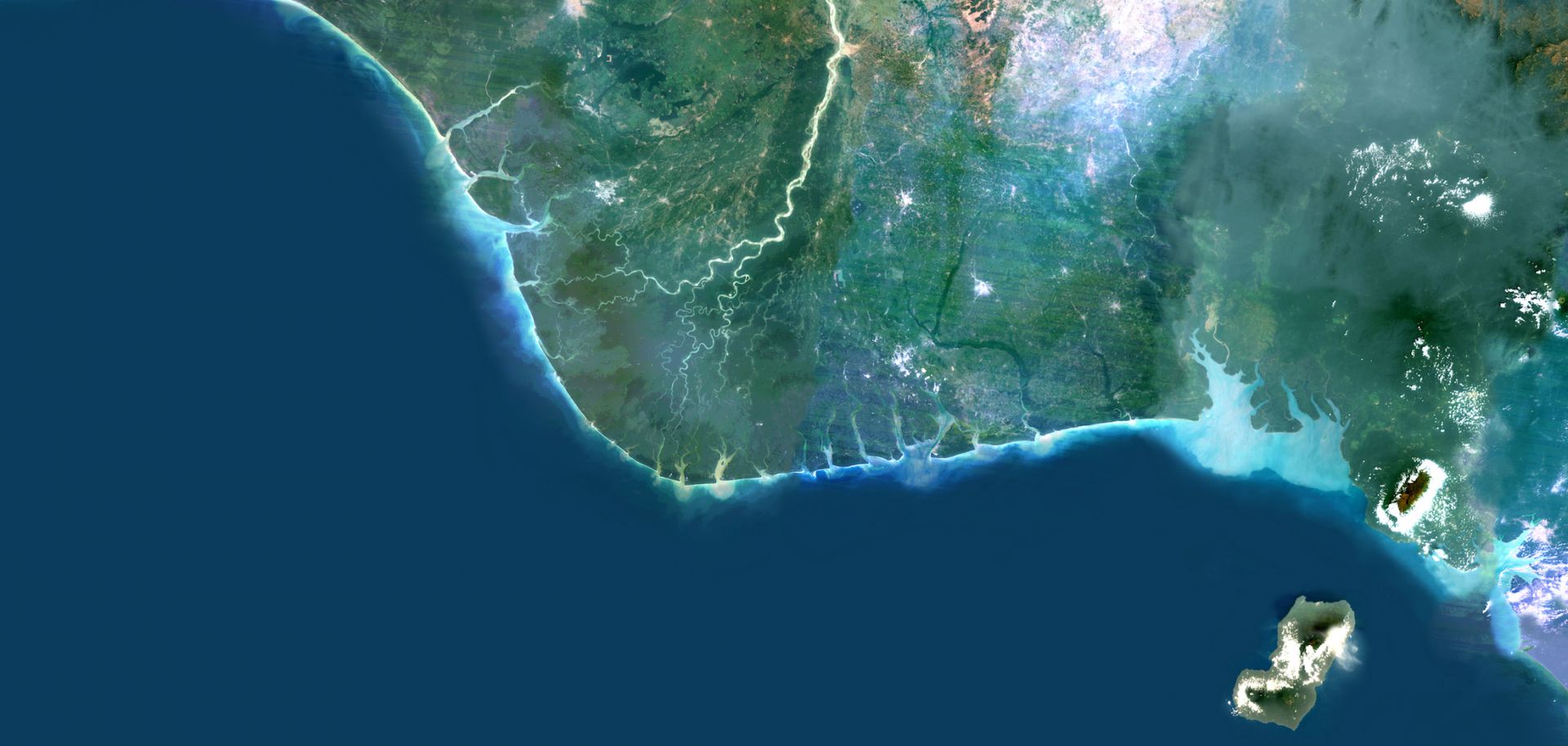
A satellite image of Nigeria's oil-rich Niger Delta region. Lucrative offshore projects have helped boost the country's crude production in recent years.
Life just got harder for major oil companies operating off the coast of Nigeria. On Nov. 4, Nigerian President Muhammadu Buhari signed a law updating the terms of the country’s production-sharing contracts that, among other changes, increase royalties on international oil firms. As Africa's top crude producer, Nigeria is almost entirely financially dependent on its petroleum operations, which account for 90 percent of government revenue. The current oil glut has thus hurt Nigeria's pocketbooks particularly hard, forcing it to consider drastic measures to squeeze out more money from its growing offshore operations. But by placing international companies in its crosshairs, Nigeria instead risks driving away the crucial deep-water investments in needs to keep its lights on.
The Need for Change — and Revenue
For more than a decade, Nigeria has been trying to amend its hydrocarbon sector with reforms that would increase its efficiency, reduce corruption, raise its regulations to international standards and update its investment terms for international oil companies. Much of these reforms were initially proposed in a 2008 piece of legislation known as the Petroleum Industry Bill. But over the years, the ambitious proposal has proven too large and too full of controversial reforms to pass in the country's fragmented legislature, costing the government a significant source of revenue.
The investment terms for its lucrative deep-water resources, for example, haven't been updated since they were signed in the 1990s when oil prices were below $20 a barrel and deep-water production was still a relatively new investment prospect. At the time, the government offered generous terms to get wary investors in the door. But today, deepwater investments — while still expensive — are nowhere near as risky.
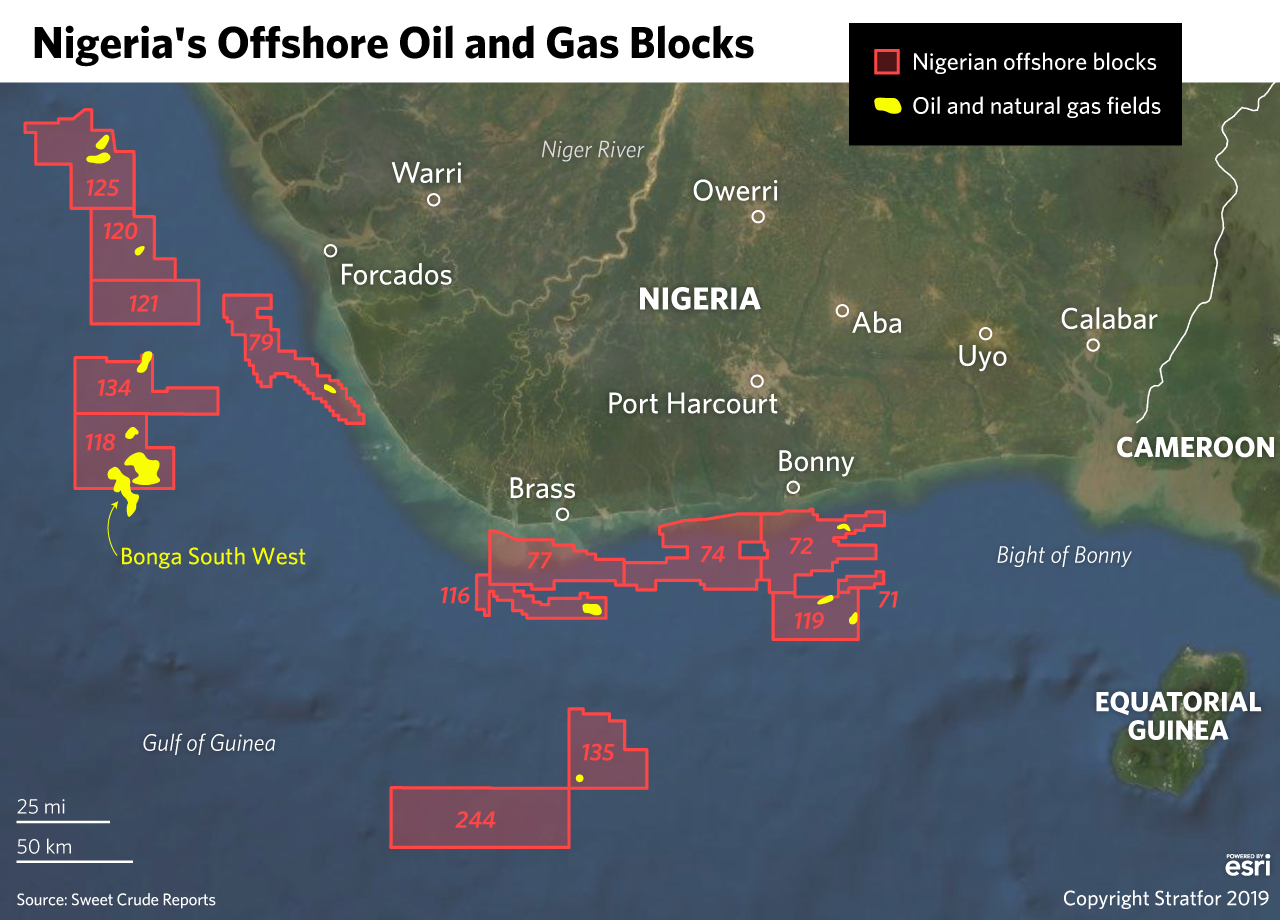
Nigeria's inability to reform its 30-year-old hydrocarbon laws have, in turn, cut into the government's profit share in these deep-water deals, which it desperately needs to make up for the losses it has incurred amid falling oil prices and slowing non-deep-water production. In recent years, offshore projects have helped bolster Nigeria's oil production, which today accounts for nearly half of Nigeria's 1.86 million barrels per day of crude oil production. But while its deep-water production has been slowly and steadily rising, Nigeria needs it to increase faster to make up for its declining non-deep-water production (and thus revenue).
Plan B: Offshore Contracts
Exacerbated by the dip in oil prices over the past year, this need for more revenue has prompted Nigeria to cast aside its failed hydrocarbon reforms and focus instead on shaking more money loose from its deep-water deals. In 2018, Nigeria's Supreme Court ruled that the government had the right to renegotiate royalties in its production-sharing contracts if oil prices rose to more than $20 per barrel. According to Nigeria's attorney general, the basis of the Supreme Court decision was to seek a colossal $62 billion in damages from oil companies including Chevron, Shell, Eni and ExxonMobil.
These oil majors have unsurprisingly rejected the claims, meaning the matter will likely be tied up in the court for years — especially if Nigeria tries to retroactively apply the new rules to current production-sharing contracts to gain back lost oil revenue. But the ruling nonetheless left oil companies with a looming big risk of a large tax bill, given that the price of Brent crude (which is the primary global oil price benchmark) has not dipped below $20 per barrel since 2002.
But now, the government has decided to take this push one step further by signing a bill into law that would amend legislation on offshore agreements under its 1993 Deep Offshore and Inland Basin Production-Sharing Contract Act. The original, nearly 30-year old legislation imposed a single royalty that fluctuated between 0 and 12.5 percent depending on water depth. But under the proposed new rules, all projects over 200 meters deep will now not only be subject to a flat 10 percent royalty fee but a second 2.5 percent royalty if oil prices are between $20 and $60 per barrel, which increases to 4 percent royalty if oil prices are between $60 and $100 per barrel. The amendments also add a cost recovery ceiling for oil companies trying to quickly recoup investment costs and build in regular five-year reviews of the royalties and production-sharing contracts.
The new legislation is expected to add roughly $1.5 billion in government revenue in just two years. But it has also conveniently armed Nigeria with more negotiating leverage just before many of its first-wave contracts are up for renewal. The majority of the production-sharing contracts that were signed in 1993 are set to expire over the next eight years. Nigeria has already begun negotiations to renew its contract with Shell, which is the first set to expire in 2023. How those negotiations unfold will thus serve as a model for future contract renegotiations in light of the new rules. This includes the $10 billion project in the massive Bonga Southwest offshore field, which Shell and its partners are currently in the works of finalizing. But if Nigeria does not find the right balance in revenue-sharing during these negotiations, it risks deterring foreign companies from investing in the country's oil sector altogether.
Short-Term Gain for Long-Term Pain?
In Nigeria, oil companies already face a multitude of above-ground investment risks, such as crude oil thefts that damage their infrastructure. And now, with the added red tape and royalties, life's about to get even more difficult for oil companies operating off the country's oil-rich coast. Lobbying groups for oil companies in Nigeria have already warned that the new changes to Nigeria's upstream oil and gas investment terms could result in oil production declining by 20 percent by 2023 and preventing $15 billion in investment.
This assessment, however, is likely the worst-case scenario. Years of uncertainty around Nigeria's future investment regime has prompted many foreign operators to freeze some of their deep-water investments. Thus, there's a chance some of these delayed projects will now finally move forward. Even with the new laws, Nigeria's deep-water production is certainly still cost-competitive as well. But that also depends largely on oil prices remaining where they are, which is by no means a guarantee.
Over the past year, oil prices have already taken a sizable dip. And there's a good chance they could drop further, given North America's rising oil production and the push toward renewable energy. Without a clear idea of where the market is headed, oil companies' are undoubtedly recalculating some of their long-term investments, which could mean scrapping or scaling back some of their more expensive projects around the world, including deep-water projects in Nigeria. Indeed, concerns about Nigeria's long-term investment environment have already prompted many foreign companies to jump ship. Most major oil firms have either left or are preparing exit plans for their operations in Nigeria's shallow water and onshore fields, where they operate in either direct concession agreements with the government or in joint ventures with the country's state-run oil company.
Some oil companies have even begun to slow down their deep-water investments. And the added costs and hassle of Nigeria's new laws risk pushing even more oil companies out the door as they readjust their global investment strategies. Total, for example, already announced Nov. 6 that it was selling its 12.5 percent non-operator stake in the Oil Mining Lease 118, which includes the major Bonga offshore complex. Thus, while the new rules may initially endow Nigeria with more negotiating power and revenue, the added production costs risk jeopardizing its crucial offshore investments in the long term. Indeed, by placing international companies in its crosshairs, Nigeria could instead fuel an even greater exodus of international oil companies seeking easier and more profitable operations elsewhere.
