
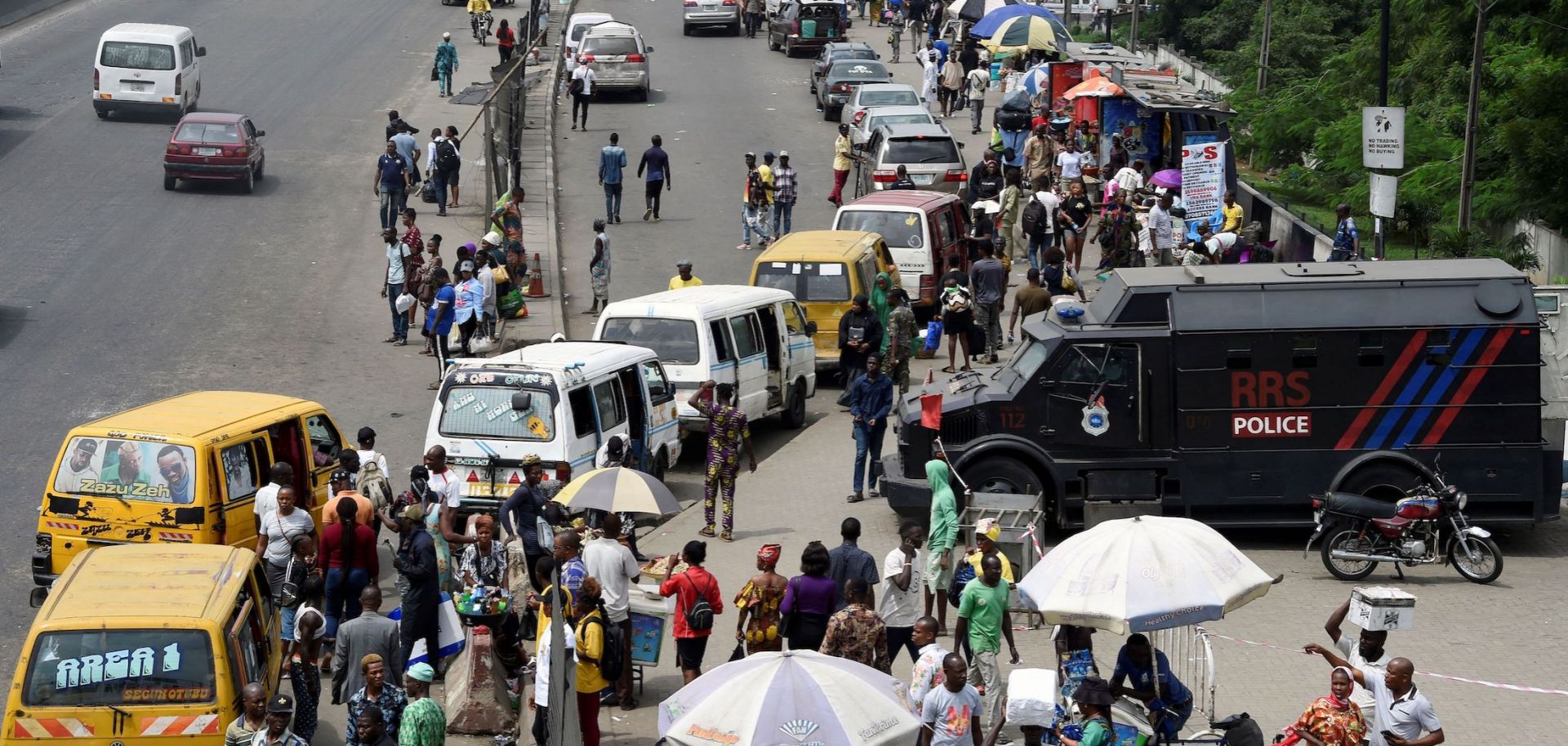
A police armored vehicle is deployed at a bus station at a boundary between Lagos and neighboring Ogun State in Lagos on Aug. 3, 2022.
Regional and religious electoral violence will threaten the integrity of Nigeria’s February general elections, likely weakening the next government’s ability to implement policy at a time of increasing economic challenges. Nigerian police reportedly killed three gunmen in a Dec. 12 shootout following an attack on the Independent National Electoral Commission (INEC) office in Owerri, the capital of Nigeria’s southeastern Imo state. The Imo state police spokesman told reporters that officers repelled the attack and arrested two of the perpetrators, but only after the attackers threw explosives onto the facility's roof, destroying part of the building. No group has claimed responsibility for the attack, but Nigerian authorities regularly attribute similar incidents to the Indigenous People of Biafra (IPOB), a separatist group based in Nigeria’s southeastern region. The incident took place ahead of the general election on Feb. 25, when millions of Nigerians will elect their next president and vice president, as well as members of the country’s Senate and House of Representatives.
- This is the third attack on INEC facilities in Imo state in the past two weeks, with similar incidents occurring in Orlu district and in Oru West earlier this month. Since campaigning for the February election began in September, other attacks have occurred in Ebonyi, Osun and Ogun states.
- In addition to attacks carried out against INEC facilities, Nigerian authorities have also accused IPOB separatists of conducting attacks on politicians in the region, including a Sept. 11 incident in which gunmen opened fire on the convoy of a senator from Anambra state, killing five people.
The attack comes amid an increase in election-related violence — particularly along regional and religious lines — as campaigning ramps up in anticipation of the general election. Anti-government sentiment is higher than usual in Nigeria’s southeast, where many perceive that the February elections will break the balance of power in Nigeria. According to Nigeria’s unofficial power-sharing rules, the presidency should rotate to a Christian from the country’s south-east in the February election. However, both major party candidates are Muslim and neither is from the south-east, which has angered Christian organizations and southern ethnic groups over the anticipated lack of representation in the federal government. As such, election-related violence will likely reach beyond IPOB separatists in the south-east, as smaller groups and individuals attempt to stem voter turnout by targeting electoral offices. Violence will also threaten regions outside the south-east since Christians in northern Nigeria have also expressed discontent with the prospect of back-to-back Muslim presidents. Against this backdrop, politicians will likely try to exploit regional and religious divides by inciting violence for their own gain, with objectives ranging from encouraging mob violence to attacking polling locations to targeting political rivals.
- Bola Tinubu, the ruling party presidential candidate, is from Nigeria’s south-west and previously served as the governor of Lagos. Atiku Abubakar, the opposition presidential candidate, is from Adamawa state in Nigeria's north-east and previously served as the country's vice president. Both candidates are Muslim, as is Nigeria’s current president Muhammadu Buhari.
Electoral violence is one of many challenges that will threaten the integrity of Nigeria’s general election, likely worsening legitimacy and governance problems for the country’s next president. Beyond the immediate security risks associated with widespread electoral violence, disruptions at polling stations and violence targeting voters and candidates will likely harm the integrity of the February polls. In many parts of the country, violence and threats of violence will likely deter Nigerians from going to the polls, dampening voter turnout. And, as in past election cycles, unsuccessful candidates will likely point to violence against their party and/or voting locations in party strongholds as evidence of foul play by their political rivals. On top of this, Nigeria is using digital voting systems for the first time in this election, and already electoral watchdogs have found extensive evidence of irregularities among the 93.5 million Nigerians electronically registered to vote. Taken together, perceptions of poor electoral integrity will likely damage the legitimacy of Nigeria’s next president in specific pockets of the country. The two main candidates (Tinubu and Abubakar) will likely both face accusations of illegitimacy in the south-east and south-south, likely strengthening the IPOB and other popular separatist sentiments. But if elected, Tinubu would likely also struggle to govern the Christian north, while an Abubakar presidency would face resistance in the south-west and the Christian north-west. Although resistance to federal authority is not new to Nigeria, the inability to implement national policy is of increasing significance as the country’s debt outlook becomes less sustainable, oil revenues fall, food insecurity worsens and jihadist insurgencies worsen insecurity.
