
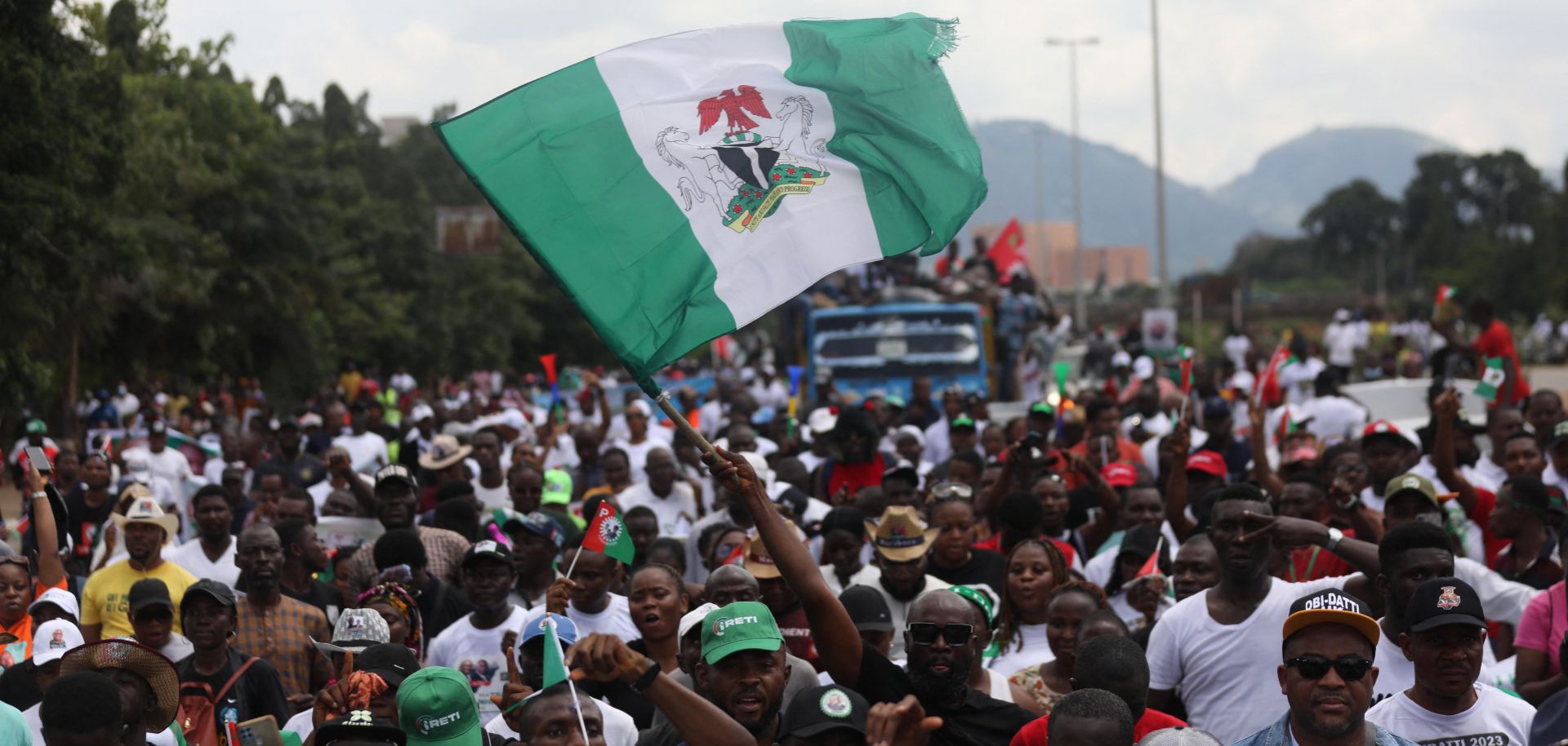
The Nigerian flag is waved above a crowd at a political rally for Labor Party candidate Peter Obi in Abuja, Nigeria, on Sept. 24, 2022.
Poor economic conditions and a failed informal power-sharing agreement mean that Nigeria's presidential campaign season will likely usher in a period of increased violence, corruption and fraud, thereby raising reputational and security risks in West Africa's largest economy. The campaign season for Nigeria's February 2023 general elections officially kicked off on Sept. 28, marking the beginning of what will be a highly contested race. The country's two largest parties — the ruling All Progressives Congress Party (APC) and the Peoples Democratic Party (PDP) — have both nominated presidential candidates who, if elected, would break with Nigeria's informal power-sharing system, which for decades has facilitated the rotation of presidents between the country's six ''geopolitical zones'' to promote a fair regional, religious and ethnic distribution of power. APC candidate Bola Tinubu and PDP candidate Atiku Abubakar are from the country's southwest and northeast zones, respectively, even though this unwritten tradition dictates that power should swing to the southeast since current President Muhammadu Buhari is from the northwest. Nigeria is also poised to discontinue its custom of switching off between Christian and Muslim presidents as well, as both Tinubu and Abubakar are also both Muslim (like Buhari).
- Ruling party candidate Bola Tinubu is the former governor of Lagos, the commercial hub located in Nigeria's southwest. Despite myriad corruption allegations, Tinubu has far-reaching political connections and deep coffers propelling his campaign. The APC selected Kashim Shettima, a sitting Muslim senator and former governor of northeastern Borno state, to be Tinubu's running mate.
- Opposition candidate Atiku Abubakar is from Adamawa state in Nigeria's northeast and served as the country's vice president from 1999 to 2007. The PDP selected Ifeanyi Okowa, a two-term Christian state governor of Delta state, to be Abubakar's running mate, creating a rift with Rivers state Gov. Nyesom Wike that could draw votes from Abubakar in the February election.
- Peter Obi, the presidential candidate from the smaller Labor Party, has also been gaining support among Nigeria's youth population, but appears unlikely to mount a serious challenge against either Tinubu or Abubakar at this stage. Obi, a Christian from Anambra state in Nigeria's southeast, defected from the PDP in May to become the Labor Party candidate. The Labor Party has never won the Nigerian presidency, but Obi has received a surge of social media support from Nigeria's youth population. Obi is also of the Igbo ethnic group, which has not held the presidency since 1966.
A cost-of-living crisis, rising insecurity, service delivery failures and a worsening economic outlook raise the stakes of the upcoming election despite widespread voter apathy. As the costs of food and fuel continue to rise despite a long-standing and costly petrol subsidy that has cost the government about $5.9 billion so far in 2022, low- and middle-income households are struggling to afford basic necessities like maize, yams, diesel and school fees. Low agricultural productivity in recent years has contributed to food insecurity, which is exacerbated by ongoing insurgencies in Nigeria's northwest, northeast and southeast that render large swaths of territory inaccessible for civilians and government services. In urban areas like Abuja and Lagos, access to government services has worsened in recent years as lack of investment and aging infrastructure take services offline. The government is unable to address many of these grievances due to financial strain brought on by currency depreciation, falling foreign exchange reserves, low foreign investor interest and decreasing crude oil production (Nigeria's largest export). As such, discontent with Buhari's government is widespread. However, many Nigerians (especially the country's youth population) are skeptical that a change of leadership will make a difference, meaning voter apathy is likely to run high. This could reduce the legitimacy of Nigeria's next president in opposition strongholds.
Violence, corruption and fraud will likely facilitate a particularly volatile campaign season that will cause voters' concerns to go unaddressed and raise reputational and security risks. Nigerian politicians have a history of capitalizing on voter grievances to incite violence against opponents, and this pattern will likely hold steady during the present campaign season. Given the low likelihood that Nigeria's next president is from the southeast geopolitical zone (which would keep with custom and require the election of Peter Obi), the southeast is particularly likely to experience violence at polling stations against visiting candidates or between rival political groups. Additionally, religious attacks across the country could ramp up in the coming months as the APC and PDP's nominations of Muslim candidates inflame Muslim-Christian divides. Insurgent and criminal groups may also form informal alliances with politicians, which would likely enrich these groups and increase the frequency of their attacks. Some politicians are also all but certain to engage in corruption and fraud to secure political endorsements from community, religious and business leaders. Given the highly volatile nature of the coming electoral season and longstanding financial constraints, the current government is unlikely to address the problems plaguing the electorate, although it may attempt to appease specific groups of people with a patronage-based allocation of resources in order to court their votes. As such, the reputational, security and financial risks of conducting business in Nigeria will likely rise, which could cause foreign businesses and investors to suspend investment or major business decisions until after the election.
