
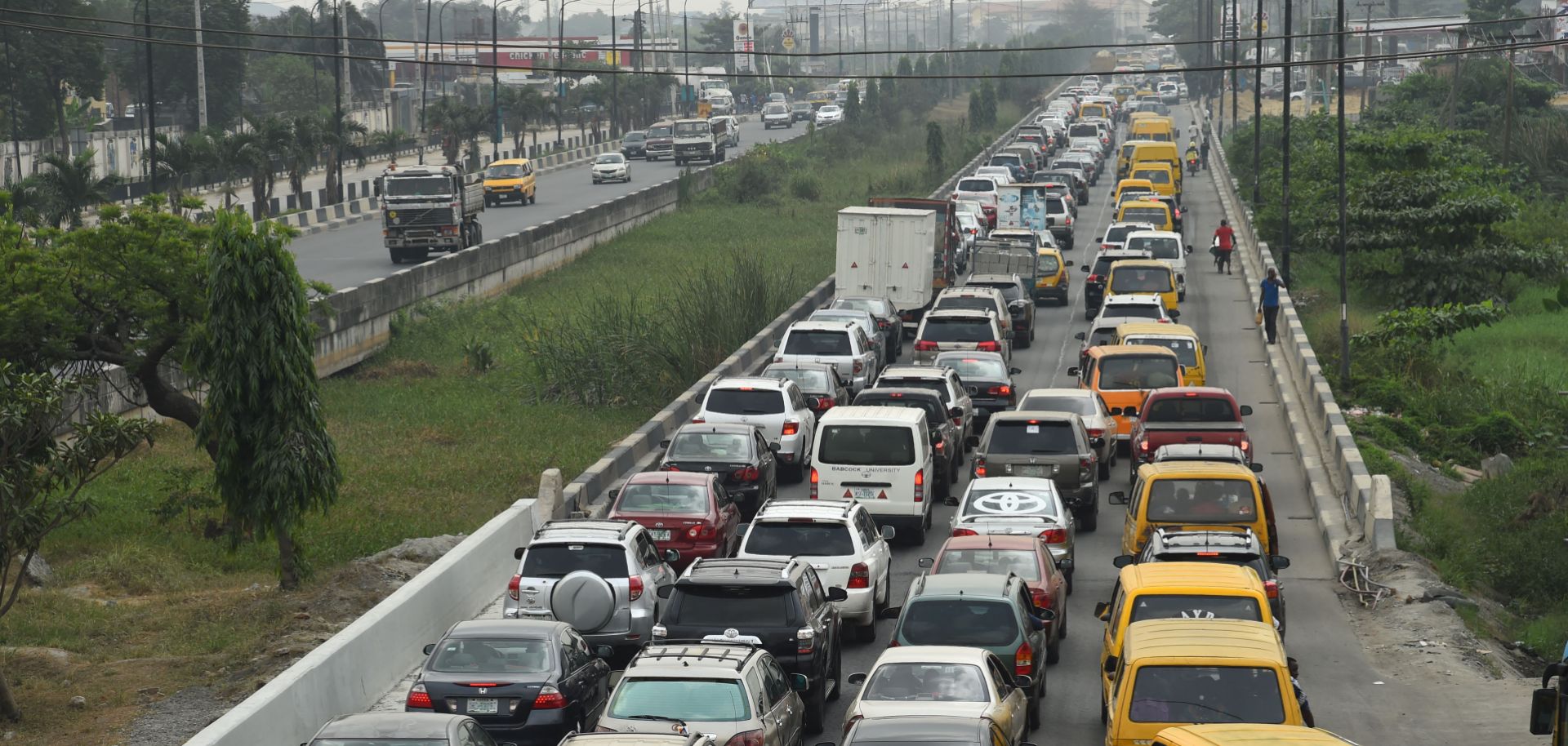
A line of cars seeking to fill up at a gas station extends down a four-lane road in Lagos, Nigeria, on Feb. 9, 2022.
Nigeria could see widespread unrest in the next 12-to-18 months, as the country's deepening fuel crisis further erodes Nigerians' purchasing power and quality of life. In addition to disrupting business operations and economic activity, the potential for such protests will increase pressure on the government to keep costly fuel subsidies in place, further dimming Nigeria's long-term financial outlook. In early May, lines to buy diesel and petrol in Nigeria's capital city of Abuja blocked traffic and caused fights over limited supplies. While the Nigerian government has not given a reason for the shortages, President Muhammadu Buhari's critics in the opposition have complained that the shortages are a result of a lack of reserves and corruption within the state-owned Nigerian National Petroleum Company. In February, lines for fuel snaked around entire city blocks in Abuja, Lagos and Port Harcourt, as well as in smaller towns and cities, after the government blocked the sale of 350,000 tons of petrol because it contained too much methanol. While government subsidies insulate Nigerians from severe price shocks to petrol, the government does not subsidize cooking gas (liquified petroleum gas) or diesel, for which prices have reached their highest levels in years.
- The global fuel crisis, spurred in large part by the Russian invasion of Ukraine, has led to supply shortages, panic buying and price hikes across the world. The impact is likely to be longer-lasting in sub-Saharan Africa due to governments and companies' inability to afford exorbitant global prices. Sub-Saharan Africa imports an average of 75% of its refined products, which is a greater share than any other region. The head of the Africa division at Vitol, the world's largest independent oil trader, recently said Africa was currently facing its worst supply crisis in 40 years.
- Shortages of jet fuel have led airline operators to cancel flights and increase fare prices, in some cases by nearly 100%. In late April, Nigerian airlines threatened to ground all flights due to increasing fuel prices, which rose from $0.46 to $1.69 per liter in the wake of Russia's invasion of Ukraine in February. After a series of negotiations, the government agreed to subsidize jet fuel and flights resumed.
- Nigeria has long suffered from fuel shortages, particularly in the 1980s and 1990s when the country was under military rule, but also more recently throughout the 2000s and in the years since.
Nigeria's fuel shortages are unlikely to ease over the next year and a half, as external market shocks continue to disrupt the country's access to refined oil imports and as domestic refining capacity remains limited. Nigeria is the largest crude oil exporter in sub-Saharan Africa, but the country lacks refining capacity. Nigeria thus imports the majority of its refined products, which makes its fuel supplies particularly vulnerable to external shocks in the global market (like those currently being caused by the ongoing Ukraine crisis). Two privately-owned refining plants are currently the only ones in operation, processing just 1% of the 1.3 million barrels of crude oil produced in Nigeria each day. Nigeria also struggles with a lack of storage. While wealthy countries like the United States have several months of supply in reserve, Nigeria is unlikely to have more than a few days of backup supplies, despite commentary from politicians to the contrary. The National Petroleum Act of 2021 aimed to change these trends by overhauling industry regulations and removing consumer subsidies that could cost the government $9.6 billion this year if oil prices continue to rise. But in response to public resistance, Buhari has pledged to keep the fuel subsidy in place through the rest of his current term, which ends in May 2023. The Dangote Refinery under construction in Lekki, Nigeria, is slated to have a capacity of 650,000 barrels per day, putting it just outside the top five refineries in the world. But even if the new refinery is able to overcome challenges endemic to Nigeria's existing refineries, like poor maintenance capabilities, new production is not scheduled to come online until early 2023. This means that Nigeria will remain beholden to refined oil imports and vulnerable to global shortages for at least another year and potentially longer, making domestic shortages all but guaranteed to occur.
- In a May 8 tweet, the Nigerian National Petroleum Company (NNPC) assured "all Nigerians" that it had ample fuel supplies and a national stock in excess of 2.5 billion liters, which would supply the country for more than 43 days. The NNPC urged Nigerians not to panic buy, and said that more supplies were coming. However, the company's claim that it had 43 days of reserves proved to be dubious, as petrol stations in Abuja turned away motorists, claiming they were out of supplies, in the days following the announcement.
- Historically, supply licensing bottlenecks have also led to shortages. In the past, the Nigerian government has limited licenses given to importers and independent markers, but delayed or insufficient permit delivery stopped supplies. The bottleneck is exacerbated when suppliers hoard products to drive up prices. To address supply bottlenecks, in August 2021, Buhari signed the Petroleum Industry Act (PIA), a comprehensive bill aiming to provide a legal, governmental, fiscal and regulatory framework for the petroleum industry. The bill also aimed to cancel fuel subsidies. Such subsidies, however, have since been extended. And many parts of the PIA also have yet to be enacted, including new licensing regulations — meaning supply bottlenecks are still a problem.
- High prices for immediate delivery are also contributing to shortages. Trading firms typically send oil products from Asia and the Middle East to sit in large tankers off the coast of Togo, where products are then split into smaller volumes and distributed. But with the price for immediate delivery so high compared with future months, combined with an increasingly volatile market and high trade costs, big oil traders have little incentive to store products for future sale and are instead opting for immediate deliveries, thereby reducing the volume of oil products on "standby."
Widespread consumer hardship raises the likelihood that the country will suffer from unrest in urban centers and subsequent business and supply chain disruptions. Given the widespread discontent with reduced purchasing power, Nigerians in urban areas are likely to protest against perceived government inaction. In such a climate, panic buying, rationing by petrol depots and dealers, striking workers, refinery failures and government corruption and/or manipulation — all common occurrences in Nigeria — could exacerbate what would otherwise be a typical fuel shortage. The government has said it will continue to subsidize petrol prices until at least May 2023, when Buhari leaves office. But continuously rising prices for diesel and cooking fuel could still provoke unrest over the next year. Additionally, as fuel shortages crop up, groups like taxi cab drivers and informal public transport drivers are very likely to protest, as are general consumers who can no longer get to work. Nigerians will also likely stage demonstrations in major cities like Lagos and Abuja, portending additional business and supply chain disruptions (in Lagos, past protests disrupted transportation to and from the construction site for the Lekki Deep Sea Port, which upon completion, will be Nigeria's largest port). Lastly, if fuel shortages and/or rising prices spur unrest that spirals out of control in the coming months, Nigeria’s next president may be less likely to revoke fuel subsidies for fear of public retribution, despite subsidies' large contribution to outsized public spending and Nigeria's growing debt burden — thereby worsening Nigeria's long-term economic outlook.
- Clashes over fuel prices and supplies have historically served as a primary driver of social unrest in Nigeria. In 2012, the country's then-president Goodluck Jonathan reinstated the fuel subsidy after nationwide protests massively disrupted business operations and escalated into violence.
