
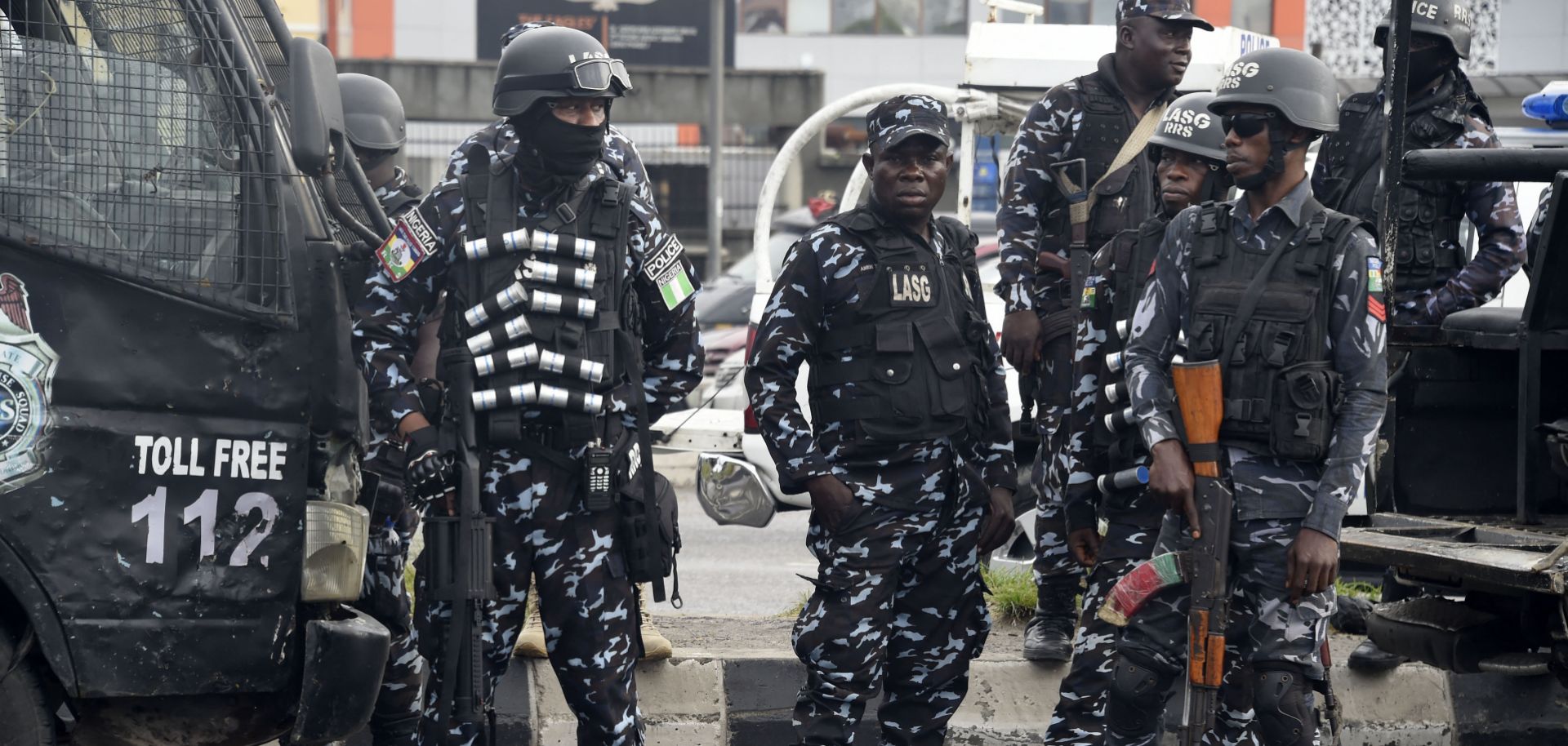
Police officers stand on a street in Lagos on Oct. 1, 2022, as supporters march to campaign for a third-party candidate running in Nigeria's 2023 presidential election.
Nigerian protesters demanding police reform commemorated the second anniversary of the Lekki massacre, underscoring the threat of police violence to political participation in the lead-up to the February 2023 general elections that will likely harm voter turnout. Police fired tear gas to disperse protesters who had gathered at the Lekki toll gate in Lagos on Oct. 20 to commemorate the second anniversary of security forces' bloody crackdown on peaceful demonstrations against police brutality, known as the #EndSARS protests. The protesters — reportedly numbering in the low hundreds — carried coffins and signs decrying state-sanctioned violence against civilians. Police officers told reporters that they were acting on a court order prohibiting anyone from gathering at the site of the October 2020 ''massacre'' (as protesters define it), during which police fired into a crowd of protesters demanding an end to police brutality and the disbandment of the Nigerian police's Special Anti-Robbery Squad (SARS), killing at least 12 and wounding many others. At the time, SARS had repeatedly been accused of extrajudicial killings, extortion and kidnapping, among other crimes.
Despite promising reforms, the government has done little to address police abuses. While the administration of Nigerian President Muhammadu Buhari disbanded SARS following the 2020 massacre, citizens and human rights groups have since reported former SARS officers in plainclothes patrolling the streets, arresting, extorting and torturing citizens. Buhari also promised to standardize the process for disciplining police officers who commit abuses and set up committees of inquiry across the country, but the government has only partially implemented these changes. This is in part likely due to the government's reluctance to constrain police powers when Nigeria faces several active insurgencies and myriad armed groups. Corruption, political expediency and resource constraints also likely account for officials' reluctance and/or inability to follow through on reforms. Politicians regularly utilize police and security forces to achieve personal ends, including intimidating or blackmailing rivals, coercing voters, vandalizing property and/or interfering in elections.
As Nigeria prepares for general elections in February 2023, police violence and clashes with demonstrators are likely to become more frequent, potentially hampering voter turnout in certain localities. Nigeria will likely experience an uptick in violent clashes between citizens and police in the next few months, given the country's long history of corruption and collusion between politicians and police, along with the increased frequency of political demonstrations ahead of elections and the lack of police reforms. Additionally, police harassment at polling stations, attempts at voter coercion and instigation of unrest at rival political gatherings also pose heightened risks, particularly in areas of the country that have high resistance to the federal government, like the southeast. While Nigerians are used to a greater risk of violence during election seasons, the threat of unrest, arbitrary arrest and/or intimidation may impact voter turnout, as in previous years targeted political violence has led polling stations in rival strongholds to close early (although these types of allegations are rarely investigated).
As voter apathy runs high, abstention from the upcoming election will only worsen public disapproval and disengagement with the central government, which will continue to fuel clientelism. The prospect of a low turnout in the election (especially among young people) means that the politicians will continue to funnel state resources to members of their shared ethnic, linguistic, religious and/or regional sub-groups to secure their votes. In the meantime, resistance to the central government among Nigerians outside of those groups will likely harden, further reducing the legitimacy of the state. In the southeast, this will likely worsen the ongoing rift between the government and the secessionist Independent People of Biafra (IPOB) movement, fueling clashes between the IPOB and state security forces.
- Nigeria ranked 154 out of 180 countries on Transparency International's 2021 Corruption Perceptions Index, which measures perceived levels of public sector corruption.
