
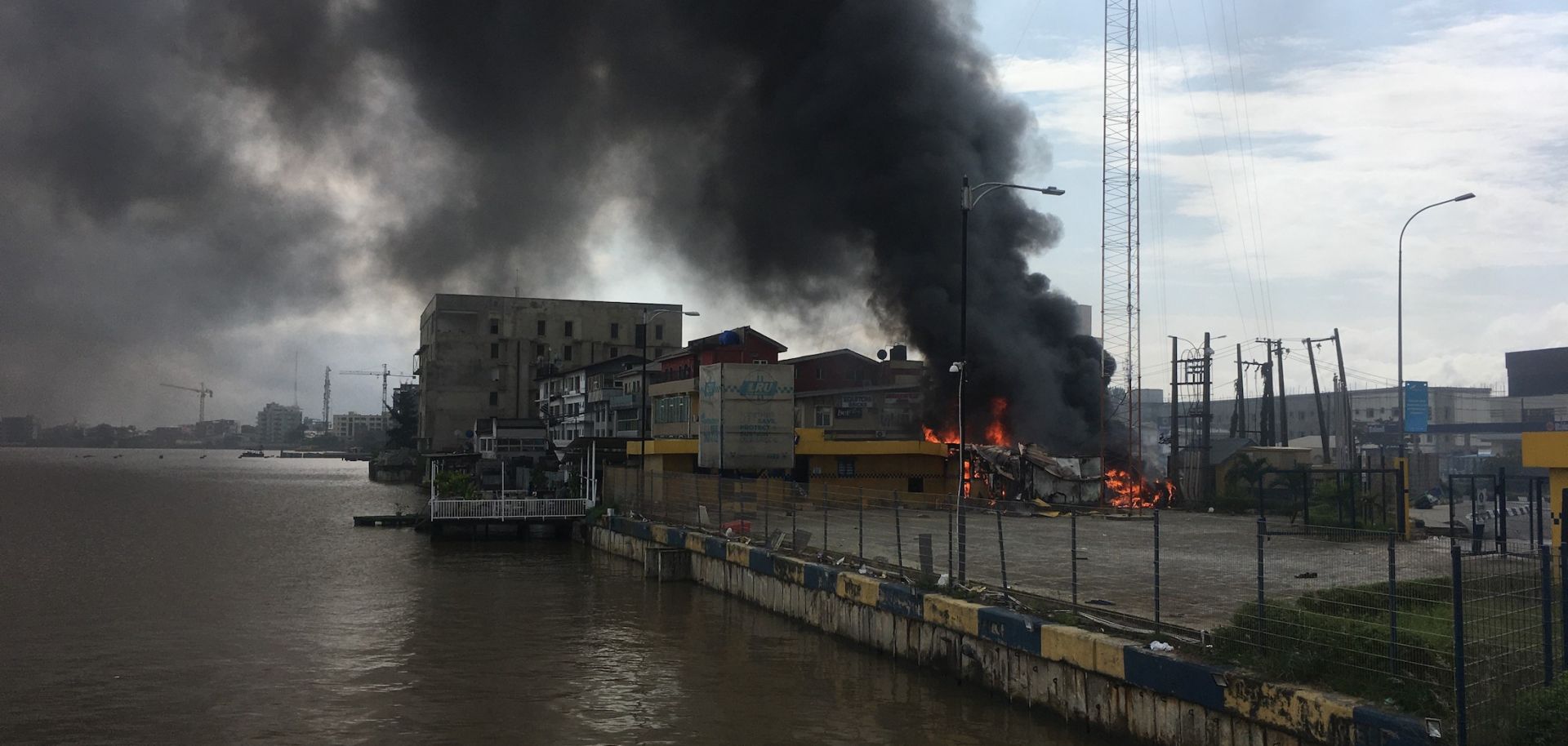
A building remains on fire in Lekki, Nigeria, on Oct. 21, 2020, after #EndSARS protests escalated into violent clashes with police the previous night.
Editor's Note: This security-focused assessment is one of many such analyses found at Stratfor Threat Lens, a unique protective intelligence product designed with corporate security leaders in mind. Threat Lens enables industry professionals and organizations to anticipate, identify, measure and mitigate emerging global threats to people, assets and intellectual property. Threat Lens is the only unified solution that analyzes and forecasts security risk from a holistic perspective, bringing all the most relevant global insights into a single, interactive threat dashboard.
Nigerian President Muhammadu Buhari and his government have few good options to contain the country’s growing protest movement without sparking broader security concerns and potentially exacerbating social tensions. More than two weeks of protests against police brutality erupted into violence on Oct. 20, when live ammunition was used against demonstrators at the Lekki toll plaza in Lagos State, killing at least one person and injuring dozens more. A viral video showing an alleged murder of a man by the police’s Special Anti-Robbery Squad (SARS) initially sparked the protests. SARS was disbanded by the government on Oct. 11 in response to initial protests, but the so-called #EndSARS movement formed amid the uproar has since expanded its focus to ending all forms of police brutality in Nigeria.
- The #EndSARS demonstrations have intensified over the last week, with protesters disrupting travel along main highways in southern Nigeria, attacking port operations and torching several police stations in the region.
- Amnesty International claims that 56 people have been killed since the protests first broke out.
- The violence has sparked widespread condemnation from opposition leaders, human rights organizations and Western governments.
- Several states and cities, including Lagos, are under curfew. The United States has also suspended consular activities in Lagos for two days.
The protest movement shows no signs of slowing and will likely continue to draw protests in the coming days and possibly weeks. On Oct. 11, the government announced it will replace SARS with a new so-called Special Weapons And Tactics unit. But protesters have already expressed fears that the new unit is essentially just a rebrand, and won’t actually change SARS’ notorious extrajudicial killings and aggressive tactics. The escalation in violent incidents has also led to more demands for justice against the police officers behind various attacks against protesters.
As the #EndSARS protest movement expands into alleged human rights violations by other elements of Nigeria’s security and military apparatus, the threat to Buhari and his allies’ political strength will increase. The Nigerian government has long struggled to address concerns over human rights abuses and the excessive use of force by the country’s police and military, and has few judicial, legislative or proposed reforms at its disposal to appease protesters’ current demands. Built-up angst over enduring security issues in the north, as well as Nigeria’s worsening economic conditions amid the global COVID-19 crisis and subsequent collapse in oil prices, has also set the stage for wider anti-government protests across larger swaths of the country that could put Buhari and the APC in even greater jeopardy.
On Oct. 22, Buhari met with intelligence, military and security officials, fueling speculation that the Nigerian government may be considering a more significant crackdown in response to the protests. Buhari did not announce such a crackdown in the national address he gave after the meeting, but there are still several factors that could result in a more aggressive government response, including:
- Larger turnout at protests: Most protests have so far been relatively small in size, numbering at most in the few hundreds and potential low thousands. The demonstrations would likely need to draw larger crowds, likely into the tens of thousands, before greater intervention is deemed necessary.
- Increase in protest violence: The vast majority of the demonstrations have so far remained peaceful, which is why the viral videos of the brutality used against protesters at the recent Lekki toll gate incident have garnered so much attention. Some protests have turned into riots and there are multiple incidents across southern Nigeria of protesters looting and burning down police stations. If such behavior becomes the norm and not the exception, we could see increased intervention.
- Increase in police violence: Compared with protest movements in other African countries, the death toll of the #EndSARS movement in Nigeria has been low. But more aggressive responses by the security forces will only embolden protesters by reinforcing their driving concerns of police brutality, increasing the risk of more violent and potentially lethal confrontations on the street.
- Broader protest demands: The litany of other grievances that various Nigerian groups have with the country’s current economic and political environment could give way to a broader, anti-government protest movement calling for significant reforms. Already in Nigeria’s southeast region, the Biafra movement has begun to join the protesters. In the north, the Coalition of Northern Groups also recently launched its own protest movement related to insecurity in the region.
- Geographic expansion: The protests have so far been heavily concentrated in southern Nigeria. A geographic expansion to the north, where the Coalition of Northern Groups recently launched its own protest movement related to insecurity in the region, would represent a more systemic challenge to Abuja.
A significant government response to the protests, however, would have major political and security ramifications for Nigeria and Buhari. The Nigerian government has long struggled to address concerns over human rights abuses and the excessive use of force by the country’s police and military, and has few judicial, legislative or proposed reforms at its disposal to appease protesters’ demands. But a harsher crackdown against the movement in the south will only reinforce many southerners' perceptions that Buhari has entrenched the country’s security sector with northerners since taking office in 2015. Southern Nigerian APC members will likely be forced to distance themselves from Buhari and the ruling party at the national level over its handling of the situation. A redeployment of military and security personnel and resources to southern Nigeria to deal with the broadening protest movement will also risk granting violent groups, including jihadists in northeastern Nigeria, more room to operate.
- The opposition People's Democratic Party (PDP) — which is the dominant party in the southern Niger Delta region – has already used the violence seen at recent protests, including the Oct. 20 Lekki incident, as examples of the APC’s inability to stabilize the situation and react aggressively.
- Buhari’s political strength is rooted in his strong security credentials and anti-corruption platform. But his administration’s struggle to contain insecurity in Nigeria’s north has significantly damaged his image in the region. Amid the ongoing protests, several northern Nigerian groups and public officials have even criticized Buhari as trying to appease demonstrators too much — arguing that for all of its shortcomings, SARS was useful in combating criminal networks and gangs in northern Nigeria.
