
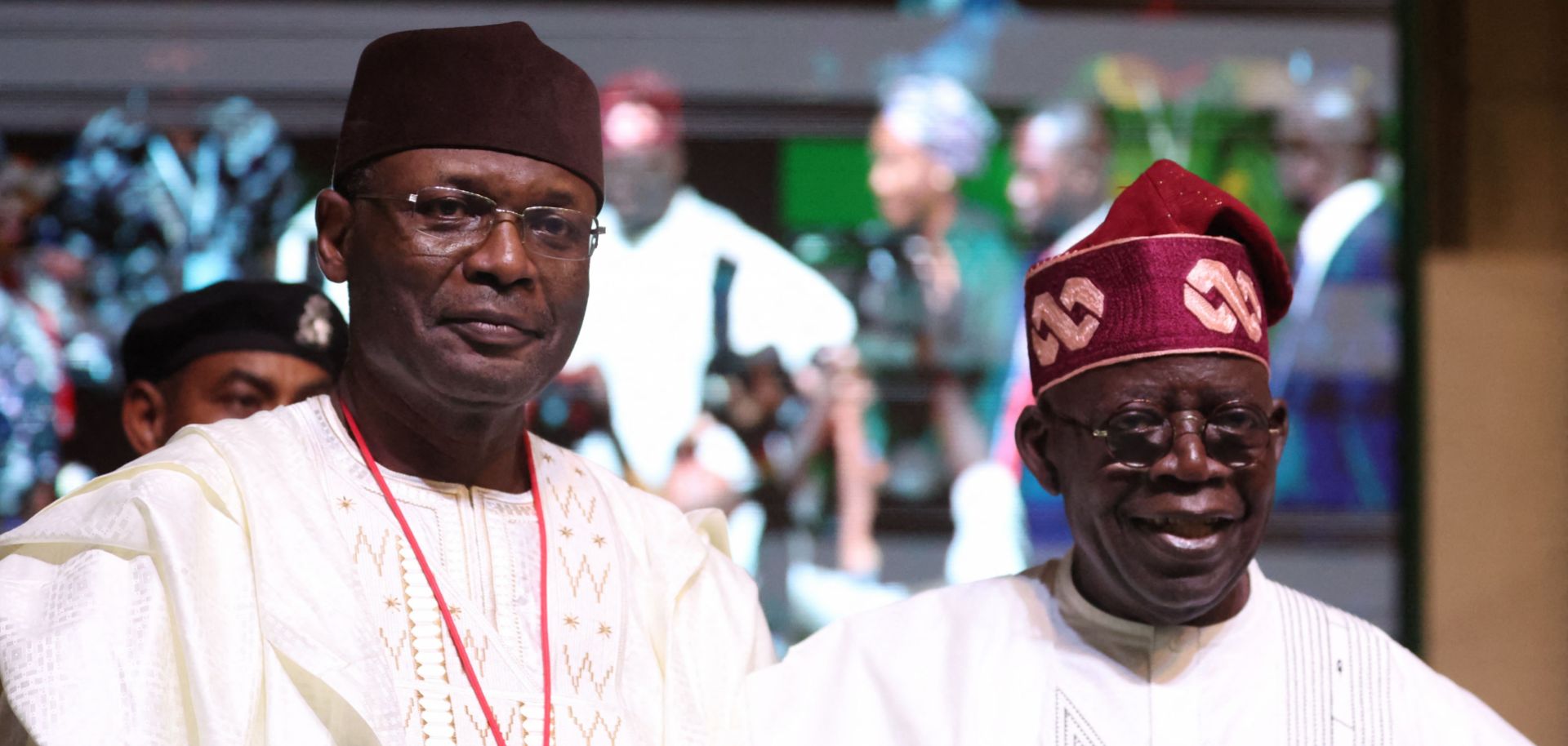
Nigerian President-elect Bola Tinubu (right) and the chairman of the country's Independent National Election Commission (INEC), Yakubu Mahmood, look on during a ceremony in Abuja on March 1, 2023.
In Nigeria, ruling party president-elect Bola Tinubu will likely face a legal challenge to his victory that will prolong the already elevated risk of electoral unrest, even though he will almost certainly still take office in May. On March 1, Nigeria's Independent National Electoral Commission (INEC) declared Tinubu of the ruling All Progressives Congress (APC) the winner of the Feb. 25 presidential election. Following the announcement, Tinubu called on his supporters to unite around him to defend the integrity of the national election, despite allegations of voting irregularities. The INEC said that Tinubu won 37% of the vote, beating out opposition candidate Atiku Abubakar and third-party candidate Peter Obi (who secured 29% and 25% of the vote, respectively).
- Abubakar ran as the main opposition candidate from the People's Democratic Party (PDP). Obi is a former PDP member who ran as an outsider candidate under the smaller Labour Party.
- Of the 87 million registered voters in Nigeria, fewer than 25 million cast a ballot in the Feb. 25 election, marking the lowest-ever turnout for a presidential race in the country's history.
Nigerian opposition parties will very likely challenge Tinubu's victory in court, citing delays in transmitting election results. On Feb. 28, the opposition PDP, Labour Party and African Democratic Congress held a press conference in Abuja to call for the cancellation of the election due to allegations of widespread rigging and manipulation of results. For the first time, Nigerians used an electronic voting system to cast their ballots in this election, which the INEC said would enable the immediate transmission of results to its viewing portal. However, voting machine malfunctions and connectivity problems reportedly delayed the transmission of results — in some cases, by several days. The PDP and Labour Party claimed that the delay granted the ruling party the opportunity to doctor the results, which the APC denies. External electoral observers like the National Human Rights Commission (NHRC) further alleged that underage voting, vote buying, voter suppression and intimidation, and destruction of ballot boxes also tainted the election. Opposition parties have until March 18 (three weeks from the date of the Feb. 25 election) to file a complaint with the Supreme Court.
- On Feb.27, the Economic Community of West African States (ECOWAS) Electoral Observation Mission to Nigeria condemned the delay resulting from violence and logistical challenges. The same day, the European Union Election Observation Mission to Nigeria also stated that a lack of transparency and operational failures hampered trust in the process and challenged Nigerians' right to vote. Finally, in its ''Preliminary Statement of the 2023 Presidential and National Assembly Elections,'' Nigeria's National Human Rights Commission (NHRC) documented incidents of both voters and electoral officials being threatened, coerced and/or intimidated by armed men in Rivers, Delta, Lagos, Kogi and Imo states.
The likely court challenge will sustain a heightened risk of unrest in the coming weeks, although the court is unlikely to overturn the election results. In the short term, opposition parties' expected court challenge and attempts to mobilize supporters against the ruling APC could spark unrest across the country. In particular, high support for Obi among younger Nigerians in the Federal Capital Territory (Abuja) and Lagos will increase the likelihood of youth protests in response to a Tinubu presidency and perceptions of electoral fraud in those areas. Protests in Nigeria's south-south and south-eastern states are also likely, given ethnic, religious and regional tensions that will be exacerbated by the election of a Muslim, ethnic Yoruba president and a Muslim vice president. This unrest could persist because the Nigerian Supreme Court is unlikely to overturn Tinubu's victory. Several Nigerian elections since the signing of the 1999 constitution have faced claims of voting irregularities, but the court has never overturned the results, which would require proving that the INEC did not follow the law and acted in ways that could have changed electoral results.
- According to Nigeria's informal power-sharing system known as ''zoning'' the presidency, the country's next president should be Christian and from the south-east zone, since outgoing President Muhammadu Buhari is Muslim and from Nigeria's north-west zone. While Tinubu is a southerner from Lagos state, he is also Muslim and ethnic Yoruba. His running mate Kashim Shettima is also Muslim, though he is from the northern Borno state.
- While this election cycle has seen less bloodshed compared with previous Nigerian ballots, the level of violence in recent weeks has still been elevated. Twitter accounts that support Tinubu and the APC have repeatedly tweeted threats against ethnic Igbos in Lagos after third-party candidate Obi (who is also ethnic Igbo) won the state. Some of these tweets have called for banning Igbo people from popular markets for ''disgracing Tinubu at the polls.'' In Lagos, police have warned against unrest and threatened to put down ''agitators.''
Tinubu's policy priorities include doing away with Nigeria's fuel subsidy, clamping down on insecurity and revamping oil and gas production. Barring an unexpected court ruling, Tinubu will take office on May 29. The president-elect has promised to end Nigeria's extremely costly fuel subsidy program, which successive presidents have failed to do because of popular resistance. In response to any attempt to remove the subsidy, Tinubu will also very likely face popular demonstrations and strikes from unions, including the two main oil workers' unions — the Petroleum and Natural Gas Senior Staff Association of Nigeria (PENGASSAN) and the Nigeria Union of Petroleum and Natural Gas Workers (NUPENG). However, acceptance among Nigeria's political elites that the policy is not financially sustainable may enable Tinubu to remove or significantly adjust the subsidy anyway. Additionally, Tinubu will likely maintain at least some elements of current President Buhari's security strategy in the Niger Delta region — which includes agreements to incorporate former militants into security roles — as he attempts to crack down on insecurity threatening oil and gas production. However, attacks against pipelines and other infrastructure will likely continue to inhibit production regardless. The future security of the Niger Delta region (and elsewhere) will also hinge on Tinubu's cabinet appointments; if representatives from the area do not receive powerful positions, the risk of violence will be greater. Tinubu has also promised to revitalize the oil and gas industry through renewed investment, although immediate economic concerns — such as the ongoing cash shortage that has stymied business activity across Nigeria — will likely take priority.
