
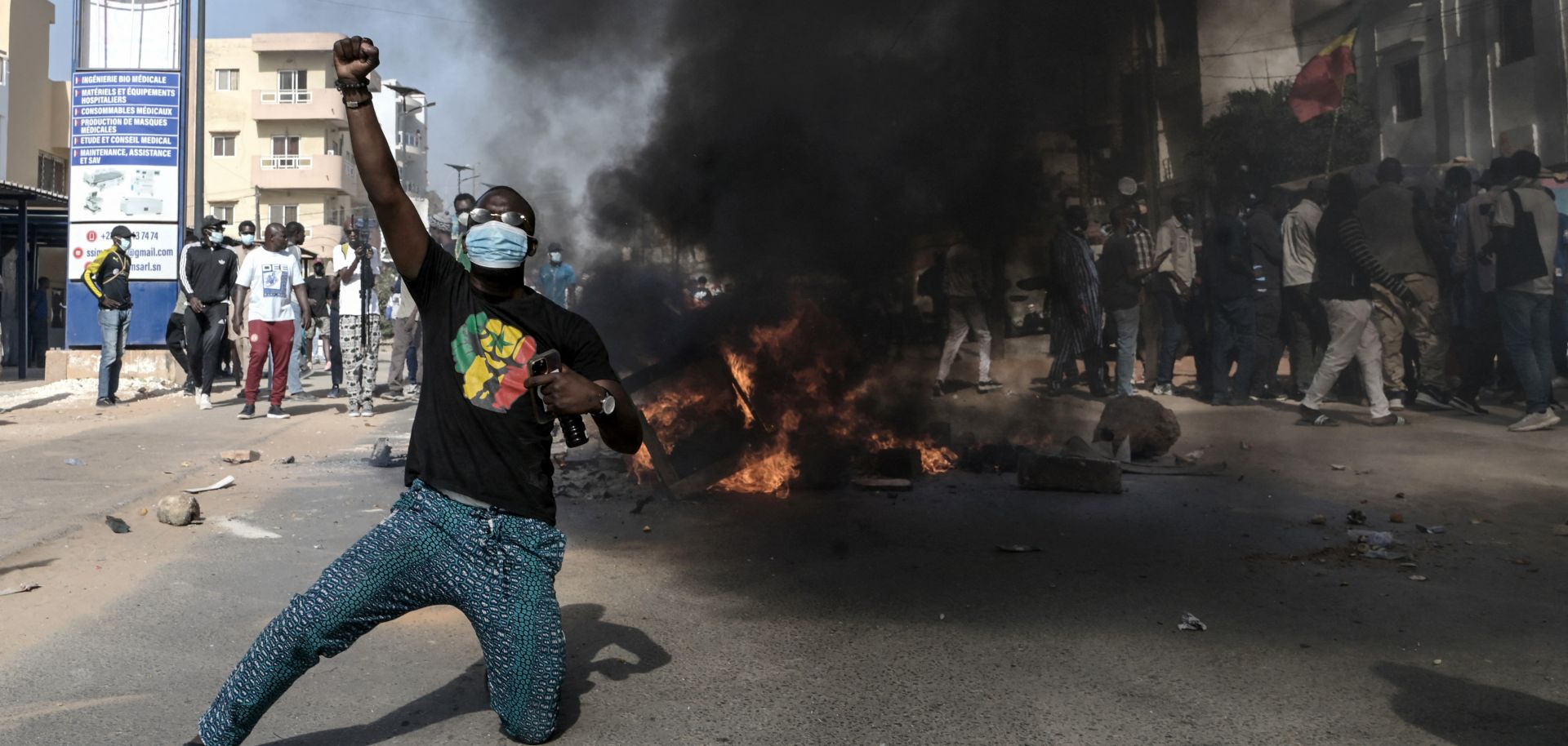
In Senegal, heightened political uncertainty and claims of ruling party electoral interference will likely trigger recurrent bouts of unrest, increasing investor hesitancy and further constraining the ability of the Economic Community of West African States (ECOWAS) to enforce regional democratic norms. The Senegalese National Assembly voted on Feb. 5 to postpone the presidential election originally scheduled for Feb. 25 until Dec. 15, and to allow President Macky Sall to remain in power until the election (despite his term technically ending on April 2). This follows weeks of speculation about potential election delays, and amid accusations from the opposition that the government was abusing its power. The announcement sparked condemnations of an ''institutional coup d'etat'' from opposition parties and violent unrest in the capital Dakar. Over a dozen opposition candidates have agreed to unite to contest the delay, with representatives saying that legal challenges and mass unrest were ''on the table.''
- Sall first announced the election would be postponed indefinitely on Feb. 3. He then revised it to a six-month postponement before the National Assembly voted to extend the delay to Dec. 15.
- In justifying the delay, Sall claimed that an ongoing dispute over the candidacy of opposition member Karim Wade between the National Assembly and the judiciary must be resolved before the vote could take place. Wade renounced his French citizenship in order to run for president, but Senegal's constitutional court ruled in January that he was still not eligible for the presidency. Wade's party then accused two of the court's judges of corruption.
- Sall's Alliance for the Republic party only holds 81 seats in the National Assembly, but 19 lawmakers from Wade's Senegalese Democratic Party (PDS) and five additional opposition lawmakers voted in favor of postponing the election, producing the necessary two-thirds majority.
- Legal experts are divided on the constitutionality of the delay: some say that the president violated the constitution and electoral code by postponing the election because only the constitutional court can delay elections and only if one of the candidates dies, while others say that the National Assembly vote makes Sall's delay constitutional.
- The government cut mobile internet the morning of Feb. 5 after several hundred protesters clashed with police over the weekend. Armored police are currently stationed around parliament and along typical protest routes. On the weekend of Sall's Feb. 3 announcement, police fired tear gas and arrested demonstrators.
The postponement comes amid widespread accusations of ruling party interference in the electoral process and allegations that Sall will use the delay to ensure the ruling party's dominance through the next election. While Senegalese politics have been contentious since the country gained independence in 1960, many civil society groups have warned of pervasive government interference and widespread irregularities by Sall's administration in recent years, fueling fears of democratic backsliding among Senegalese opposition parties and Western partners. Senegal has suffered from several bouts of unrest in recent years in response to the government's alleged interference in the July 2021 legislative elections and its use of police violence to quell unrest. Sall's government has also been accused of meddling in judicial and electoral commission decisions on the candidacies of opposition leaders like Ousmane Sonko, who in June was sentenced to two years in prison on charges of ''corrupting youth'' and barred from running in the presidential race. Sall announced on July 3 that he would not seek what much of the country saw as an unconstitutional third term, ending months of uncertainty and concern that Sall's candidacy would plunge the country into chaos. Even so, Sonko's imprisonment and disqualification, in particular, have continued to fuel allegations that Senegalese elections are neither free nor fair. Against this backdrop, several opposition parties, civil society organizations and media outlets have alleged that the dispute over Wade's candidacy is an excuse to delay the election and give Sall more time to unite his ruling APR party behind Amadou Ba, his chosen successor, before the vote is held.
- On Jan. 22, Senegal's Constitutional Council published its list of approved candidates for the presidential election. Sonko and Wade were not included on the list, while ruling party candidate Ba and 19 others were approved to run for president.
- On Jan. 31, the Senegalese National Assembly passed a resolution to create a parliamentary commission of inquiry into the electoral process, which was supported by both Sall's APR and Wade's PDS. Representatives of opposition parties, including Sonko's African Patriots of Senegal for Work, Ethics and Fraternity (PASTEF) party, said that the commission was a joke, intended to present a veneer of electoral transparency to the international community.
Senegal's political chaos will likely trigger recurring rounds of unrest and hurt Western investor confidence. It's not yet clear how the opposition's legal challenges to the electoral delay will progress, as the constitutional court usually rules on the side of the president. Barring an unexpected court order demanding the presidential election be held on Feb. 25, court challenges and appeals will likely continue for months without altering the newly adopted Dec. 15 election date. Given the scale of unrest triggered by previous electoral disputes over the last two years, thousands of Senegalese will very likely take to the streets in the coming weeks in Dakar, Ziguanchor and Theis, among other towns and cities, to answer opposition parties' calls to protest. In response to the unrest, the government will probably cut mobile internet service, ban demonstrations and deploy security forces that will use rubber bullets, tear gas and barricades to attempt to dispel protesters. In some cases, clashes between demonstrators and police will turn violent, likely leading to arrests, injuries and even deaths. Violent unrest, coupled with the unprecedented nature of the electoral delay and uncertainty over whether the presidential election will be further postponed, will very likely hurt Western investor confidence in Senegal. This could deter new investments, raising risk premiums and further sinking the value of Senegal's debt. However, creditors are unlikely to withdraw their existing investments due largely to sunk costs and expectations of financial dividends in the medium term. Senegal's economy is projected to grow by 8.8% this year due largely to new hydrocarbon projects coming online; whether investor hesitancy meaningfully harms the country's upward economic trajectory will mostly depend on whether the election is held on Dec. 15 or devolves into a protracted political crisis.
- Following Sall's Feb. 3 announcement, Senegal's dollar bonds due in 2033 fell 3.6% to 83.77 cents on the dollar and its 2037 debt declined by 4.7% to 69.84 cents on the dollar.
Meanwhile, the election delay and claims of an ''institutional coup'' will further limit ECOWAS' ability to enforce democratic norms in West Africa. The electoral delay in Senegal is another blow to the West African regional bloc, which has faced an onslaught of criticism in the last year over its inability to compel its members to adhere to the rules of democratic transfers of power. Coups across the Sahel, ECOWAS' lack of follow through on its threat to intervene following the July coup in Niger and the recent decision by Burkina Faso, Mali and Niger to leave the bloc have significantly weakened the bloc's negotiating position and ability to compel compliance. Following the Senegalese legislature's Feb. 5 decision to postpone the presidential vote, ECOWAS urged Sall to adhere to the original electoral timetable. While the bloc could still take harsher action by deploying a mission to Senegal and amping up its rhetoric against the country's ruling party, ECOWAS appears very unlikely to resort to economic or political sanctions, given its reluctance to implement such sanctions on Sahelian states following violent coups. The election delay in Senegal, one of ECOWAS' former model democracies, and the bloc's subsequent immediate inaction will only add to these challenges, potentially emboldening more West African leaders to subvert democratic processes by reinforcing the view they'll face little, if any, consequences for doing so.
