
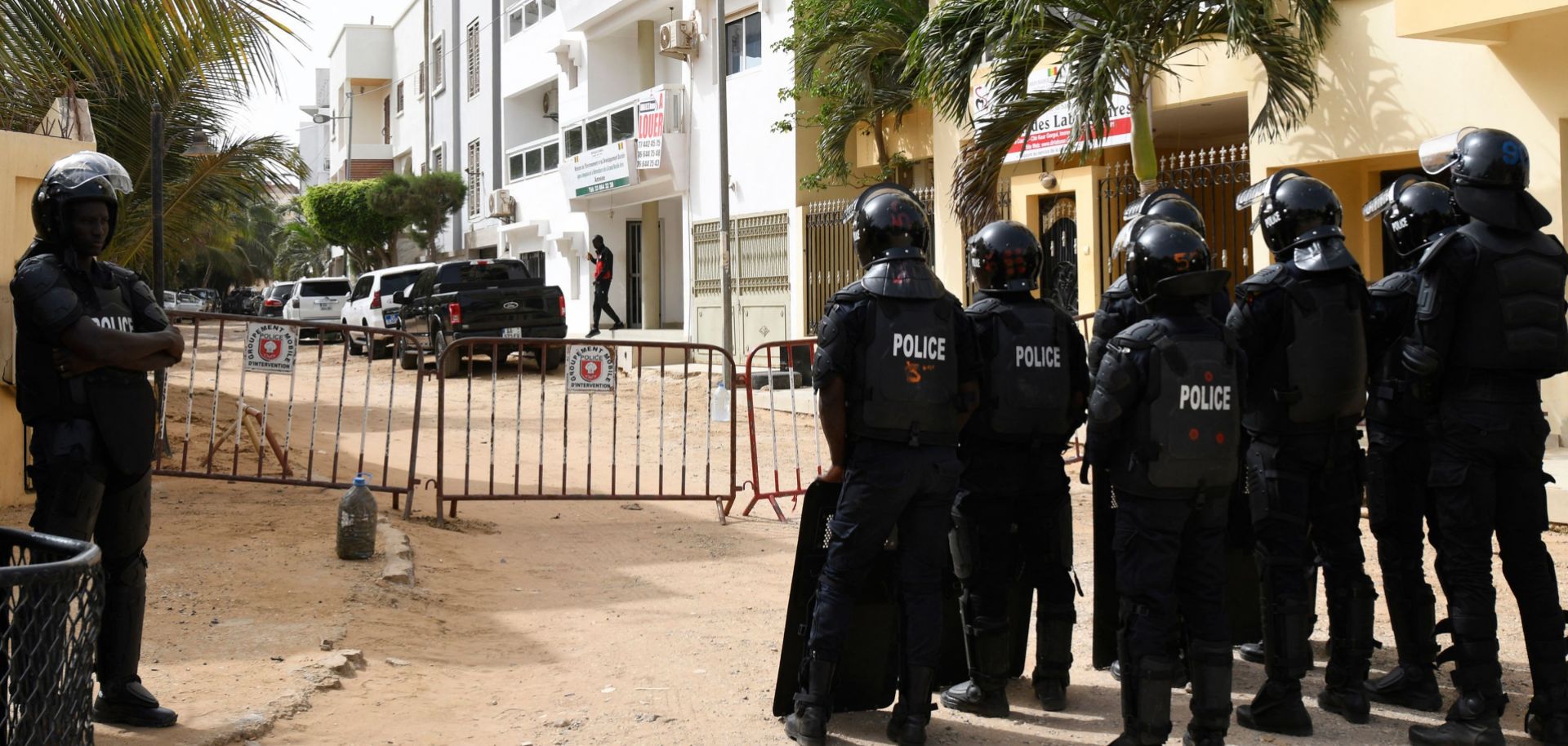
Police are seen at the entrance of the street leading to the house of Senegalese opposition leader Ousmane Sonko on June 17, 2022, in Dakar.
The Senegalese government’s decision to exclude opposition members from upcoming legislative elections will likely prompt more unrest in the short term, increasing political uncertainty and the risk of economic crisis. Violence between protesters and police broke out across the country on June 17 after opposition leaders called for demonstrations against the government’s decision to bar a list of candidates for Senegal’s legislative elections on July 31. Law enforcement blocked access to the home of Ousmane Sonko, the country’s main opposition leader, preventing him from leaving his house in Dakar to join the protests. Police also arrested opposition party ministers Dethie Fall and Mame Diarra Fam, as well as Ahmed Aidara, the mayor of Guediawaye, a sub-region of Dakar. Three people were killed in the violence, including a taxi driver who was shot and killed in Ziguinchor, Casamance, located in southern Senegal. Sonko then issued an ultimatum to President Macky Sall, demanding that the president release political prisoners or risk facing more violence as Sonko and his political allies attempt to free them extrajudicially.
- The results of the July 31 legislative elections will determine the makeup of Senegal’s 165-member National Assembly, which is currently dominated by Sall’s Alliance for the Republic.
- On June 3, Senegal’s constitutional council banned a list of opposition candidates from running in the July 31 legislative elections, including party leader Sonko.
Opposition leaders decry what they say are President Sall and his allies’ attempts to consolidate power, potentially aimed at securing an unconstitutional third term. Despite Senegal’s relatively strong democratic traditions, banning political opponents is a recently recurring tactic in Senegalese elections. In 2019, Sall’s government barred Khalifa Sall, the former mayor of Dakar, and Karim Wade, son of former president Abdoulaye Wade, from running because of previous corruption convictions, which both politicians say were politically motivated. In May 2019, the parliament (dominated by Sall’s Alliance for the Republic) approved a bill to abolish the position of prime minister, which Sall’s critics condemned as a blatant power grab. Additionally, various charges and court proceedings against Sonko and other opposition leaders have been leaked to the press in recent years, revealing shaky legal rationale and potential collusion between the executive and judiciary. Political opponents like Sonko and wide swaths of the Senegalese electorate say that these measures are intended to concentrate Sall’s power so that he and his allies may wield the necessary legislative power to alter the constitution ahead of the 2024 election to permit a third term. While Sall said early in his first term that he would leave office when his term expired, he has abstained from commenting on term limits or his political future in recent years, adding some credence to the opposition’s accusations.
- In the 2019 presidential election, Sonko ran against Sall, winning only 16% of the vote compared to Sall’s 58%. Following this election, Freedom House downgraded Senegal from “free” to “partially free,” citing the exclusion of two major opposition figures.
- Police arrested Sonko in March 2021, charging him with disrupting public order. Sonko was on his way to court to stand for rape charges at the time of arrest, which he and his supporters say is politically motivated. After his release from jail (the opposition leader remains under judicial supervision), Sonko launched the opposition coalition Yewwi Askan Wi, or Free the People in Wolof, in September 2021 to contest municipal and departmental councils. Sonko was elected mayor of Ziguinchor in the southern Casamance region in January 2022.
- In June 2021, the National Assembly passed two counterterrorism laws that can be used to target civil society leaders and expand police surveillance power by criminalizing political speech and peaceful protest as “acts of terror.”
If opposition candidates remain excluded from elections, unrest is very likely to continue leading up to and potentially after the July 31 elections, which will, in turn, increase political uncertainty and the risk of economic crisis. Senegal’s relatively strong democratic traditions will likely empower opposition leaders’ calls for demonstrations and free and open elections. Following the protests on June 17, Sonko said that unless he and his colleagues are permitted to stand for election, his opposition Yewwi Askan Wi coalition will disrupt and prevent the polls from taking place. Given the mobilization of thousands of protesters on June 16-17, even if Sonko and other leaders are arrested or blocked from leaving their homes, the threat to disrupt elections is credible. In the medium-to-long term, continued political exclusion and/or repression will threaten Senegal’s position as one of West Africa’s most stable democracies. Additionally, the exclusion of opposition candidates from the upcoming elections would support suspicions that Sall will seek a third term, creating uncertainty over the future of Senegal’s political system as Yewwi Askan Wi has said it would stop this from happening using any means necessary. Uncertainty over whether Sall will seek a constitutionally forbidden third term — which would all but certainly cause widespread unrest — will likely harm the country’s role as a regional mediator and leader. The country also faces a worsening economic position as global food and fuel prices rise, inflation increases, purchasing power decreases, and the Senegalese franc depreciates. Widespread unrest and/or political paralysis brought on by uncertainty could exacerbate these challenges by leading to disruptions to business activity, as well as complicating Senegal’s greater economic recovery from COVID-19.
- Following Sonko’s arrest in March 2021, violent unrest erupted in several cities, killing 14 demonstrators and causing millions of dollars in damage as protesters burned and looted shops and private property. According to Amnesty International, defense and security forces shot 12 of those who were killed.
- Across West Africa, food and fuel shortages and economic challenges inflamed by the war in Ukraine are exacerbating political grievances. Prior to the war, Senegal imported 66% of its wheat from Russia and Ukraine, and supply shortages are driving food insecurity, poverty and price hikes that will aggravate political grievances over the next year and potentially longer.
