
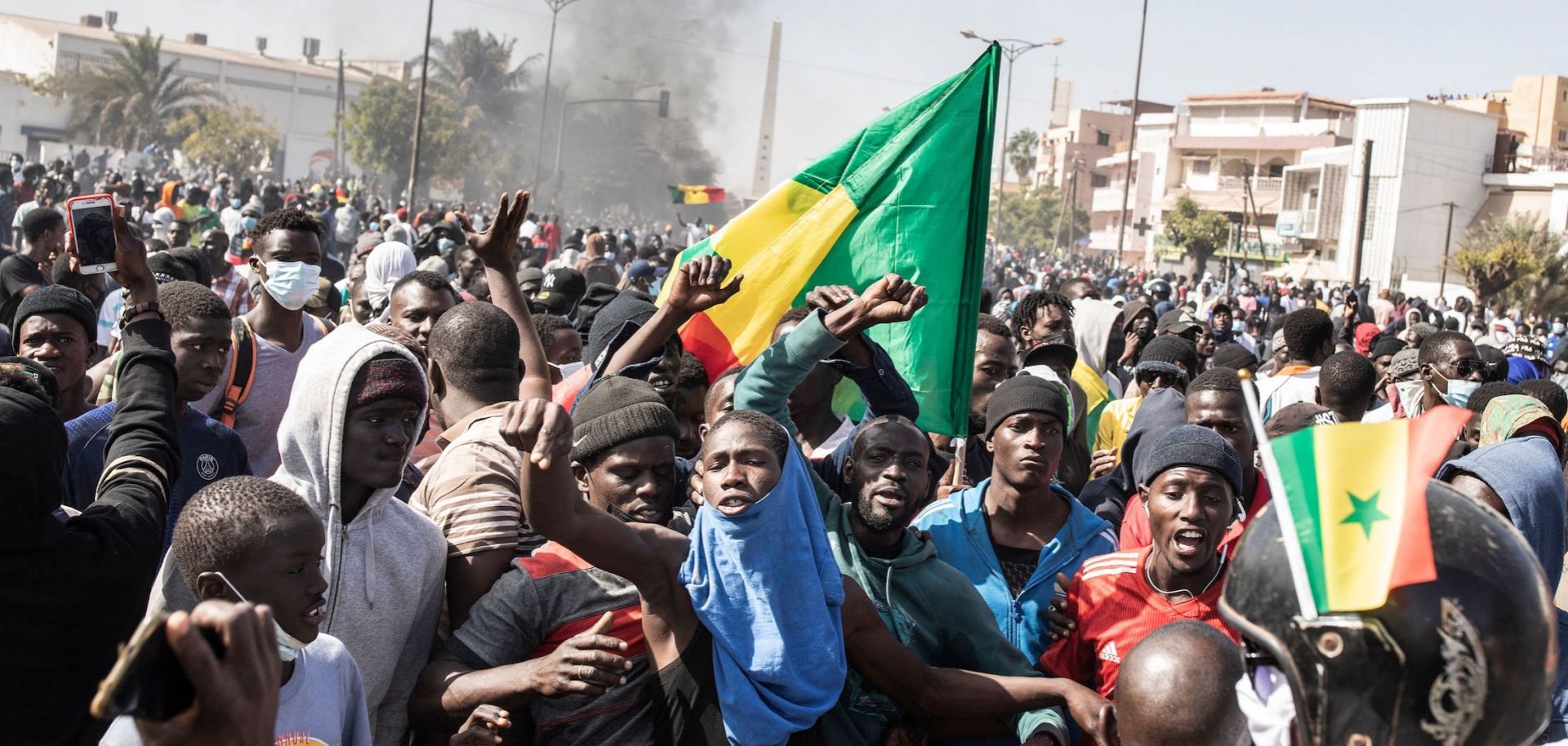
Protesters gather in the Senegalese capital of Dakar on March 8, 2021, after the country's opposition leader was indicted on rape charges.
The arrest of Senegalese President Macky Sall’s opposition rival has placed his government in the hot seat by galvanizing not only support for the opposition’s pro-democracy agenda, but simmering public anger over the country’s ongoing economic slowdown. Senegal has been engulfed in a surge of anti-government protests following the March 3 arrest of charismatic opposition leader Ousmane Sonko, who was formally indicted on March 8. Sonko faces rape charges, which he and his supporters view as baseless and a politically motivated attempt by President Sall and his ruling Alliance for the Republic (APR) party to remove potential opponents ahead of the country’s upcoming elections. Although it’s unclear whether Sall will pursue a third term, or whether it would even be constitutional to do so, Sall and Sonko (or their political allies) will likely run against each other in the 2024 presidential election.
- Following Sanko’s arrest, anti-government protests and violent riots broke out across Senegal, including in the capital of Dakar, as well as the restive southern region of Casamance. 11 people have been killed in clashes between demonstrators and security forces since March 3.
- In response to the violence, the opposition Movement for the Defense of Democracy (M2D) coalition, formed last week after Sonko’s arrest, called off mid-week protests and asked supporters to instead participate in two days of planned civil disobedience and demonstrations on March 12 and 13.
- The M2D group has already demanded the immediate release of political prisoners and says it will be publishing a list with more demands soon.
The opposition will use Senegalse’s intense reaction to Sonko’s arrest as leverage to fuel their ongoing political battles with Sall’s government over executive power and the country’s rule of law. The political opposition has grown increasingly concerned in recent years about perceived efforts by Sall’s ruling APR party and associated institutions to sideline opposition leaders, as well as silence the press and civil society organizations. And Sonko’s arrest has only exacerbated these fears, given that a conviction could exclude him from running in the 2024 presidential election, where he is expected to be a primary opposition candidate. In recent days, the new M2D coalition has united many of these prominent opposition parties in the country under the banner of protecting Senegal’s unique “democracy and rule of law,” as it seeks to capture public anger to grow the movement’s reach.
- In addition to being a vocal critic of President Sall, Sonko has also built a reputation as an anti-corruption crusader that has made him popular with Senegalese youth.
- With democratic elections and a diverse spectrum of powerful opposition parties and civil society groups, Senegal is touted as one of the most politically stable countries in Africa. This was on full display in 2012, when opposition parties came together to successfully halt their own political ally, Abdoulaye Wade, from running for a controversial third term in office for fear that it reflected his disregard for constitutional term limits.
The fresh wave of anti-government sentiment has also galvanized Senegalese’s existing grievances over the country’s pandemic-induced financial woes. These grievances will likely continue to propel the current unrest until Senegal's economy stabilizes and grows again, which could be many months. In the decade leading up to the onset of the COVID-19 pandemic in early 2020, Senegal’s economic growth was among the highest in Africa, averaging 6% annually. But pandemic-related slowdowns in Senegal’s primary economic sectors, including agriculture and services, have since firmly pushed Senegal into economic contraction, exacerbating existing unemployment and poverty risks while aggravating anti-government anger.
- The market researchers at Fitch Solutions recently highlighted social instability as one of the major factors that risk hampering economic growth in Senegal in 2021.
- Roughly 46% of Senegal’s population currently lives at or below the poverty line. Youth unemployment also stood at 8.6% in 2020.
President Sall will likely issue quick reforms to ensure his hold on power amid the recent protests and ongoing economic crisis, though it’s unclear whether such measures would be enough to satisfy Senegalese demonstrators. In response to the recent surge of protests, Sall promised a continuation of his landmark national dialogue process, as well as new economic stimulus measures. Political scrutiny on Sall, however, will intensify in the lead-up to legislative elections slated for 2022, followed by the 2024 presidential election, which could manifest in louder calls for the president to resign. Riots this week also targeted French-owned businesses, a signal that Sall is increasingly believed to cooperate too closely with France and that his political reputation is becoming tainted with colonial overtones.
Although Senegal has evaded most of the militancy issues plaguing many of its Sahelian neighbors, a prolonged protest movement could aggravate the country’s relative stability. In halting protests mid-week, the political opposition showed its ability to not only mobilize but influence the actions of its supporters. However, it also reflected a deep awareness of the risk of igniting a caustic security situation that the movement cannot control. Indeed, although M2D is united by the belief that Sall “no longer has the moral dignity to lead Senegal,” the group has also sought to find a balance between the “fight to preserve democratic gains” and the “focus on material losses and insecurity.” Even Sonko himself has urged calm in the restive regions of Senegal, including Casamance, where a secessionist movement has birthed most of Senegal’s minor issues with militancy.
