
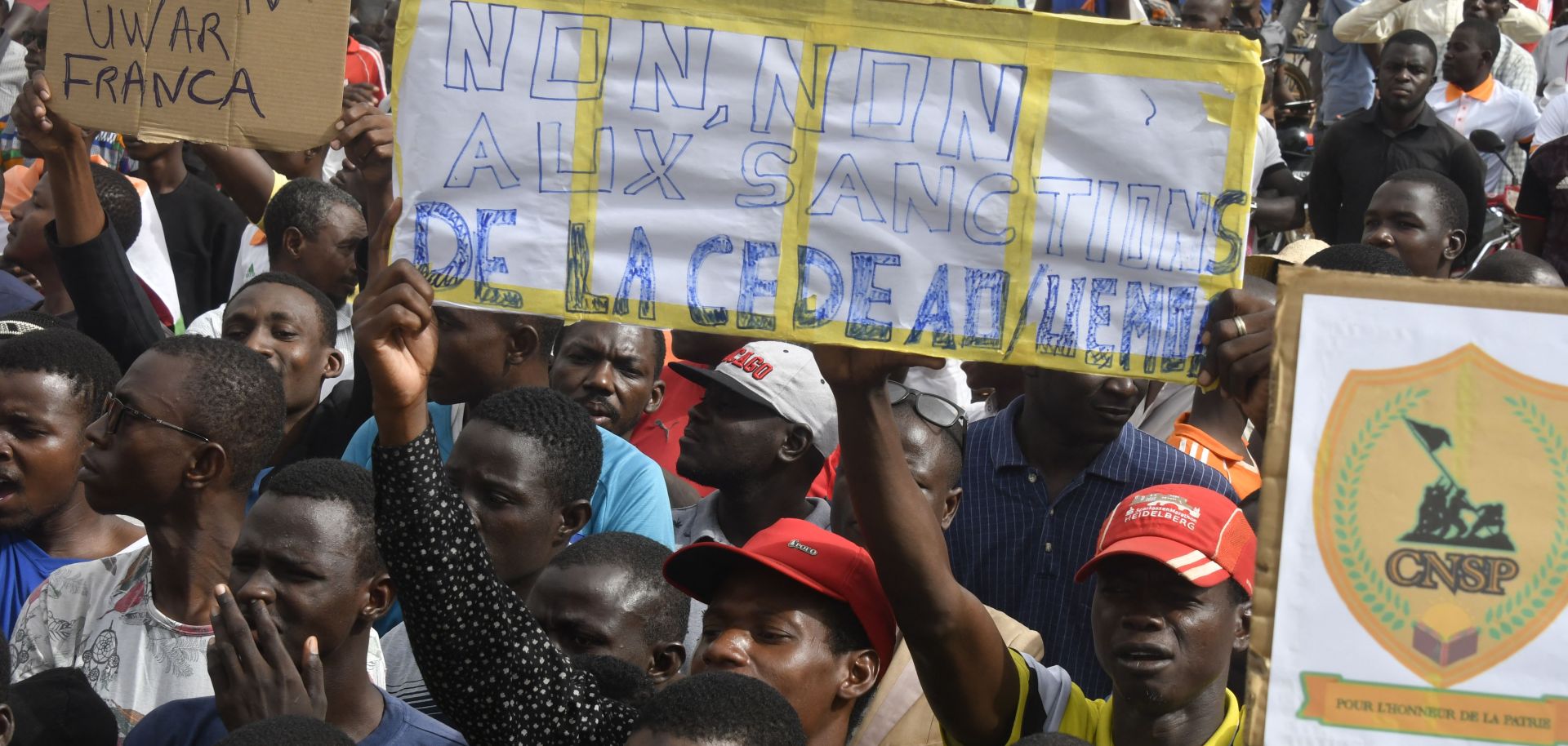
While an ECOWAS intervention would probably topple the Nigerien junta eventually, an intervention risks swelling into a regional conflict, giving jihadist groups more space to operate and making any restored Nigerien civilian government extremely fragile. On Aug. 10, the Economic Community of West African States (ECOWAS) activated its standby force to "restore the constitutional order" in Niger, but said it will continue to pursue peaceful diplomatic measures. While Nigeria, Senegal and Togo have all previously committed troops to the mission, the deployment size, mandate and timeline are unclear. France and the United States have said that they will support an ECOWAS mission to reinstate overthrown President Mohamed Bazoum, bolstering the financial, tactical and equipment capabilities of a possible intervention. Meanwhile, the Nigerien junta has threatened to kill Bazoum if ECOWAS attempts an intervention, which — beyond the obvious succession question — could trigger a larger crisis if Bazoum's supporters rise up against the junta in widespread unrest.
- Ahead of the ECOWAS announcement, Burkina Faso's and Mali's military governments said they would view an intervention as an act of war, and would stand with Niger against external forces.
- The immediate mobilization of standby forces will not result in an immediate intervention, because the African Union must first approve the deployment. (The AU unofficially called for an intervention to reinstate Bazoum on Aug. 11.) The U.N. Security Council may also be required to give the greenlight, although this raises the possibility that a Russian and/or Chinese abstention could delay or prevent an intervention. Furthermore, the logistics of a military intervention will likely take weeks to organize, which ECOWAS may be hoping is enough time to reach a negotiated settlement with Niger's junta. For example, the 2017 ECOWAS intervention in Gambia took about seven weeks to deploy after President Adama Barrow requested the regional bloc's assistance.
- Cote d'Ivoire has reportedly agreed to send 850 to 1,100 troops that will prepare to deploy as soon as possible, but the total size of the intervention and the size of the Beninese, Nigerian and/or Senegalese contingents are unknown. Given that it has the strongest military in the bloc and its proximity to Niamey, Nigeria is likely to comprise the backbone of any intervention.
Thus far, ECOWAS military leaders have not publicized how an intervention would be carried out, but it would almost certainly require a complex invasion from Nigeria at least partially facilitated by France and/or the United States. ECOWAS does not have the military capacity to launch a surgical intervention focusing on Niamey through an airlift due to logistical and training limitations. Instead, any intervention would need to come across Niger's borders with Nigeria, Benin or both, and travel (potentially through hostile terrain) up a handful of highways to Niamey. Depending on the route, the journey could range from about 300 to 500 kilometers (about 185 to 310 miles), but there are few highways in southwestern Niger. This means that if the Nigerien military can stay unified and seeks to withstand the intervention with force, it could have a large security presence along any route that is used. This could force or require ECOWAS — or even France — to use its air superiority to weaken resistance to the intervention. Even if ECOWAS were to carry out a land invasion of Niger via Nigeria or Benin, the massing of the troops, equipment and machinery near the Nigerien border would likely require U.S. or French logistical support. The pace of any intervention and its success also depends on three more key variables:
French and U.S. support. France and the United States have about 1,500 and 1,100 military personnel in Niger, respectively. Direct French support for the military intervention via its troops in Niger would improve the prospects of the intervention and increase the likelihood of a quick intervention to remove the junta, but faces significant political constraints, as French President Emmanuel Macron is loath to embark on another hostile intervention in West Africa. In addition, ECOWAS seems intent on making sure that this intervention is African-led and -financed and minimizes Western support, as it does not want to be portrayed as a puppet of the West given that anti-French sentiment remains an issue in most of West Africa. The United States is highly unlikely to get directly involved for similar reasons.
Potential Wagner deployment and willingness to fight. As ECOWAS countries prepare for a military intervention, Niger is hoping to get Russian Wagner Group paramilitary forces to deploy to Niger. While this could strengthen the junta to a degree, in other theaters — namely Mali and Libya — Wagner troops have not always engaged directly against other country's forces. It is unclear if any Wagner troop deployment would be willing to engage directly against ECOWAS forces in an intervention, especially as Russian President Vladimir Putin has been trying to woo African leaders to prevent them from aligning with the United States and Europe against Russia over the Ukraine conflict.
Potential divisions in the Nigerien military. The odds of a quick and successful intervention would also increase if there were defections and splits within the Nigerien military, leading some forces to decline to engage with ECOWAS forces. The Nigerien military was not initially on board with the coup against Bazoum, with the military leadership initially giving the coup leaders an ultimatum to reinstall Bazoum. Ultimately, the military sided with the coup leaders specifically, saying they did so to avoid bloodshed. It is entirely possible that a large portion of the military could cite the same reasoning with respect to an intervention. According to intense speculation, the national guard could be a source of defections, as the junta has been quick to try to overhaul its leadership.
An ECOWAS intervention would prove particularly effective if it received support from some factions of the Nigerien military. While an intervention remains unlikely, factions of the military that remain loyal to Bazoum (or that have determined in the interim that supporting Bazoum is more politically expedient than loyalty to the junta) could facilitate an ECOWAS intervention, enabling intervening forces to quickly overwhelm the junta and its remaining supporters. While this scenario could still involve some clashes among ECOWAS forces, Bazoum supporters, junta loyalists and civilians who support Bazoum's overthrow, violence would be limited and short-lived given the presumed strength of the ECOWAS alliance with some factions of the military. This type of intervention would mean that U.S. and French troops would stay in Niger to bolster the democratic government's military capacity against jihadist groups. But it also runs the medium-term risk of exposing Niger's civilian leader (whether Bazoum or someone else) to future coups by members of the military critical of U.S. and French support. There is recent precedent for this: Both Burkinabe and Malian coup leaders catalyzed resistance to French intervention into support for their respective military putsches.
- Former Nigerien Minister of State Rhissa Ag Boula formed the Council of Resistance for the Republic on Aug. 8 with the aim of reinstating Bazoum. Boula has political ties across the Sahel and has the support of many ethnic Tuaregs given his role as a former Tuareg rebel leader. The Council of Resistance for the Republic could also throw its weight behind an ECOWAS intervention, which would further improve its likelihood of a quick and relatively painless transition.
If, on the contrary, the Nigerien military remains united, a drawn-out conflict would be a boon for the region's jihadist groups and also risk a broader conflict with Mali and Burkina Faso. Should the Nigerien military remain united against ECOWAS, the fight around Niamey could quickly be bogged down, which would expose ECOWAS' supply chains and the logistical challenges needed to support a foray deep into Niger. While French and American logistical support could help mitigate some of these challenges, ECOWAS may still struggle to project force throughout Niger and may find itself only controlling specific tactical sites that have strategic or political importance, thereby creating the conditions for a long-term conflict for which ECOWAS may not be militarily or politically prepared. A drawn-out conflict would only increase the number of Nigerien and regional forces and the amount of time that they are pulled away from counterterrorism missions, enabling groups like Jamaat Nusrat al-Islam wal-Muslimin and the Islamic State Sahel to take advantage of increased space to operate. If the Nigerien junta looks like it may be able to withstand the military intervention, Mali and Burkina Faso may even be compelled to send forces or military aid to support the Nigerien junta, which would add to the space that jihadist groups have to operate and increase the risk of the conflict spiraling into a regional war. But perhaps most challenging of all, even if ECOWAS succeeds in a longer conflict, the subsequent Nigerien government — especially if it is under Bazoum — would be extremely weak, fragile and potentially coup-prone, which may force ECOWAS to deploy a peacekeeping mission in the country for a lengthy period in an effort to prevent another government collapse.
- A lengthy conflict would also involve more casualties, which would likely make the intervention even more unpopular in West African countries contributing troops to the mission. In places like Senegal, this could lead to violent protests. In places like Nigeria, it could undermine new President Bola Tinubu's efforts to unify the country amid rising discontent over the country's cost-of-living crisis and his removal of fuel subsidies.
- Although Burkina Faso and Mali face significant logistical and security challenges that would prevent them from sending significant military support to Niger to help defend against the intervention, Burkina Faso could aim to carry out border incursions in countries like Cote d'Ivoire to demonstrate consequences for participating in the intervention.
