
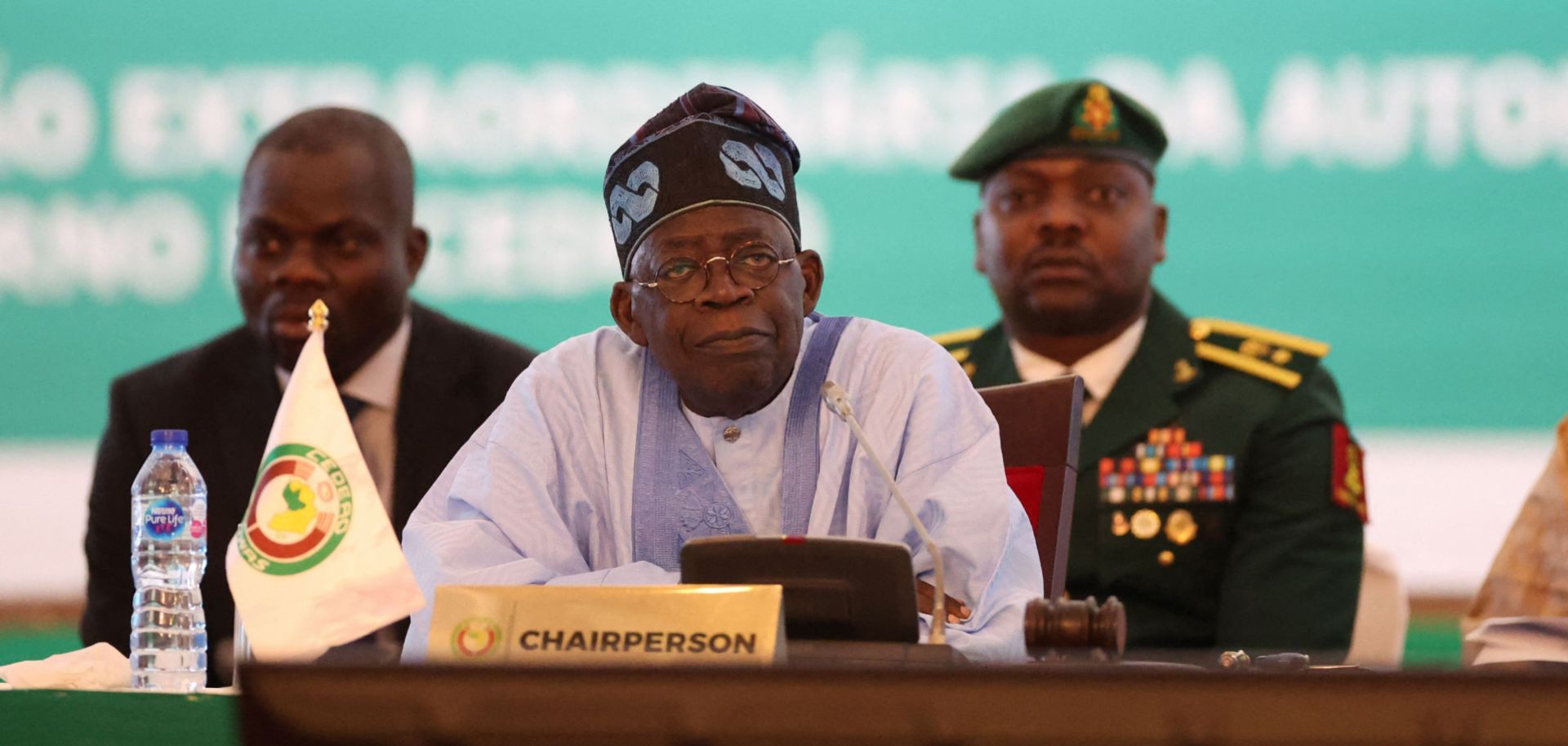
Despite its desire to set a precedent against coup leaders, the Economic Community of West African States (ECOWAS) will likely struggle to follow through on its threat to forcefully remove Niger's new military government due to political and logistical constraints. Top ECOWAS defense officials will reportedly meet this week to discuss a potential military intervention in Niger after a group of soldiers calling themselves the National Council for the Protection of the Homeland (CNSP) seized the country's government on July 26 — marking the latest in a string of West African coups. During an emergency ECOWAS meeting on July 30, the 15-nation African bloc announced that it would give the coup leaders in Niger one week to cede power and reinstate the country's democratically elected president before it took ''all measures necessary to restore constitutional order in the Republic of Niger,'' including the potential use of force. In response to the recent military takeover in Niger, ECOWAS and the West African Economic and Monetary Union also imposed sanctions with immediate effect, including border closures and bans on commercial flights, as well as freezes on financial transactions, national assets and aid flows. France and the European Union have suspended security cooperation with and financial aid to Niger as well, while the United States has offered support to deposed President Mohamed Bazoum, who has been held in military custody since the July 26 coup.
- On July 28, the CNSP installed the commander of Niger's presidential guard, Abdourahamane Tchiani, as head of state. Tchiani also led the group that detained Bazoum in the presidential residence on July 26, when it was unclear whether the military would support the presidential guard's bid for power.
- On July 31, the CNSP arrested Mahamane Sani Mahamadou — the country's oil minister and the son of Niger's former president Mahamadou Issoufou — who had spoken out in recent days in support of Bazoum. Former oil minister and president of Bazoum's Nigerien Party for Democracy and Socialism, Ousseini Hadizatou, was also arrested on July 31 — potentially suggesting an attempt by the military to consolidate bargaining power ahead of negotiations with ECOWAS.
The coup in Niger is testing ECOWAS' efforts to dissuade military coups in the region through threats of intervention. ECOWAS member states have experienced six coups since 2020 — two in Mali, two in Burkina Faso, and one each in Guinea and Chad. In response to this wave of political instability, ECOWAS leaders agreed in 2022 to set up a regional security force to respond to jihadist threats and prevent military coups. Nigerian President Bola Tinubu, who was elected as chairman of ECOWAS on July 9, has since pledged to further toughen the bloc's stance against military coups and enhance its deterrence mechanisms against would-be coup leaders. Niger's recent coup will thus be the first test of this new doctrine set out by ECOWAS' more hawkish members, led by Nigeria, who are likely seeking to make an example of Niger by demonstrating the bloc's willingness to intervene with force. This position is supported by Western governments like France and the United States that have relied on Niger (specifically the Bazoum administration) as a strategic partner in their efforts to combat terrorist activity and Russia's growing influence in the region. Finally, considerable domestic support for Bazoum and resistance to the coup — both among Nigerien citizens and potentially certain factions of the military — will likely further support the argument for an ECOWAS intervention. While the Nigerien Armed Forces sided with the presidential guard in the days after it declared the coup, the degree to which the army is unified behind the new junta is unclear. This means factions of the country's military could still support Bazoum, which would facilitate an ECOWAS intervention — not only by reducing the number of external troops needed to forcefully oust the junta, but also by mitigating the risk of popular resistance to an external encroachment on Niger's sovereignty. Concurrently, it is possible that ECOWAS is attempting to use the threat of a military intervention to compel support within the military for Bazoum and his reinstatement.
- About 1,000 to 1,500 French troops are stationed in the capital Niamey and assist the Nigerien Armed Forces with training, equipment support and counterterrorism missions. The United States has about 1,100 troops in Niger, where the U.S. military operates out of two bases. In March, the State Department said the U.S. government provided Niger with about $101 million in bilateral assistance (in addition to $150 million in new regional assistance) in the 2022 fiscal year. Over the past year, both France and the United States have ramped up their counterterrorism support to Niger following the withdrawal of French troops in neighboring Burkina Faso and Mali.
- Demonstrations in support of both the new military junta and Bazoum have broken out in the capital Niamey in recent days, leading to some clashes but so far no reported deaths.
- ECOWAS member states with relatively strong democratic institutions and transfers of power through mostly free and fair elections, like Ghana and Senegal, will likely support Nigeria's push for a harsher response to military coups.
But ECOWAS' limited security capabilities and potential dissent among member states may ultimately prevent the bloc from following through on its threat to launch a military intervention in Niger. Although ECOWAS agreed to establish a regional security force last year, the details and funding of the force have not yet been determined, as the regional chiefs of security were scheduled to meet to discuss the force in late 2023. As such, it's not clear what an ECOWAS military intervention in Niger would look like, including which countries would supply the funding and manpower. Nigeria has the largest military within the bloc, but myriad domestic security threats — including rampant banditry, expanding jihadism and the latent threat of unrest — may still make President Tinubu hesitant to commit troops. Alternatively, a Telegram channel aligned with Russia's paramilitary Wagner Group alleged that a meeting took place overnight on July 31 during which ECOWAS representatives agreed that a military intervention in Niger would originate from Chad, where France has strong ties to transitional President Mahamat Idriss Deby. Further, while France and the United States would likely be willing to help with funding, training, equipment and/or operational and logistics support, neither country is likely to provide leadership for such an intervention, given elevated anti-French sentiment across the region and the high likelihood that such involvement would lead to greater support for Niger's coup leaders. Finally, an ECOWAS military intervention requires unanimous support from member states. Burkina Faso, Guinea and Mali are all currently led by military juntas and would be most likely to reject such a proposal. But all three of these countries are also currently suspended from the bloc and are thus unable to prevent the passage of the measure. However, other West African states that have their own propensities for non-democratic transfers of power — including Benin, Ivory Coast and Togo — may be hesitant to back the measure as well, for fear of setting a precedent for regional military intervention in the event of a coup. Furthermore, French support for an ECOWAS intervention in Niger could actually make West African leaders more wary of supporting the measure, due to concern of reprisals at home for furthering French aims in the region. Given these numerous constraints, an ECOWAS intervention is possible but certainly not guaranteed, meaning Niger's leadership could remain in a state of flux as ECOWAS determines its next move.
- On July 28, Niger's junta leader Tchiani accused France of preparing to intervene militarily to free and reinstate Bazoum. France's foreign ministry did not confirm or deny the accusation, though President Emmanuel Macron pledged to respond ''immediately'' to any violence against French interests in Niger. Pro-coup demonstrators attacked the French embassy in Niamey on July 30 and were reportedly dispersed by security forces using tear gas.
