
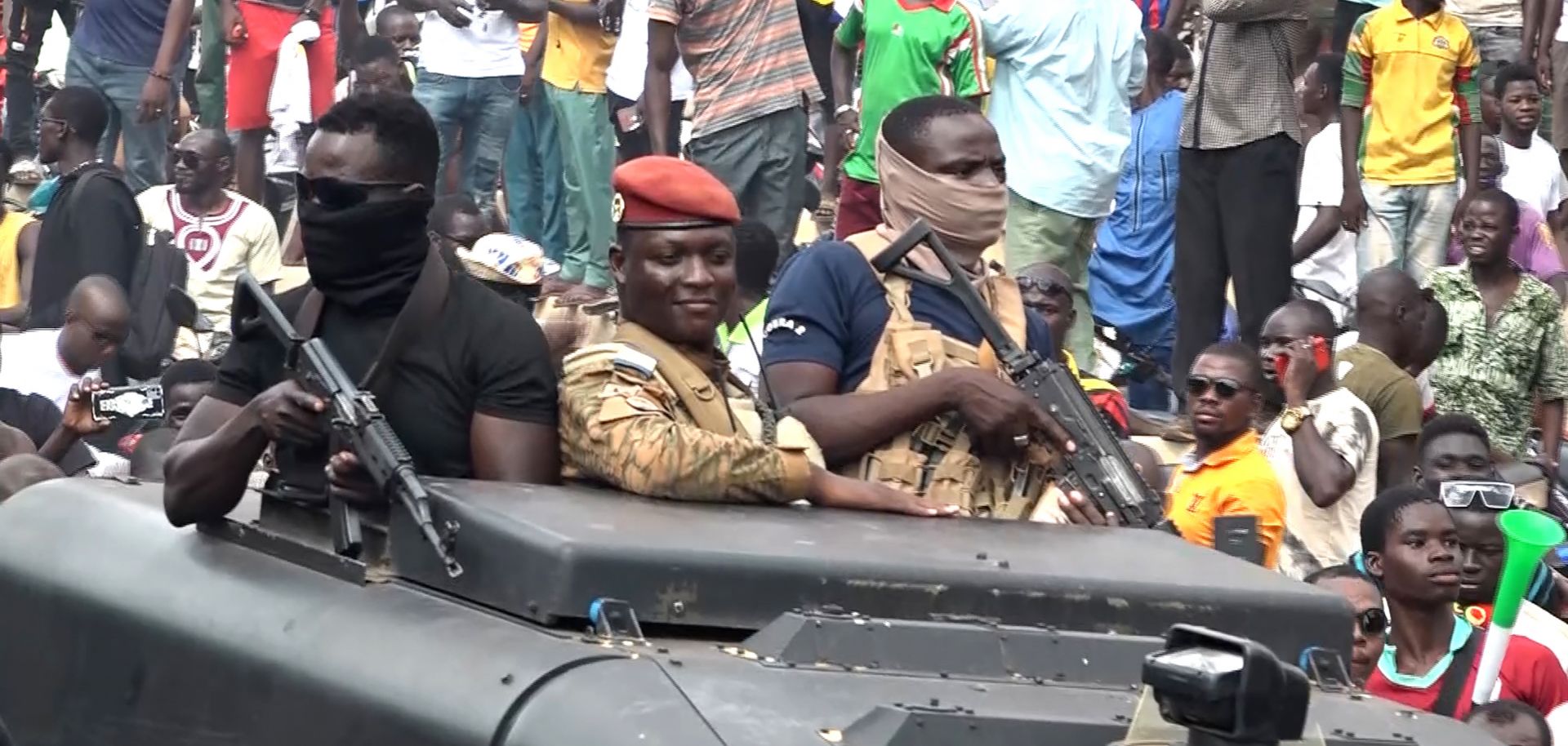
Burkina Faso's new military junta is unlikely to curb rising insecurity, while fraying ties with France could worsen the regional threat of jihadism. Ibrahim Traore, a captain in the Burkinabe army, seized power Sept. 30 in a military coup, the country's second coup in nine months. Traore and members of Burkina Faso's special operations forces stationed themselves at the state media building and the presidential palace while negotiating with the leader of the previous coup, Paul-Henri Sandaogo Damiba, who agreed to leave the country in exchange for his personal safety and assurances that the new government will respect election commitments already made to the Economic Community of West African States, AP reported Oct. 2. Traore suspended the constitution, dissolved the transitional government and closed the country's borders. Following the coup, a mob attacked the French Embassy in Ouagadougou, apparently under the false impression that Damiba was hiding out inside. Protesters chanted pro-Russian slogans and called for France, which regularly carries out counterterrorism missions in the country, to leave Burkina Faso.
- ECOWAS sent a delegation to Ouagadougou on Oct. 3. Whether Traore's junta will adhere to the two-year transition timeline Damiba had previously proposed to ECOWAS remains unclear despite reports of having committed to doing so. If the new junta does not, ECOWAS may implement sanctions against specific individuals like the bloc recently did against members of the Guinean junta for failing to present an acceptable timeline for new elections. ECOWAS is less likely to impose larger economywide sanctions because of their toll on civilian populations and their tendency to reinforce regional isolation as evidenced in Mali.
- In January, Damiba and a cadre of soldiers overthrew the democratically elected Roch Marc Christian Kabore, whom they accused of failing to curb rising jihadist violence. As in the most recent coup, Damiba suspended the Burkinabe Constitution, dissolved the government and closed the country's borders.
Just as after the previous coup, Traore and the mutinying soldiers declared that the government they had just overthrown failed to address the jihadist insurgency adequately. According to the Africa Center for Strategic Studies, nearly 40% of Burkina Faso's territory is currently ungoverned due to the insecurity that has worsened over the course of the year. While the triborder area between Burkina Faso, Mali and Niger remains a hot spot for groups like Jamaat Nusrat al-Islam wal-Muslimin and the Islamic State in the Greater Sahara, the scope and cadence of attacks in North Central, Southeast and Southwest Burkina Faso are also expanding. Violence has displaced nearly 2 million Burkinabe in the north, and the ensuing humanitarian costs have spurred demonstrations across the country decrying the government's inability to stem the violence, as has anger at insufficient resources for soldiers and military families.
- The Africa Center for Strategic Studies estimates that more than two-thirds of violent events linked to Islamist militancy in the Sahel in 2022 have occurred in Burkina Faso.
The change in leadership is unlikely to improve the Burkinabe government's security response due to long-standing challenges, while fraying ties with France could prompt new vulnerabilities. Training, equipment, resource and personnel constraints will persist, as will divisions within the Burkinabe security establishment. This means that despite Traore's strong rhetoric that his government is capable of stemming jihadist violence in ways that Damiba's government was not, Burkina Faso's new junta will face the same challenges as its predecessor — making a sudden victory over militants highly unlikely. Additionally, remarks by Traore's junta appear to indicate disapproval of Burkina Faso's security partnership with France, a contrast with the previous government. Coordination problems between French and local troops have hampered counterterrorism operations for years, and a degradation in the bilateral relationship could exacerbate these problems, making each side's efforts even less effective. This means jihadists may have an even more permissive environment to conduct operations in Burkina Faso and in neighboring countries, while a more aggressive Burkinabe security posture could increasingly harm civilians, thereby undermining local support and making such communities more vulnerable to jihadist recruitment.
- In an extreme case, were Burkina Faso's new junta to follow in the footsteps of its neighbor Mali and end all security agreements with France, militant groups like JNIM and ISGS will expand their operations and territorial reach, as France is currently the strongest military presence in the region. This would subsequently raise the jihadist threat levels in coastal West Africa, where a subtle uptick in attacks in northern Ghana, Togo and Benin has occurred over the last year.
