
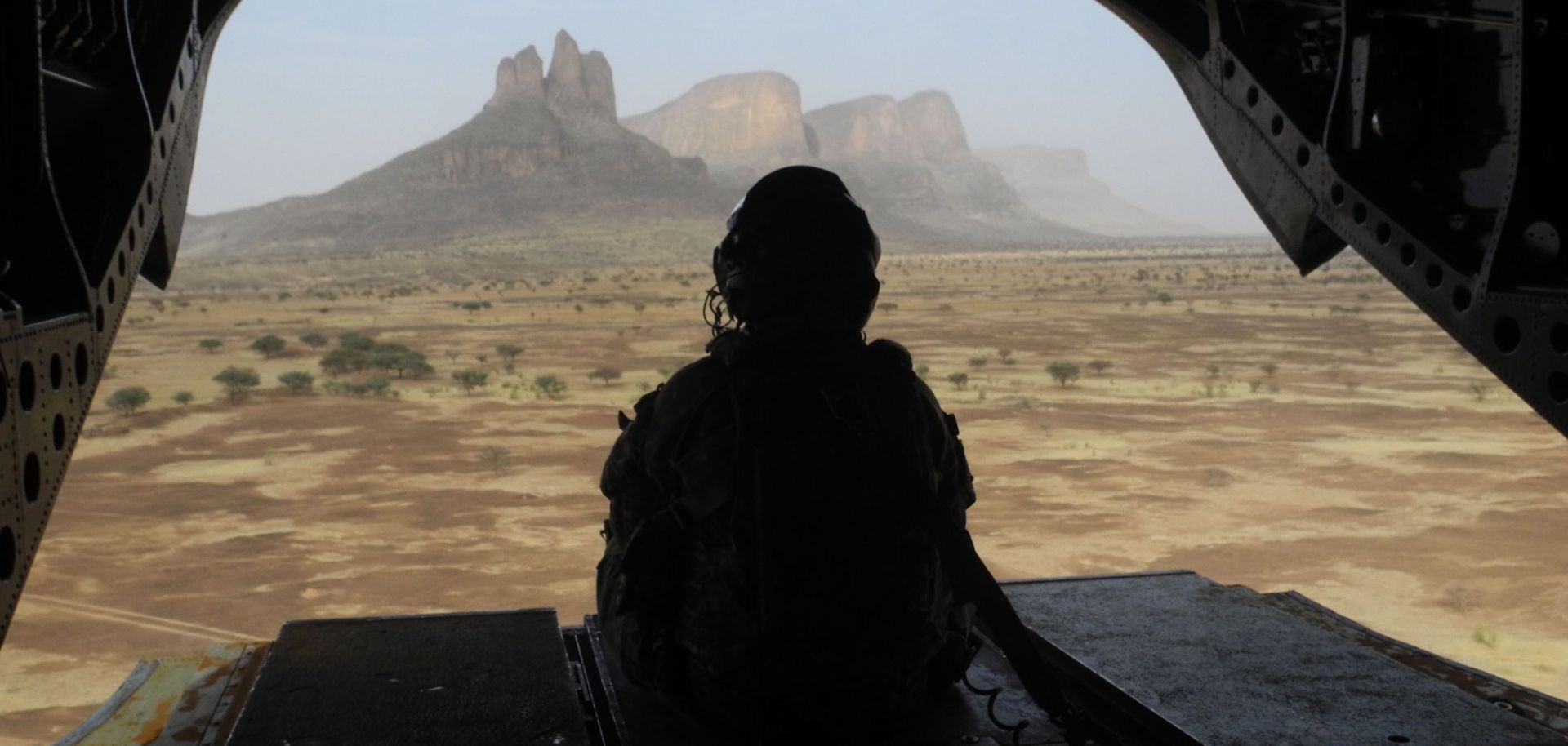
A British soldier leaves the Hombori area aboard a Chinook helicopter on March 28, 2019 during the start of the French Barkhane Force operation in Mali's Gourma region.
By David Newman, RANE Global Security Analyst
Growing insecurity in Mali, Burkina Faso and Nigeria is forcing littoral West African nations to reckon with a rising jihadist threat to their territories, but their military-led approach is unlikely to be successful absent broader improvements to governance, economic development and regional coordination. Mali and Burkina Faso have faced worse deterioration in their security environments than has Nigeria. After the junta seized power in May 2021, Mali has grown increasingly alienated from the international community, as evidenced by France's recently completed withdrawal from the country in August 2022; the EU suspension of elements of its training mission in April 2022; Mali's withdrawal from the Group of Five (G5) Sahel in May 2022; and its ongoing tense relationship with the U.N. peacekeeping mission (MINUSMA, short for the U.N. Multidimensional Integrated Stabilization Mission in Mali). Especially since France began its withdrawal in February, jihadist groups like Jamaat Nusrat al-Islam wal-Muslimin (JNIM) and the Islamic State in the Greater Sahara (ISGS) have exploited the resulting security vacuum and expanded their activities southward from Mali's northern and central regions to the capital of Bamako, which they now directly threaten. In Burkina Faso, a January 2022 coup — ostensibly driven by frustrations over the government's inability to stop jihadist attacks — has not led to any clear improvements in security, and jihadists continue to expand their geographic reach. As a result of the western Sahel's deteriorating security, Cote d'Ivoire, Togo, Benin and Ghana have experienced a spike in jihadist activity, and militants in Mali and Burkina Faso have increasingly carried out cross-border attacks. To the east, Nigeria's security has not meaningfully improved — and in some cases has deteriorated — under President Muhammadu Buhari's administration, most notably demonstrated by the fact that the Islamic State West African Province (ISWAP) continues to expand geographically and stage attacks farther from its northeast operating bases to the point that it threatens the capital of Abuja. In conjunction with an ever-turbulent northwest region plagued by bandit gangs and the al Qaeda-linked Ansaru jihadist group, this expansion has allowed Islamist militant groups to forge relationships and transport resources across borders.
- Highlighting jihadist geographic expansion in Mali, on July 20, Katibat Macina, a local group affiliated with JNIM, attacked Mali's main military base and the residence of interim President Assimi Goita, located approximately 15 kilometers (about 9 miles) from Bamako.
- Togo, Benin and Cote d'Ivoire have all experienced cross-border jihadist attacks from neighboring Mali and Burkina Faso over the past year. The tri-border region between Mali, Burkina Faso and Niger has been a hotbed for JNIM and ISGS attacks and cross-border transport for years now, and ISWAP continues to wage an insurgency in Niger's Diffa region in the Lake Chad Basin region it shares with Nigeria and Cameroon. Ghana has not yet experienced such attacks, but in early July, militants from Burkina Faso crossed into Ghana's Upper East Region in pursuit of Burkinabe citizens fleeing attacks in the notoriously porous border region.
- Reflecting jihadist groups' focus on local recruitment and suggesting an emerging threat to Benin, JNIM featured two fighters speaking Bariba — one of the languages used by local communities living in northern Benin — in a recruitment video the group circulated on social media in early August. Meanwhile, a recent report from a local Ghanaian news source estimated that jihadist organizations have recruited 200-300 Ghanaian citizens in Burkina Faso.
- A March 2022 report by the South Africa-based Institute for Security Studies noted that violent extremists take advantage of local conflicts and porous borders to traffic resources like arms and motorbikes from Nigeria through Benin and Togo to Burkina Faso. Such a free flow of resources enables groups to fund their operations, make valuable contacts, support recruitment efforts, and more deeply infiltrate the coastal states overall.
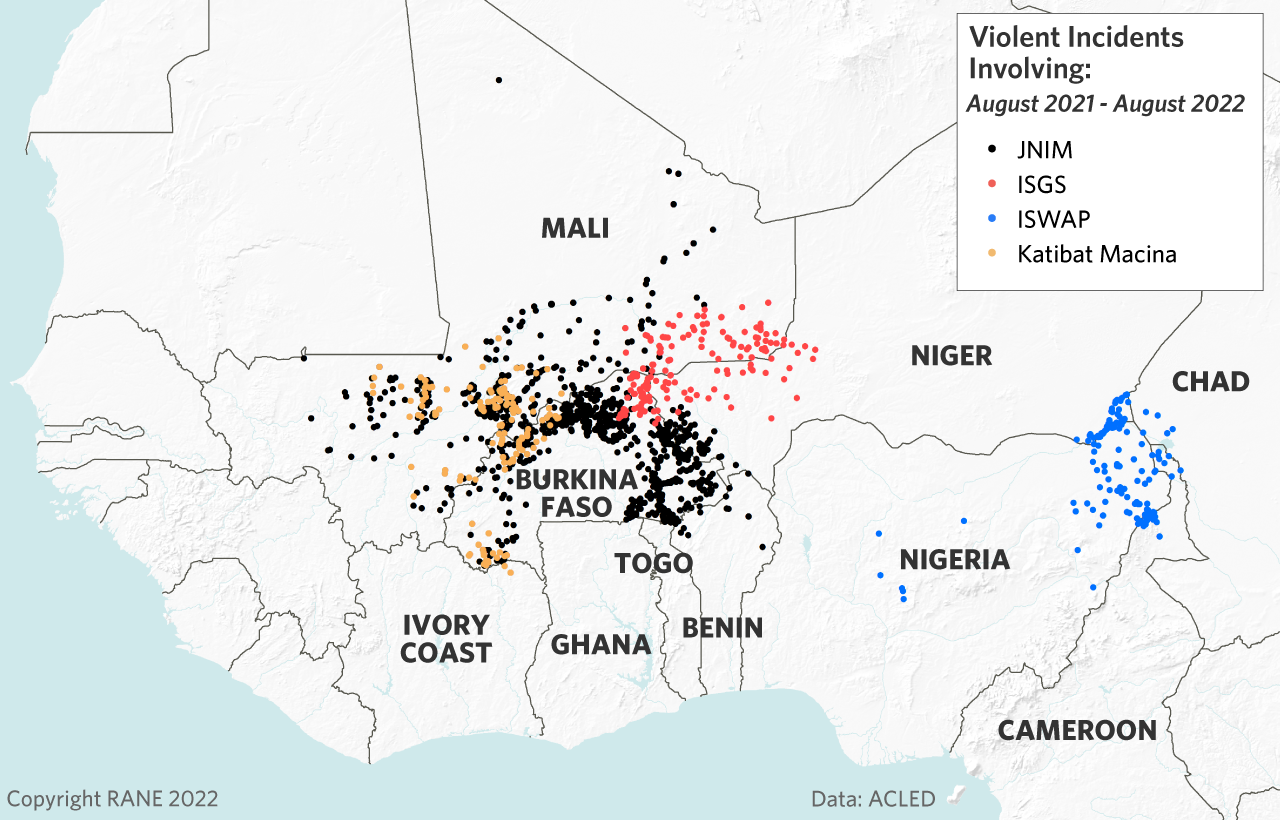
In response to the expanded threat, coastal West African states have adopted a military-led approach to counterterrorism through increased border security and bilateral agreements. Over the past year, Cote d'Ivoire, Ghana, Togo and Benin have all increased troop deployments to their northern border regions in an attempt to stave off jihadist encroachment. With relatively small and generally poorly trained and equipped militaries ranging from approximately 10,000-16,000 active personnel, however, governments are attempting to bolster their defense capabilities through bilateral agreements with regional states and major foreign partners. Having just completed its withdrawal from Mali, France is repositioning a reduced troop deployment in Niger and has offered further security cooperation with other West African states including Benin and Cote d'Ivoire. West African states are also seeking arms, training and other forms of security cooperation from major global partners like the United States, the European Union, Turkey, China and Russia. With a heightened focus on border security, governments have been particularly interested in acquiring drone technologies for border surveillance and perhaps targeted strikes. Beyond major foreign partners, West African states are also seeking to strengthen regional bilateral relationships to carry out joint operations and share intelligence. Since July 2022, for example, Niger has signed a military cooperation agreement with neighboring Benin and agreed to begin conducting joint operations with Burkina Faso in its border regions, while Togo reportedly increased its intelligence sharing with Burkina Faso and Ghana following a July 15 attack in its northern Savanes region.
- In 2021, West Africa accounted for more than 40% of defense spending in sub-Saharan Africa, according to the U.K.-based International Institute for Strategic Studies. Highlighting the worsening threat environment, Benin, Ghana, Liberia, Sierra Leone and Senegal all increased defense spending by more than 20% from 2020-2021, even as the majority of other sub-Saharan African countries decreased defense spending. The largest arms exporters to sub-Saharan Africa from 2016-2020 were Russia, China, France and the United States, in that order.
- France intends to keep about 2,500 troops in the Sahel, including about 1,300 troops in Niger, 700-1,000 troops in Chad and a few hundred troops in Burkina Faso. French President Emmanuel Macron has also stated his intent to ensure that France offers further security cooperation with littoral West African states, as evidenced by his July 27 visit to Benin, which was preceded by the French Armed Forces Minister Sebastien Lecornu's July 16 visit to Cote d'Ivoire. That said, rising anti-French sentiment in the region (which had helped drive its departure from Mali) will likely make coastal governments more likely to seek less-visible French military support, such as weapons and training, rather than large troop deployments.
- Despite U.S. Africa Command being notably under-resourced compared to other U.S. regional combatant commands, the United States maintains a military presence in Ghana, Senegal, Niger and Burkina Faso. In February 2022, the annual U.S.-led Operation Flintlock exercise, a counterterrorism and counterinsurgency training program, was for the first time held in Cote d'Ivoire with Niger, Ghana and Cameroon as additional participants.
- Turkey has reached various military cooperation agreements with several West African states — including Niger, Benin, Nigeria and Cote d'Ivoire — with the most recent deals signed with Togo in August 2021 and Senegal in February 2022. Some of these deals include the Turkish sale of its acclaimed TB2 Bayraktar armed drones, which African states likely intend to bolster their airstrike and surveillance capabilities without the costlier equipment and training required for more technically complex conventional airstrike capabilities with manned aircraft.
Despite these military moves, poor governance and economic challenges will limit coastal states' ability to limit jihadist expansion. In addition to securing borders, the effectiveness of each state's counterterrorism efforts will also hinge on its ability to win the "hearts and minds" of border communities most vulnerable to jihadist recruitment and/or coercion. This will be a challenge, however, because many coastal states possess a clear "north-south" divide, where there is a Muslim-majority north that feels neglected if not outright discriminated against. In addition to being closer physically to Sahelian jihadist groups, these northern areas have seen far less economic development, have vastly less physical infrastructure, and receive far fewer government services compared to the southern parts of the country that typically house the centers of government power and economic activity. Residing in countries that are already some of the least developed in the world amid rising food insecurity, global commodity prices and youth unemployment, these communities are particularly susceptible to violent extremists, who have proven adept at exploiting local grievances to recruit and insinuate themselves into local communities. While West African states have acknowledged the importance of addressing terrorism's root causes, and some have launched development and education initiatives to supplement their heightened security deployments, these efforts are in their infancy and largely more rhetorically than practically significant. This means that the balance remains heavily on the side of military initiatives, with the attendant risk that they either mistakenly or even deliberately harm civilians and risk communal alienation that jihadist groups could exploit.
- Highlighting the north-south divide in coastal states, a 2019 World Bank report noted that while the extreme poverty rate in Ghana has drastically declined over the past three decades, inequality in the country has widened, with poverty now heavily concentrated in three northern regions. The same is true for neighboring coastal states: for example, the poverty rate in Togo's northernmost region was 74.6% but just 23.7% in its southernmost region in 2015.
- A May 2022 report by the Morocco-based Policy Center for the New South noted government discrimination and social exclusion directed toward ethnic Fulani pastoralists in both the Sahel and coastal West Africa. Al Qaeda-linked groups have historically exploited this dynamic to recruit from Fulani populations across the region, as evidenced in June 2021, when JNIM used an ethnic Fulani Ghanaian to carry out a suicide bombing against French forces in Mali.
- On July 9, the Togolese military carried out an airstrike in the northern Tone prefecture of the Savanes region that killed seven teenagers after mistaking them for a group of militants. Within a week, the Beninese army killed a Fulani pastoralist after mistaking him for a JNIM fighter in its northern Alibori region. While these two incidents reflect the risk of mistakenly targeting civilians, a July 2022 Amnesty International report noted that heightened security deployments in Togo and Benin have also led to the arbitrary arrests of individuals based on their ethnic Fulani identity, among other human rights abuses. If such abuses continue, they risk leading to direct targeting of civilians in military operations and extrajudicial killings, which in Mali resulted in its soldiers (and allegedly Russian private contractors) summarily executing more than 300 civilians (the majority of whom were ethnic Fulani) in the village of Moura in March 2022.
- Togo's Inter-Ministerial Committee for the Prevention and Fight Against Violent Extremism was formed in 2019 and seeks to study the vulnerabilities in local communities that can push young people toward extremist groups and to promote civil-military relations in its north. In July 2022, the Ghanaian government launched a "See Something, Say Something" campaign and created a hotline for citizens to report suspicious activity. While it is too early to evaluate the efficacy of such preventive measures, it will likely hinge on governments addressing much deeper and harder to combat socioeconomic and political challenges in regions vulnerable to jihadist exploitation. For example, according to Ghanaian government statistics, the majority of populations living in the northern regions of the country do not own a phone of any kind nor have access to the internet — both of which would be essential to contacting the hotline to report suspicious activity.
At the broader regional level, multilateral institutions and initiatives will continue to face funding shortfalls, disputes among members, and command and control challenges that will limit effective counterterrorism cooperation and coordination. Among many others, the most notable components of the regional security architecture are the G5 Sahel Joint Force (now effectively G4 Sahel following Mali's departure in May); the Economic Community of West African States (ECOWAS) Standby Force, which is currently deployed in Guinea-Bissau; the Multinational Joint Task Force (MNJTF) that combats ISWAP and Boko Haram in the Lake Chad Basin; and the Accra Initiative, a multilateral security cooperation mechanism established by Benin, Burkina Faso, Côte d'Ivoire, Ghana and Togo in 2017 (with Mali and Niger as observers). While varied in terms of size and structure, all of these share common challenges including insufficient funding, overlapping responsibilities, and disunity among member states that hinder consistent and effective operations; this is especially because they risk overcrowding the security space with overlapping and at times conflicting geographic spheres of responsibility that regional states with severe capacity constraints are ill-equipped to balance. Finally, the effectiveness of all these initiatives depends on what often can be tense relations among member states, meaning interstate disputes can hamper counterterrorism progress.
- ECOWAS has the most developed and institutionalized counterterrorism mechanisms, but the bloc has yet to actually implement such strategies despite their being years old, causing member states to look to coalitions of the willing like MNJTF and G5 Sahel Joint Force for counterterrorism support. These coalitions, however, are heavily reliant on external funding from the United States, France and the European Union meaning that the support will wax and wane with the political will and policy changes of these countries regardless of the urgency with which coastal states perceive it.
- The most prominent recent demonstration of interstate disputes hampering regional counterterrorism efforts can be seen in Mali's May 15 withdrawal from the G5 Sahel due to the other member states' refusal to allow the Malian junta to assume the rotating presidency. Even before Mali withdrew, an April U.N. monitoring report noted that the G5 Sahel defense ministers had not met since November 2021, and a follow-up report in June said that since the start of 2022, the joint force conducted only three reconnaissance missions in the tri-border region between Mali, Niger and Burkina Faso.
- While some member states may seek to revive or restructure the G5 Sahel Joint Force, littoral West African states may also look to the Accra Initiative as another avenue for multilateral counterterrorism operations in the region. Having only conducted four joint operations since its founding in 2017, the Accra Initiative will also struggle to acquire sufficient funding for future operations and will have to manage interstate tensions to be fully effective.
