
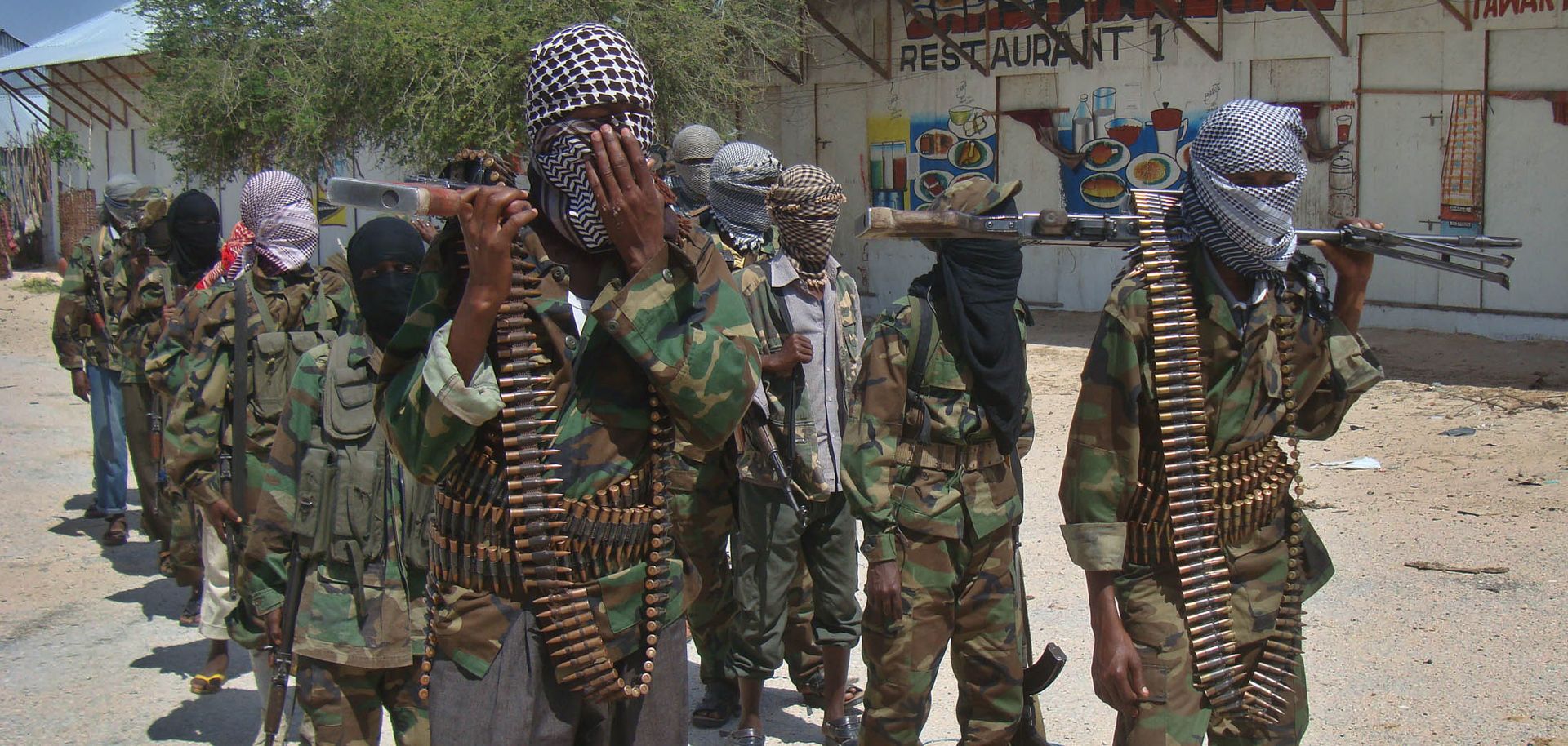
Al Qaeda-linked al Shabaab recruits walk down a street in the Somalian capital of Mogadishu following their graduation in March 2012.
Editor's Note: This column is the second of two-part series that explores the legacy of al Qaeda leader Ayman al-Zawahiri, who was recently killed in a U.S. drone strike in Kabul. The first part, which discusses the slain leader's ideological background and his role in taking the jihadist fight directly to the United States and other Western countries, can be found here.
Falling Behind
Al-Zawahiri became the leader of al Qaeda in 2011 after Osama bin Laden was assassinated by the United States. Like any new leader, al-Zawahiri attempted to consolidate his control and re-energize the diffuse group, but his efforts largely failed. Most immediately, he was unable to turn the Arab Spring, which had broken out in late 2010, to al Qaeda's advantage. Not only did popular protest movements across the region largely reject extremism, but authorities' subsequent crackdowns only further entrenched authoritarian states that were even more determined to curtail dissent, be it from demonstrators or extremists. Next, when civil war broke out in Syria in 2011, al Qaeda again struggled. Despite founding an affiliate in the country, it slowly distanced itself from its parent organization before eventually cutting official ties; meanwhile, other extremist forces united behind what would later emerge as al Qaeda's greatest competitor and direct challenger to al-Zawahiri's vision: the Islamic State.
Al-Zawahiri had long conflicted with what formally became the Islamic State in 2014, dating back to the group's roots as al Qaeda in Iraq (AQI) in the aftermath of the U.S. invasion in 2003. AQI's leader, Abu Musab al-Zarqawi, then pioneered a ruthlessly violent strategy that appeared extreme even from al Qaeda's perspective: for al-Zarqawi, Iraqis were either with AQI or they were apostates — there was no middle ground. Al-Zawahiri repeatedly denounced the AQI leader for turning the Iraqi populace against al Qaeda, specifically over al-Zarqawi's declaration of an ''all-out war'' against Shiite Muslims, who make up the majority of Iraq's population.
U.S. forces eventually killed al-Zarqawi. But in the wake of his death, remnants of AQI distanced themselves from al Qaeda and renamed their group the Islamic State of Iraq. This set the stage for what would ultimately become the biggest strategic challenge to al-Zawahiri's historic prioritization of the ''far enemy.'' In taking over large parts of Iraq and Syria and declaring a caliphate, the Islamic State was able to directly hold and govern territory in a meaningful way — something al Qaeda had never accomplished. For years, al Qaeda had portrayed itself as the leader of the global jihadist movement and advocated a so-called ''strategic patience'' approach in which targeting the ''far enemy'' would ultimately lead to the collapse of un-Islamic governments. But it was the Islamic State that had now actually succeeded in creating an Islamic theocracy in what seemed to be just a few short months. While the Islamic State also became known for a series of lethal attacks in the West, most notably the 2015 Paris attacks, the group's center of gravity – literally and ideologically – was always the territory it ruled. Under its so-called ''remaining and expanding'' strategy, the Islamic State was first and foremost focused on the caliphate itself, a direct rebuke to al Qaeda which, for all its violence, had never come anywhere close to as much.
Therein lay the strategic dichotomy: al-Zawahiri had always maintained that Muslims would only ever topple the secular and corrupt governments in the West (or the ''far enemy'') by attacking the United States and Europe on their own soil. But the Islamic State proved just the opposite. Even if only for a short time, its creation of a caliphate appealed to many extremists who had grown impatient with what they saw as decades of jihadist struggle for no practical achievements. In fact, it is notable that it was only after founding its caliphate in 2014 that the Islamic State began to invest in external operations in the West — a reversal of what al-Zawahiri had long advocated. While this did not mean that al Qaeda under al-Zawahiri lost all relevance, battlefield and ideological competition with the Islamic State severely amplified pre-existing challenges, including strained connections with some of al Qaeda's own affiliates and ongoing counterterrorism pressure.
In this environment, even as he kept some semblance of cohesion over al Qaeda, al-Zawahiri lost much of whatever direct operational control he once exerted, being largely reduced to a symbolic figurehead who occasionally put out new videos. And even in those videos, he was uninspiring, with his long diatribes on Islamic jurisprudence quickly becoming stale and irrelevant — especially compared to the more seductive violent propaganda of the Islamic State. In fact, his last major video, released this past September to coincide with the 20th anniversary of the 9/11 attacks, was most notable for simply proving he was still alive — hardly a ringing endorsement for his leadership.
Local vs. Global
No matter who takes over, al Qaeda faces a massive task merely to hold it together, let alone reinvigorate it. To be sure, the group has a few things going for it. Most notably, the collapse of the Islamic State's caliphate has reduced that group's appeal and, in the minds of some extremists, also validated al Qaeda's argument for ''strategic patience'' that does not rush the creation of a caliphate. Meanwhile, certain al Qaeda affiliates — such as al Shabaab in Somalia and Jama'at Nasr al-Islam wal Muslimin (JNIM) in West Africa — remain major local threats and, in some cases, are poised to expand their territorial reach in Africa.
But this state of affairs is a far cry from al-Zawahiri's ideological emphasis on directly attacking the ''far enemy,'' which supposedly is what defines al Qaeda's brand. While al Qaeda may still call for mass attacks in the West in its propaganda, it has pointedly failed to successfully carry out any in nearly two decades, instead relying on scattered supporters to commit occasional and far less impactful violence in the group's name.
As such, in trying to shore up the organization, al-Zawahiri's successor faces a major decision in whether to reprioritize a global strategy in attacking the ''far enemy'' or instead double down on pushing affiliates' success in local areas. The al Qaeda of today is far less capable and the West is far more prepared than on the eve of the 9/11 attacks in 2001. But for al Qaeda to stay relevant it may also need some high-profile attacks in the West to burnish its credentials.
However, even if it were able to pull off a mass attack, al Qaeda is unlikely to sustain anywhere close to the operational tempo it had in the late 1990s and early 2000s. Reprioritizing attacks in Western countries would undoubtedly galvanize a response from those powerful and wealthy governments, one which could ultimately challenge al Qaeda's progress in the areas of the world. This includes the Sahel region of sub-Saharan Africa, where al Qaeda militants have the most momentum. Al Qaeda might therefore prefer to only rhetorically attack the ''far enemy'' and instead concentrate its actual efforts on building its affiliates' capabilities to conduct local attacks — trying to do something akin to what the Islamic State briefly accomplished but in a more sustainable way.
As hard of a calculation as this might be for al Qaeda's next leader, the implications for the West may be just as complex. While a further decline in al Qaeda's focus on attacking the West would reduce the threat to Western populations, there is in some ways an eerie sense of deja vu when comparing the current threat landscape to that seen in the late 1980s and early 1990s, before al Qaeda became a household name in the West. Then, as now, the group is cementing its status in some seemingly far-flung areas of the world (perhaps even Afghanistan once again). For the time being, al Qaeda's aims and capabilities remain focused on local priorities. But as seen before, this is by no means guaranteed to last, especially given that growing successes on the ground generally translate into greater ambitions. In a revealing statement issued by the U.S. Department of Justice in December 2020, authorities indicted a Somali national who al Shabaab reportedly directed to obtain flight training in the Philippines in preparation for a ''9/11-style attack in the United States'' — a worrisome reminder that al Qaeda's affiliates may not be satisfied with local attacks.
This suggests that the West may have to make its own decision: either forcefully strike local al Qaeda affiliates now to try to forestall their development (and risk shifting their attention from local priorities back toward the West), or continue trying to contain al Qaeda affiliates to far-away areas like the Sahel (at the risk of enabling them to grow powerful enough to one day attack the homeland). In this respect, al Qaeda's next leader may maintain al-Zawahiri's ''far enemy'' vision, but as part of a broader strategy that in some ways hinges just as much on what the West does next as what al Qaeda and its affiliates do.
