
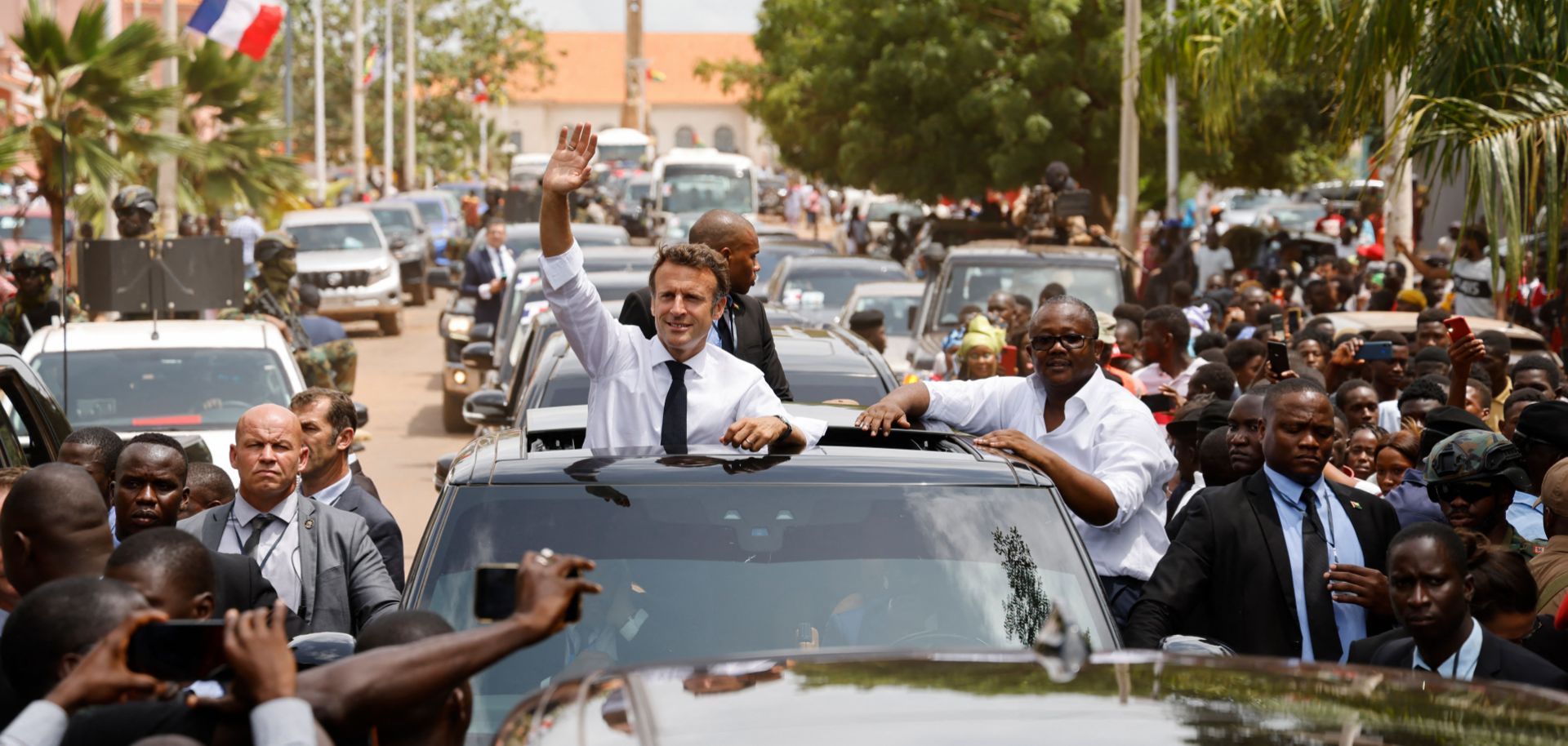
During the final day of the African tour that also included visits to Cameroon and Benin, French President Emmanuel Macron (left) waves to a crowd through the roof of a car in Bissau with Guinea-Bissau's President Umaro Sissoco Embalo.
French President Emmanuel Macron and Russian Foreign Minister Sergey Lavrov’s trips to Central African countries early this week illustrate Paris and Moscow's interest in the region, which will give those states the opportunity to extract concessions from both. On July 25, Macron landed in Yaounde to hold meetings with Cameroon’s president Paul Biya, kicking off the French president’s first tour of Africa since being reelected in April. The night before, Republic of the Congo President Denis Sassou-Nguesso welcomed Sergey Lavrov at his presidential retreat, prior to Lavrov traveling to Kampala on July 26, where he met with Ugandan President Yoweri Museveni. Lavrov’s trip began with the publication of an op-ed across many of the continent’s news outlets blaming the growing food insecurity faced by African countries on the West. Macron, however, publicly dismissed his comment as “nonsense, with the French president thereafter accusing Russia of using food as a “weapon of war.”
- During his meeting with Sassou-Nguesso, Lavrov reportedly reiterated assurances that Russia would not block Ukraine’s Black Sea wheat exports (which was meant to appease concerns in most African countries about the potential worsening of the global food crisis), confirmed Lukoil’s support for the construction of a pipeline between Brazzaville and Pointe-Noire, and announced a conference in late September on Russian investments in the Republic of the Congo.
- In Uganda, Museveni praised relations with Moscow and suggested that Russia had “not made a mistake” by invading Ukraine. Museveni’s son and aspirant successor, Muhoozi Kainerugaba, has voiced strong support for Russian President Vladimir Putin’s invasion of Ukraine on social media.
This diplomatic ballet underscores both France and Russia’s interest in Central Africa, which is set to intensify the competition between Paris and Moscow in the region focusing on security, investments and food supplies. Russia will seek to bolster its relations with African countries that have taken a neutral stance toward its invasion of Ukraine. Moscow could reward those countries with additional cereal exports, arms deals or further Russian investments — especially in the field of mining, hydrocarbons, agricultural equipment and nuclear. Strengthening its relations with African countries will enable Russia to showcase that it is not internationally isolated despite Western sanctions, while also securing their continued neutrality (if not support) during key votes at the United Nations. France, meanwhile, is set to counter Russia’s narrative by helping countries in the region cope with the global food crisis, as well as diversifying its bilateral partnerships to new fields including education and digital. Paris will also look to bolster local regulation in Central African states to ensure that French companies are operating on a level-playing field with their Russian and Chinese counterparts.
- Macron's first presidential term was characterized by a focus on the Sahel and attempts at reaching out to English-speaking African countries. However, his choice to travel first to Cameroon after his recent reelection suggests that his second term will likely see him recenter France's diplomatic efforts on its former colonies, where Paris still retains much sway. This will be especially true in Central Africa, where Russia is increasingly contesting French influence, as evidenced by the Wagner Group’s presence in the Central African Republic and Moscow’s signing of a defense agreement with Cameroon in April.
- France and Russia’s interests in Central Africa diverge on a wide range of issues, including governance and mining. But that does not mean those interests will never overlap — especially on counterterrorism initiatives against groups like Boko Haram and the Islamic State in West Africa Province (ISWAP), which both Paris and Moscow both perceive as threats.
- Macron’s trip to Cameroon saw him strongly promote the Food and Agricultural Resilience (FARM) initiative, which seeks to alleviate growing food insecurity in the aftermath of Russia’s invasion of Ukraine, including by raising agricultural output in Africa and the Middle East by increasing crop yields and ramping-up the local production of fertilizers.
- To increase its appeal in the region, France is set to bolster its Choose Africa and Digital Africa policy initiatives, which respectively aim to support small businesses and digital innovation on the continent.
Central African states will likely look to leverage Russia’s interest to maximize investments and security commitments from both Moscow and the West. Countries in the region have no clear interest in becoming committed Russian allies, as this would reduce their ability to extract further commitments from France and complicate their relations with Western donors, which remain key to local economies. The absence of pressing Russian interests in Africa and the ongoing war in Ukraine will also reduce Moscow’s appetite for new big investments and weapon deals in the region, which will likely see Russia continue to favor its low-cost information warfare strategy. But despite Moscow’s constrained ability to press ahead with large investments in Africa, its continued stirring of anti-colonial grievances will remain a serious problem for France, which Paris will attempt to counter this reputational damage by increasing its own security and economic involvement in Central Africa. However, balancing between the West and Russia could become a challenge for local African leaders should anti-French sentiment grow unabated and pose additional security, economic and reputational risks for French and, to a lesser extent, Western companies active in the region.
