
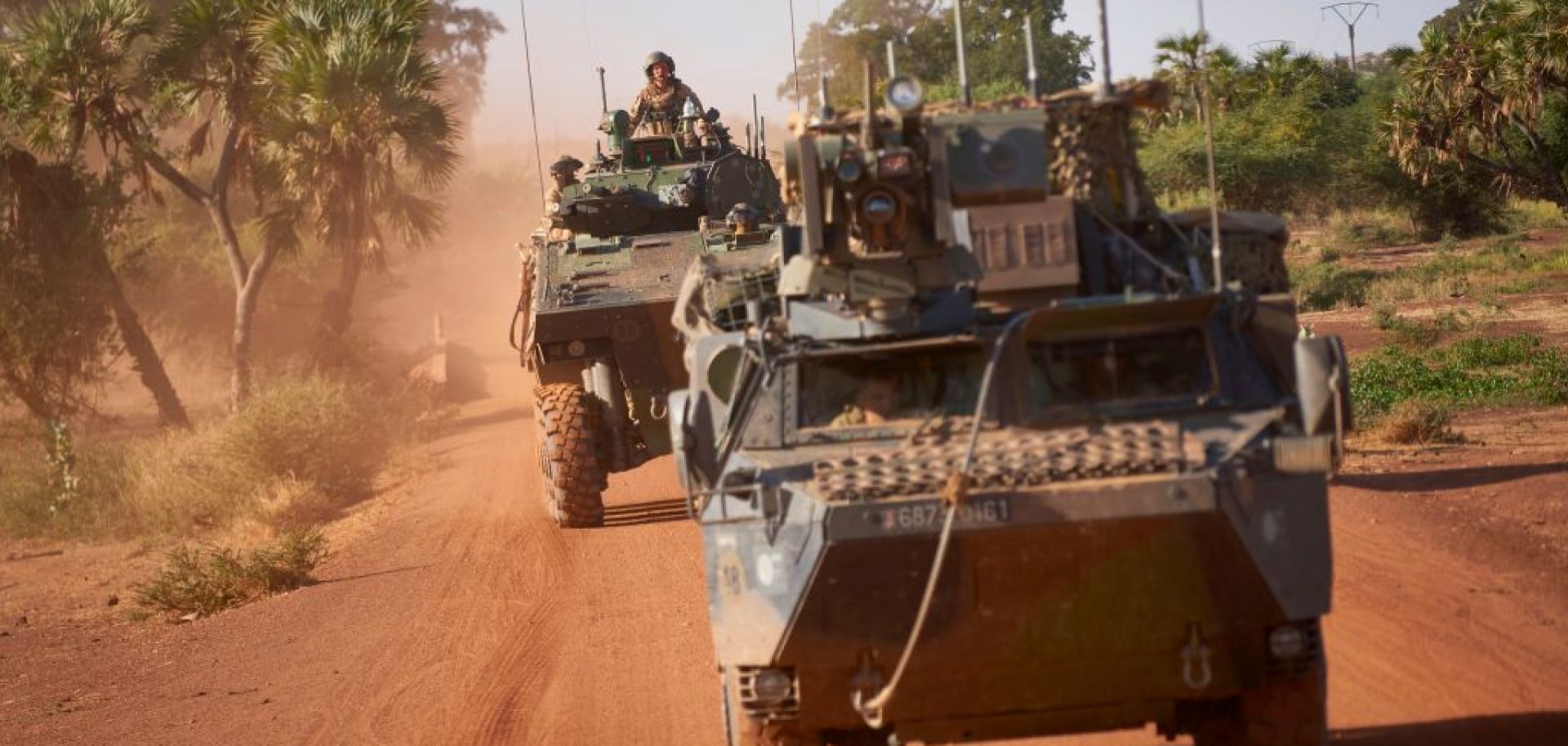
A French army patrol in November 2019 in northern Burkina Faso.
The French military withdrawal from Burkina Faso will likely accelerate the spread of the jihadist insurgencies already running rampant in the country, putting the capital and other coastal West African countries in greater danger of attack. This will increase the risk of political instability and worsen Burkina Faso's already poor economic outlook. Burkinabe government spokesman Jean-Emmanuel Ouedraogo on Jan. 23 confirmed that French troops must withdraw from Burkina Faso within one month — a call that first appeared on the state-owned Burkina Information Agency on Jan. 18 — ending days of uncertainty about the future of French operations in the country. French President Emmanuel Macron on Jan. 22 had said that he was awaiting clarification from Burkinabe interim President Ibrahim Traore directly, but Ouedraogo said the decision had been made and no confirmation was needed.
- France has approximately 400 troops stationed in Burkina Faso to support local counterterrorism operations. The Burkinabe government now apparently has suspended the 2018 military accord that allowed this French military presence in the country.
The demand for France's withdrawal comes amid heightened anti-French sentiment and expanding jihadist insurgencies. Hundreds of protesters, some of whom held Russian flags, demonstrated Jan. 20-1 in the Burkinabe capital of Ouagadougou against France's continued military presence in the country. Similar demonstrations have occurred in the last few years given that many in Burkina Faso blame France for the various jihadist insurgencies that control nearly 40% of Burkina Faso's territory. While evidence suggests that French military cooperation in the Sahel has actually bolstered local military capabilities against jihadists, the insurgencies' spread has fueled allegations (in part perpetuated through Russian disinformation campaigns) that French operations represent Western imperialism and have failed to improve security. Traore took power in a military coup in September 2022, and so is not directly accountable to a public angry with the Burkinabe government's handling of rising insecurity and continued willingness to host French troops. That said, both Traore and his predecessor, Paul-Henri Sandaogo Damiba (who seized power in a January 2022 military coup after an intense round of anti-French protests), in part used anger over just these issues to overthrow two successive governments. Traore may now be attempting to preserve his own power within the military establishment by using France as a scapegoat for worsening insecurity.
- Traore also tried and failed to secure new weapons contracts with both the United States and France, but reportedly has succeeded with some military equipment purchases from Russia in late 2022, so kicking France out will not necessarily mean Burkina Faso cannot still acquire weapons.
The French withdrawal from Burkina Faso may coincide with the introduction of Russian paramilitary forces, and will likely further degrade security in Burkina Faso and neighboring states, undermining political stability and economic growth. In December 2022, Burkina Faso's mines minister denied allegations by Ghanaian President Nana Akufo-Addo that the Burkinabe government paid Russian mercenaries from the Russian paramilitary Wagner Group by giving them rights to a mine on Burkina Faso's southern border with Ghana. While these allegations were never proved or completely dispelled, France's departure from Burkina Faso makes a Wager deployment far more likely, as several African states (including Burkina Faso's northwestern neighbor Mali) have turned to the paramilitary group for military support and private security in recent years when relationships with Western partners deteriorated. If Wagner troops are, or will soon be, in Burkina Faso, their presence will likely worsen insecurity due to their regular human rights violations. As seen in Mali, such violations have hardened negative attitudes toward the government and driven jihadist recruitment. Even without a Wagner intervention in Burkina Faso, France's withdrawal portends reduced intelligence, communications, logistics and materiel capabilities for the Burkinabe military, which will very likely create opportunities for local branches of al Qaeda and the Islamic State to expand their operations. Given already high public discontent with insecurity, further jihadist encroachment — perhaps including increased strikes near the capital of Ouagadougou — is likely to stoke public anger, providing future windows for opportunistic military leaders to seize power as happened with Damiba and Traore. The French withdrawal will also raise the threat levels in neighboring West African states, where jihadist groups already target northern communities in Ghana, Benin, Togo and Cote d'Ivoire. Burkina Faso is already one of the world's poorest nations, and strengthened jihadist insurgencies will reinforce this status by inhibiting local business activity and trade; investor hesitancy is also likely to increase in neighboring states where jihadist activity is a growing threat.
- More than 40% of the Burkinabe population lives below the global poverty line, and the country ranks 184 out of 191 in the 2021-22 Human Development Index report produced by the United Nations. Poor infrastructure, an arid climate and limited natural resources, among other challenges, have hampered Burkina Faso's economic growth for decades. Ongoing insurgencies also have constrained gold exports and agricultural production, further reducing growth prospects.
