
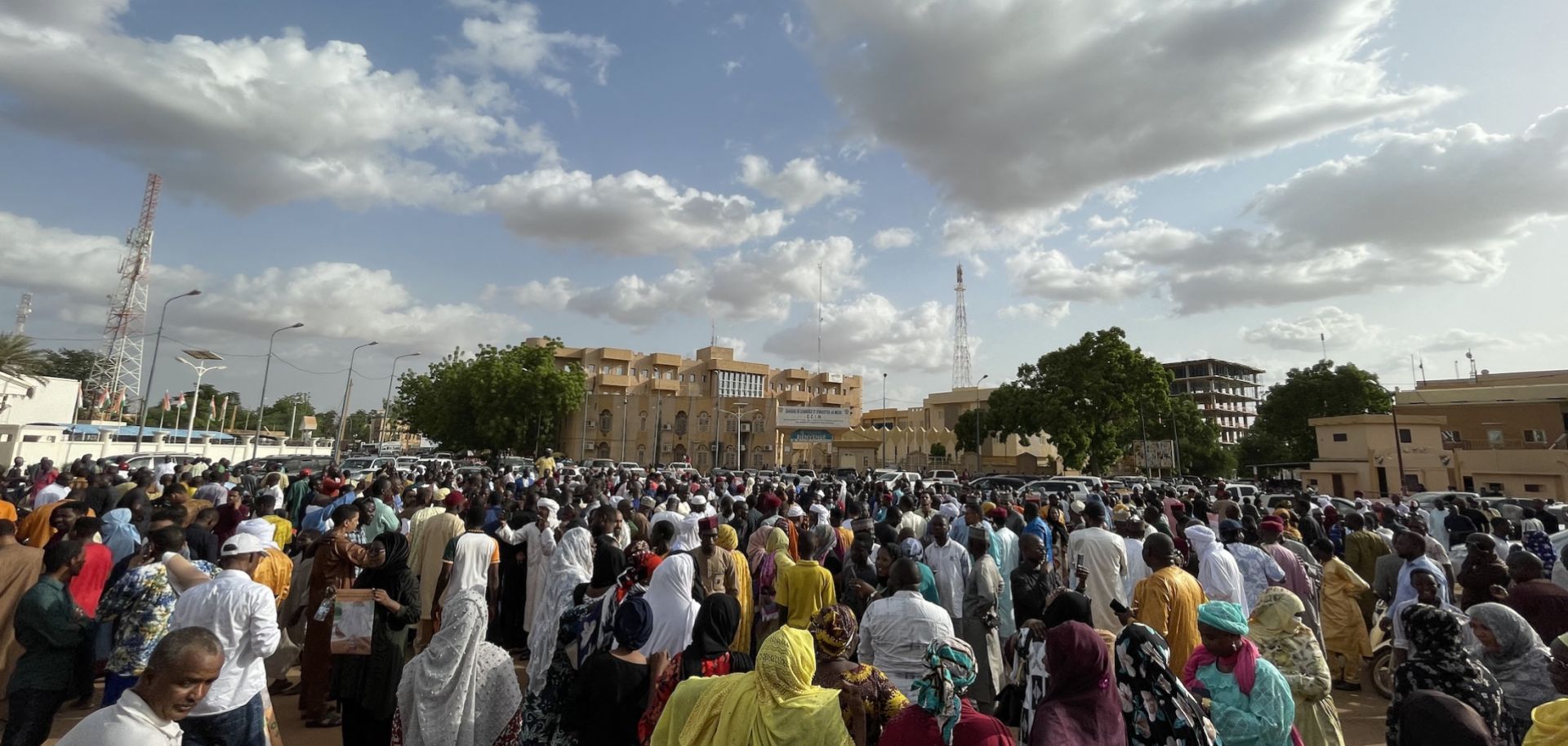
In Niger, a successful coup could weaken the country's relationship with France and create new openings for jihadist groups and alternative world powers like Russia and China. Early on July 26, members of the Nigerien presidential guard blocked access to the residence of President Mohamed Bazoum and the offices of the presidential complex. While no special military forces have been seen in the area of the presidential building and no gunshots have been heard, Bazoum's status has triggered fears that a coup is underway. The presidency tweeted that the guards had started an ''anti-republican'' movement ''in vain'' and that Bazoum is well, but the tweet was later removed. The presidency also said in a statement that the national army is ready to attack the guards if they do not abandon their activity. Bazoum is currently negotiating with an unknown number of presidential guard personnel who are detaining him in his residence, according to a Jeune Afrique report. Later in the day, news outlet Tchad One reported that Bazoum resigned and that General Salifou Modi of the Niger Armed Forces (Bazoum's former chief of military staff) will lead the transition, but this is unconfirmed.
- Beninese President Patrice Talon and Nigerian President Bola Tinubu are reportedly en route to Niger to mediate the standoff.
- Rumors indicate that Bazoum may have been considering replacing General Omar Tchiani as head of the presidential guard, which (if true) may have triggered the attempted mutiny. Early in the day, the Niger Armed Forces did not appear to support the presidential guard's activities, as the army had threatened to attack the guard if the president was not released. But more recent (and still unconfirmed) reporting suggests that the military and presidential guard may have reached an agreement to oust Bazoum.
Whatever the proximate cause, tensions between civilian and military leadership, growing resistance to Bazoum's close relationship with France, an expanding jihadist threat and a long history of military overthrows mean Niger has long been at risk of coups. Niger is one of the only countries in the Western Sahel with a civilian-led government. As such, civil-military tensions are a latent risk, particularly over how to handle the country's relationship with France and the worsening jihadist threat to the region. While factionalism within Niger's armed forces has existed for decades, there have been signs of resistance to France's large role in the country's counterterrorism operations amid a regional wave of anti-imperialist, anti-French sentiment, which could serve as a wedge for military discontent with Bazoum. In neighboring Burkina Faso, anti-French sentiment helped give rise to the country's September 2022 coup and subsequent ousting of French forces. In Niger, Bazoum has strengthened ties with France since taking office in March 2021, which has further bolstered the Niger Armed Forces' capabilities against jihadist groups like Jama'at Nasr al-Islam wal Muslimin (JNIM) and Islamic State Sahel Province, even as these groups continue to gain territory in nearby Burkina Faso and Mali. While the Niger Armed Forces do not appear to be supporting the current attempt to oust Bazoum, divisions over the country's reliance on its former colonizing state could lay the groundwork for political rifts. It's also worth noting that Niger has experienced four coups since independence from France in 1960, and many more unsuccessful attempts (the latest of which occurred two days before Bazoum's inauguration in March 2021). The high prevalence of coups in Niger and in the broader West African region means that some members of the military may view coups as a legitimate means of transferring power, potentially increasing military officers' willingness to participate.
- Resistance within the Nigerien military to the country's security partnership with France is far less prevalent than in the security establishments of neighboring Mali and Burkina Faso. But in recent years, regional news outlets have hinted at some discontent in the Niger Armed Forces regarding Bazoum's close relationship with France.
- About 1,000 to 1,500 French troops are stationed in the capital Niamey and assist the Nigerian Armed Forces with training, equipment support and counterterrorism missions. Over the past year, both France and the United States have ramped up their counterterrorism support to Niger following the withdrawal of French troops in neighboring Burkina Faso and Mali.
If Bazoum is pushed out of power, a new military regime could eventually reduce Niger's dependence on France, thereby opening a new security vacuum in the region for jihadist groups and alternative world powers to exploit. Early on July 26, there were few indications that the armed forces supported the presidential guard's efforts to detain Bazoum, but the most recent and still unconfirmed reports suggest a possible agreement among the military and presidential guard. With negotiations between Bazoum and his captors ongoing, it is possible that the incident will end in a negotiated settlement, depending on the presidential guard's demands. However, if the guard is able to secure support among even some factions of the armed forces, the likelihood of a successful coup increases markedly. The armed forces' position along the road to the national broadcasting station will be an important indication of a possible breakdown within the military, as control of the state television and radio is usually an early objective of coup plotters. If the coup is successful and follows a similar trajectory as those in Burkina Faso and Mali (which also had a coup in May 2021), the new military regime may seek to scale back its engagement with France. A new military-led government in Niamey would face complex calculations, including external pressure from the United States, which has hundreds of soldiers stationed in Niger to fight regional militancy. There are thus various steps such a government could take to readjust its relationship with France, should it choose to do so. If, however, the current power struggle in Niger yields a military regime that decides to completely reject France's presence in the country, IS Sahel and JNIM militants would likely exploit the resulting security vacuum in Niger's western provinces, while the Islamic State in the Greater Sahara would likely seize the vacuum in the Lake Chad Basin. Under this scenario, the reduced pressure on jihadist groups emanating from Niger would likely also enable greater territorial expansion in the Western Sahel and accelerate the frequency of terrorist attacks in coastal West Africa. In addition, a French exit from Niger would open the door to the possible introduction of Russia's Wagner Group, which recently advertised a ''new path'' to Africa. Such a relationship with the Russian paramilitary organization is certainly not guaranteed, even if the coup is successful. But Wagner's presence in Niger would likely facilitate greater Russian influence, solidifying its position as a counterweight to France in the Sahel.
- Niger is Africa's largest uranium exporter, with French companies mining and exporting the majority of the country's ore. While this will not necessarily change if the coup is successful, a new military regime could demand higher royalty payments. In a more extreme scenario, such a regime may also reject French partnerships in favor of those with Russia or China, further orienting Niger away from the West.
