
Russia's engagement with African countries will help Moscow shore up its war economy and increase its political and military leverage vis-a-vis the West, but expanding jihadist activity in the Sahel risks undermining the Kremlin's approach to Africa in the coming years. On July 25-27, Tuareg rebels from Mali's Permanent Strategic Framework for the Defense of the People of Azawad reportedly killed at least 84 members of Russia's paramilitary Wagner Group, as well as over 47 Malian security forces near the northern town of Tinzaouaten, marking one of Wagner's largest defeats on the continent. First deployed in 2018 to the Central African Republic, the Wagner Group — also known as the Africa Corps — has since expanded its military footprint in Africa to Libya, Sudan, Mali, Burkina Faso and Niger. While late Wagner leader Yevgeny Prigozhin first oversaw these deployments, Russia's Ministry of Defense largely took over the group's operations on the continent following Prigozhin's failed march on Moscow in June 2023. But even before Prighozin's death, the Wagner Group's deployments to Africa served the Kremlin's interest by helping regimes hostile to the West consolidate power. In parallel, Russia has expanded its diplomatic activity on the continent, signing a wide range of economic and technical cooperation agreements focusing on energy, natural resources and infrastructure. Moreover, the Kremlin has deployed a string of information and misinformation campaigns on the continent aimed at fuelling the rise of anti-Western sentiment and boosting Russia's image among African populations.
- Russia has an estimated 5,000-6,000 paramilitary personnel in Africa, with 1,800 forces in Libya, 1,500-2,000 in the Central African Republic, 1,600 in Mali,100-200 in Burkina Faso and 100 military instructors in Niger. The number of Wagner forces in Sudan is currently unclear given Russia's ongoing pivot from supporting the Rapid Support Forces to the Sudanese Armed Forces, but the latest estimates suggest that the group has around 100 troops in the country.
One of the Kremlin's central objectives in Africa is to shore up Russia's wartime economy by developing sanctions-proof revenue streams and addressing domestic labor shortages, which will better position Moscow for a protracted confrontation with Ukraine and the West. Following its 2022 invasion of Ukraine, Russia has faced a wave of Western economic sanctions that have denied it access to key revenue streams, undermining Moscow's ability to wage war against Ukraine. Despite Western criticism, many African leaders have welcomed Russia's efforts to expand economic cooperation, and a further expansion of Russia-Africa trade will disincentivize the vast majority of countries on the continent from imposing economic sanctions on Russia. This will enable the Kremlin to mitigate the impact of Western sanctions by opening new markets for Russian companies, building sanction-proof supply chains, and facilitating Russian companies' access to additional jurisdictions to evade sanctions. Russia's efforts to create fresh revenue streams in Africa also involve a broader push to expand its stake in the continent's mining sector, with a particular emphasis on precious metals. Moreover, Russian recruitment agencies are actively targeting thousands of skilled and unskilled African workers in an attempt to plug domestic labor shortages linked to Russia's war mobilization efforts and growing brain drain problem. Rising African immigration will likely increase social tensions in Russia, but it will help the Kremlin lower inflationary pressure in key sectors such as agriculture, manufacturing and construction. While Russia's economic ties with Africa will not fully erase the economic impacts of the Ukraine war and Western sanctions, they will likely assist Moscow in shoring up the country's war economy, which will better position the Kremlin for a protracted confrontation with the West.
- Russia has struck numerous deals to develop civilian nuclear power in African countries, and Russia's state-owned nuclear power company Rosatom is already leading the construction of a nuclear power plant in Dabaa, Egypt.
- A significant share of Russia's shadow fleet, which Moscow utilizes to evade the Group of Seven's oil price cap, is already registered in African countries, including Gabon, Cameroon, the Comoros and Mozambique.
- Data from the Russian recruitment platform HeadHunter Group shows that the number of employment vacancies for African workers increased tenfold year on year between the first half of 2023 and 2024, with the number of vacancies for Kenyan workers rising from 161 to around 6,400 over the same period. While work migration remains in the hundreds for most other African countries, the current trend suggests Russia could attract tens of thousands of African workers over the next few years.
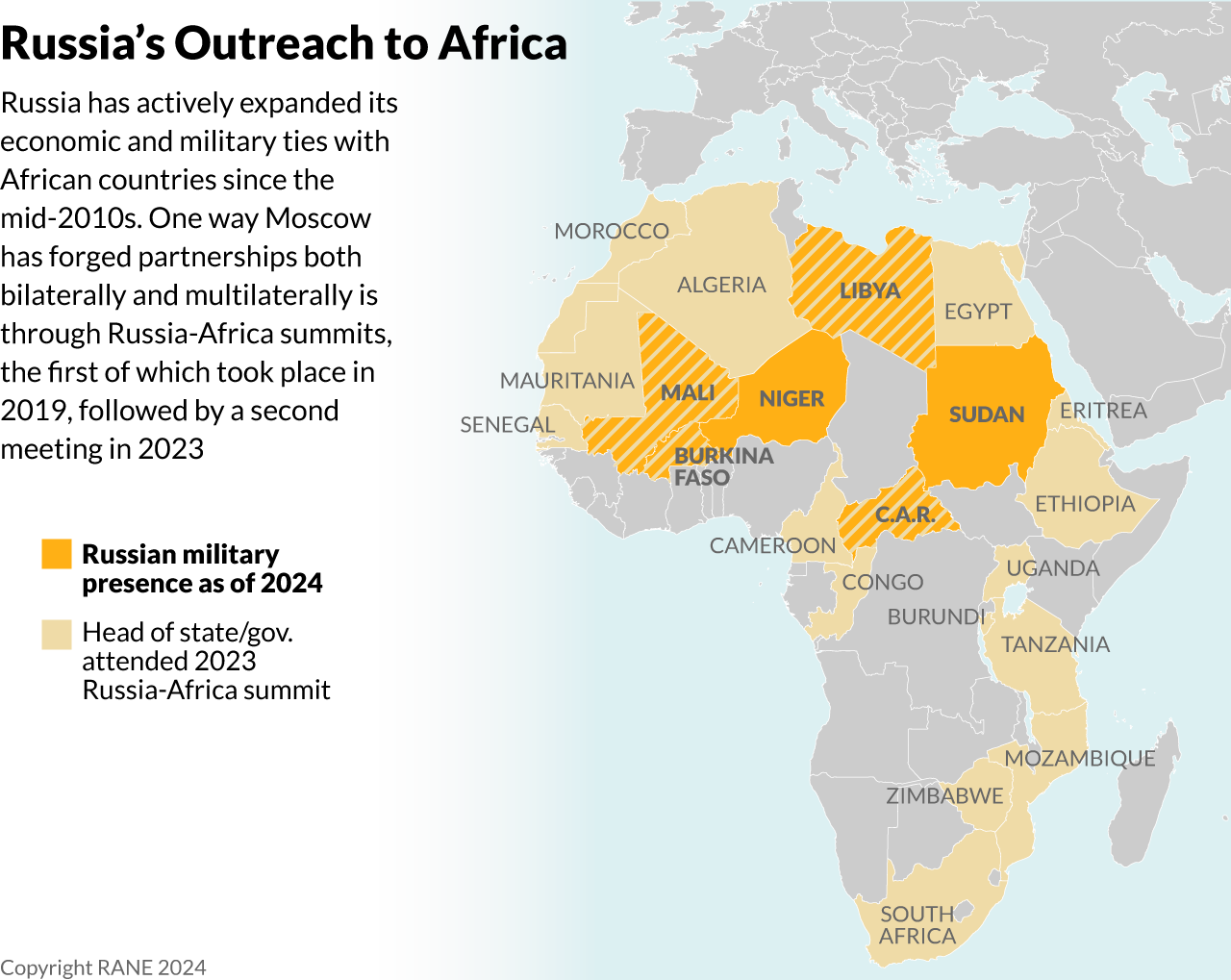
Russia's outreach to Africa is pivotal to the Kremlin's competition with the West in the Global South and could enable Russia to strengthen its power projection capabilities in the Indian and Atlantic oceans in the medium and long term. As part of Russian President Vladimir Putin's ambitions to challenge an allegedly Western-led world order, the Kremlin is leveraging anti-imperialist narratives to undermine Western interests in Africa and across the Global South. This ideological push has enabled Russia to forestall Western efforts to isolate it diplomatically in response to its invasion of Ukraine, particularly since many African leaders face domestic political pressure to retain cordial relations with Moscow and distance themselves from the West. In the coming years, the Kremlin will likely leverage its influence on the continent to press ahead with attempts to interfere politically in Western-friendly African countries. Major targets for Russian political interference on the continent in 2025 could notably include Cote d'Ivoire and Cameroon, as both countries appear set to face contested presidential elections in which elderly leaders who retain close ties with France are expected to run. Another prominent target for Russian destabilization campaigns will be Kenyan President William Ruto, who has positioned himself as a leading U.S. ally but faces growing public opposition. Moscow's expanding influence in Africa will also likely include efforts to secure naval access points on the continent, as recently seen in Sudan, to strengthen Russia's ability to project power globally. In the short-to-medium term, Russia will likely focus these efforts on coastal West Africa, which, if successful, would enable the Kremlin to secure logistical routes from the Sahel to the Atlantic Ocean and ease operational constraints facing the Wagner Group's operations in the Sahel.
- Ivorian President Alassane Ouattara's refusal to comment on whether he will run in Cote d'Ivoire's October 2025 presidential election and the lack of a clear successor have fuelled speculation that the 82-year-old president will run for a fourth term, which would risk triggering significant political turmoil.
- In Cameroon, 91-year-old President Paul Biya has strengthened ties with Russia over the past decade, despite keeping close ties with France. However, political instability surrounding Cameroon's 2025 presidential election could enable Moscow to expand its influence in the country, which plays an important logistical role in the Wagner Group's operations in the Central African Republic.
- In late May, the Sudanese Armed Forces confirmed that it would allow Moscow to set up a naval supply point near Port Sudan in exchange for military support.
Russia will likely attempt to weaponize emigration from Africa against the European Union, which risks accelerating the rise of far-right parties in Europe and could ultimately prompt the European Union to reduce support to Ukraine. The Sahel's deteriorating security environment is a major factor in internal displacement and emigration from the region. Russia and its ally Belarus have a history of weaponizing illegal immigration against the European Union, which suggests that the Kremlin will likely leverage its influence in the Sahel to fuel growing migration flows to Europe. While Moscow has been keen to help friendly regimes in the region consolidate power, Russia's apparent intent to fuel migration to Europe suggests that the Kremlin has little interest in committing further resources to stabilizing the region, as doing so would reduce Africa's migratory push factors. The Kremlin is also likely to encourage Sahelian states to adopt a less cooperative approach with the European Union on migration issues, as seen with Niger's scrapping of a law criminalizing the transport of migrants to the country's northern border with Algeria and Libya in December 2023. In addition, Russia could use its military presence in the Sahel and Libya to support the activities of migrant smuggling networks. Taken together, this suggests that Russia has the ability to fuel growing migration flows toward Europe, which would likely raise the costs the European Union faces in securing northern African countries' cooperation on migration issues. Moreover, rising migratory pressure on the European Union's southern border will likely fuel rising anti-immigration sentiment in the bloc, which could propel more far-right parties into power in Europe. If more far-right parties gain influence at the national level, the European Union may incrementally increase its pressure on Ukraine to enter peace talks with Russia and could ease financial and military support to Kyiv, which would position Moscow to secure a favorable outcome to the war.
- In Libya, the Wagner Group reportedly maintains close contact with trafficking gangs. Moreover, the Libyan National Army — with which the Kremlin has strong ties — has aided migrant smugglers by granting them security clearance.
Despite Russia's recent diplomatic gains in Africa, further advances by jihadist groups in the Sahel will force the Kremlin to choose between pressing ahead with a significant troop buildup in the region or risking the collapse of its most prominent allies on the continent. While Russia's low-cost strategy in the Sahel aligns with the Kremlin's strategic interests vis-a-vis Europe, its current provision of military support to Mali, Niger and Burkina Faso has not compensated for the French and U.S. exits from the region. This has left a major security vacuum in the Sahel that al Qaeda affiliate Jamaat Nusrat al-Islam wal-Muslimin, or JNIM, and Islamic State Sahel Province, or ISSP, have exploited by markedly expanding the geographical scope of their attacks over the past year, and both groups appear likely to maintain their momentum in the next few years. Further territorial advances by JNIM and ISSP will threaten to destabilize Russia-friendly juntas by triggering fresh coup attempts and could ultimately lead jihadist militants to topple military rulers in the medium-to-long term. Jihadist progression in the Sahel thus poses a major policy dilemma to Russia, as it will force the Kremlin to either press ahead with the deployment of several thousand more paramilitary forces to buttress local juntas or face a potential collapse of its most prominent allies on the continent. Moscow's decision on the matter will likely depend on the battlefield situation regarding its war with Ukraine, as it would prove more challenging to commit to a military buildup in the Sahel should Russian troops remain engaged in a high-intensity conflict against Kyiv. In addition to security considerations, Russia will also weigh whether the cost of such a military buildup in the Sahel would be worthwhile both financially and politically. Therefore, the Kremlin could decide that although the collapse of Russia-friendly juntas would delay efforts to expand its influence in Africa, Russia would have more to gain from the direct security threat a steep destabilization of the Sahel would pose to Europe.
