
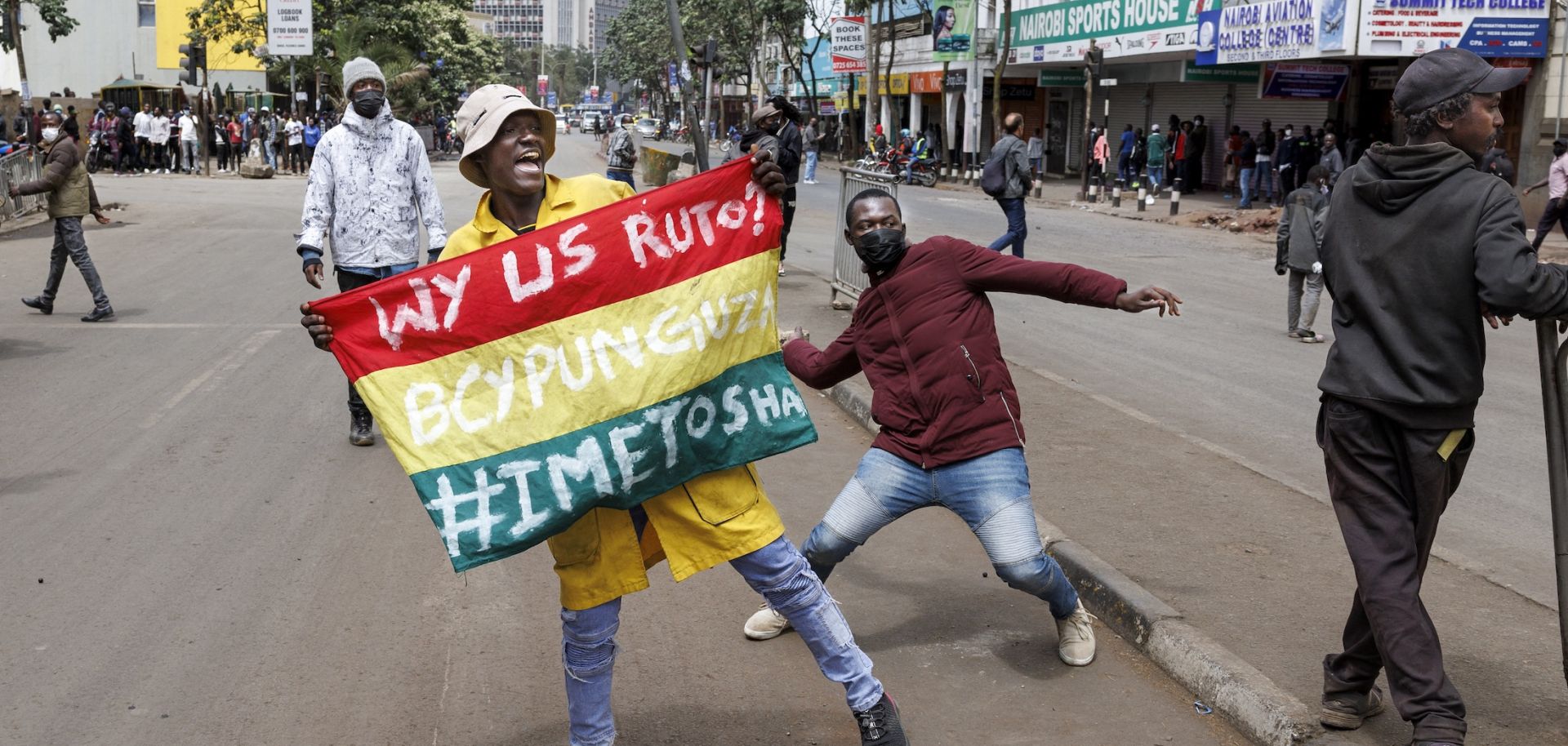
The Kenyan government's apparent intent to press ahead with budget cuts to make up for the lost revenue from the scrapped finance bill will risk reigniting large-scale protests that could force Ruto to scale back fiscal consolidation efforts, which would fuel renewed concerns about the country's debt sustainability. On June 26, Kenyan President William Ruto announced that he would not sign the controversial Finance Bill 2024, which aimed to raise $2.3 billion in new tax revenue. This came after protesters opposing the bill stormed the Kenyan Parliament on June 25 following the bill's approval in a third reading by 195-106 votes, prompting a heavy crackdown by law enforcement in which at least 23 people were killed. In a bid to appease protesters, Ruto said his government would launch a dialogue with Kenya's youth — who led the protest movement — as well as with professional and religious bodies, on how to manage Kenya's debt. However, he also announced that the scrapping of the finance bill would prompt the government to consider $1.5 billion worth of public expenditure cuts in this fiscal year, adding that development programs would be affected.
- During his June 26 address, Ruto also announced that the government would be pressing ahead with cuts to its operational expenditures, while also calling on Kenya's parliament, judiciary and county governments to press ahead with similar steps.
- Cuts to the 2024/2025 budget are expected to force the government to axe or postpone plans to hire 46,000 teaching interns within Kenya's Junior Secondary School, as well as scale down programs for rural and agricultural development, such as fertilizer subsidies.
The nationwide protests against the finance bill showcase the limits of Ruto's approach to fiscal consolidation, which has enabled Kenya to return to international capital markets but has come at the cost of high socioeconomic grievances. Kenya's debt-to-GDP ratio rose from around 43% in 2013 to 73% as of fiscal year 2023/2024. In April 2021, the country struck an agreement with the International Monetary Fund (IMF) granting it access to $3.6 billion in exchange for fiscal consolidation measures and structural reforms. Since taking office in September 2022, Ruto has largely sought to safeguard Kenya's debt sustainability by expanding the country's domestic tax base rather than cutting public spending. Ruto's policies have eased concerns about Kenya's short-term debt sustainability and have enabled the country to refinance its debt on international capital markets, which it had been sealed off from since 2021 due to prohibitive costs. But while these policies have strengthened Kenya's economic credentials, the government's tax hikes have fuelled widespread socioeconomic grievances and deepened the country's cost-of-living crisis. The nationwide protests against the Finance Bill 2024 have demonstrated the limits of this strategy, and showcased that further tax hikes would jeopardize the country's social and political stability.
- Total planned expenditure in Kenya's budget for fiscal year 2024/2025, which Kenyan lawmakers approved on June 13, currently stands at 3.992 trillion Kenyan shillings ($31.19 billion), up from 3.85 trillion shillings in the 2023/2024 budget and 3.37 trillion shillings in the 2022/2023 budget.
- Kenya's budget for the fiscal year 2024/2025 forecasts a fiscal deficit of 597 billion Kenyan shillings, or 3.3% of the country's GDP, which the government intends to plug through 333.8 billion shillings in net external borrowing and 262.2 billion shillings in net domestic financing.
- In February 2024, the Kenyan government completed a $1.4 billion Eurobond buyback after successfully issuing a $1.5 billion Eurobond. While the bond was sold at a premium, it enabled Kenya to reduce the country's default risk perception ahead of an expected $2 billion maturity in June 2024 and reverse a steep decline in the Kenyan shilling's value.
While the budget cuts Ruto hinted at would enable Kenya to uphold recent improvements to its creditworthiness, their implementation will likely trigger new rounds of protests that could force Ruto to water down fiscal consolidation plans, which together with rising political uncertainty would risk triggering renewed concerns about the sustainability of Kenya's debt. Together with austerity measures across the three branches of government, the $1.5 billion cut to public spending in the 2024/2025 budget that Ruto hinted at will — if implemented — enable Nairobi to make up for most of the revenue that the finance bill sought to raise. The passing of these budget cuts will thus likely prove sufficient for the IMF to approve its upcoming seventh review of Kenya's support program, which will help maintain recent improvements to the country's creditworthiness, as well as its access to international capital markets. However, cuts to the education sector will likely prove highly unpopular and trigger renewed demonstrations. Should protests escalate to a similar scale as the anti-Finance Bill demonstrations, Ruto may be compelled to scale back plans to reduce Kenya's fiscal deficit in the upcoming fiscal year. While the IMF may be willing to show flexibility in the face of Kenya's social and political challenges, Ruto's inability to curb the fiscal deficit would portend higher interest rates on the country's sovereign bonds, which would threaten to derail the Kenyan government's purported plans to press ahead with a second $1 billion Eurobond buyback in the second half of 2024. The recent interest rate surge on Kenyan Eurobonds, which rose from around 9.5% in late May to 10.5% as of late June, is unlikely to in itself derail the upcoming issuance. However, the risk that the anti-finance bill protests morph into wider anti-government protests, together with emerging tensions within Ruto's ruling coalition and watered-down fiscal deficit reduction targets, will threaten to cause a further repricing on Kenyan bonds that could price out Nairobi of international capital markets. This would renew concerns about Kenya's ability to meet external debt payments, and likely cause inflation to rebound in the event of a pronounced depreciation in the Kenyan shilling.
- Kenya's National Treasury expects to receive an estimated $1.4 billion from the IMF's upcoming two final reviews, including $500-600 million from the seventh review.
- Credit default swaps on five-year Kenyan bonds increased from 394 basis points on June 12 to 468.32 on June 26, but remained significantly below levels seen prior to Kenya's February refinancing, when they stood at over 700 basis points.
- Showcasing Kenya's rising political uncertainty are emerging divisions between Ruto and Kenyan Vice President Rigathi Gachagua, who has blamed the uproar against the finance bill on a failure by Kenya's National Intelligence Service to accurately brief Ruto on the scale of anti-government sentiment.
