
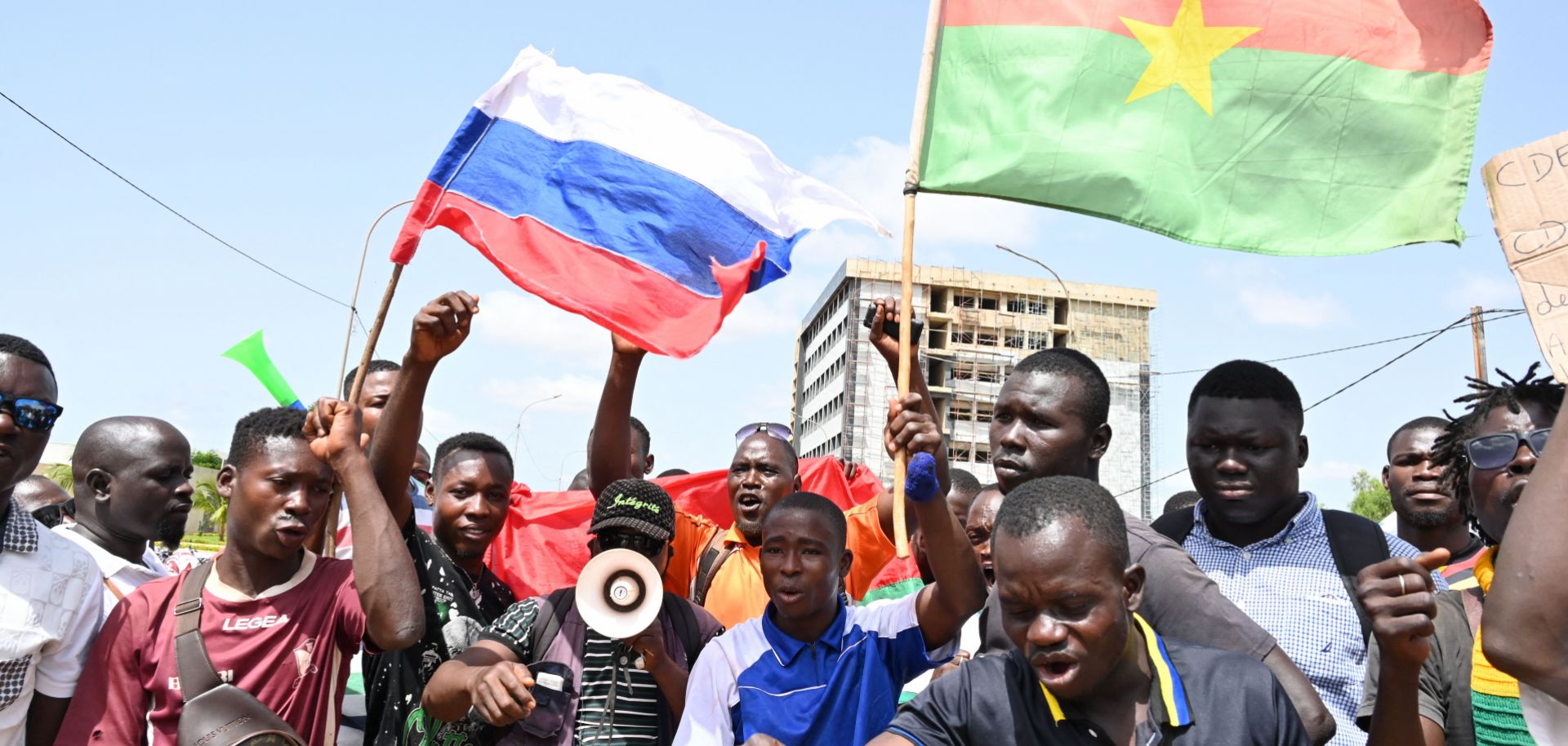
In sub-Saharan Africa, Russia will continue to capitalize on anti-French sentiment and political instability by launching disinformation campaigns designed to increase its influence across the region. Burkina Faso, Guinea, Mali and Sudan — and, most recently, Gabon and Niger — are among the African countries that have experienced military coups over the past two and a half years, fueling fears of a growing ''coup contagion'' across sub-Saharan Africa. Of the three Sahelian countries on this list (Mali, Burkina Faso and Niger), the coup leaders leveraged anger toward French political and military activity in the region to justify their political takeover (among other reasons) and took steps to suspend French media sites — like Radio France International and France 24 — from operating within their borders, thereby cutting off credible French news sites. Amid the consequent information vacuum, Russian-aligned threat actors were able to quickly and effectively launch disinformation campaigns that sought to further fuel anti-French sentiment among local populaces, while bolstering positive perceptions of Russia. Those campaigns materialized on social media platforms, including a network of accounts dubbed Russosphère, which have proliferated anti-French content and pro-Russian content on Facebook, YouTube and Twitter, in addition to Telegram and VK. Russian-backed accounts on these social media sites spread narratives that likened French activity in the region to modern-day colonialism, as well as positive posts depicting Russia's Wagner mercenary group as a positive force throughout the region. Local groups on the ground, including some believed to have direct connections with the Russian government, also supplemented Russia's influence operations by dispersing disinformation within local Facebook groups that aligned with anti-France and pro-Russian narratives; in Niger, these groups staged physical protests calling for revolution against France's presence in the country as well.
- According to research published in Feb. 2022 by the Atlantic Council's Digital Forensic Research Lab, pro-Russian accounts proliferated an array of anti-French and pro-Wagner narratives on Facebook targeting audiences in Mali surrounding that country's May 2021 coup. The posts called for France's withdrawal from Mali and celebrated the military takeover of coup leader President Assimi Goita. During the growing security crisis in the months leading up to the January 2022 coup in Burkina Faso, the same Russian-aligned network also added pages focusing on Burkinabe audiences, calling for Russian intervention in the Sahel and the eviction of French influence.
- In Niger, two groups — PARADE Niger and the Union of Pan-African Patriots — exhibited particularly strong Russian alignment, calling for increased cooperation with Russia and exhibiting diplomatic connections evidenced by visits from representatives of Russia's Foreign Ministry. During Niger's coup, these groups called publicly for greater cooperation with Russia and have promoted Russian-aligned propaganda on their social media sites.
While Russian influence operations have played a discernible role in some of these coups, Gabon's recent coup was marked by an absence of strong Russian influence, illustrating some key factors that highlight what can make Russia's disinformation playbook less relevant. Compared with the recent coups in the Sahel, the Aug. 30 coup in Gabon differed in its drivers and subsequent exploitable grievances, which, in turn, left far less fertile ground for Russian disinformation promoting anti-French narratives in the small Central African country. For one, Gabon's coup leaders overthrew a widely unpopular authoritarian leader after he won a controversial third term that would have extended his family's 56-year rule over the country. Unlike Mali, Burkina Faso and Niger, Gabon also hadn't previously suffered from the rising insecurity from a range of jihadist and militant groups that had undermined popular support for its elected government and cast French (and other Western) forces in those countries as incompetent or complicit Additionally, the buildup to the coups in Mali, Burkina Faso and (to a lesser extent) Niger was much more drawn out, with increasing levels of political instability and insecurity developing over several months. Gabon's coup, by contrast, appeared to happen practically overnight following the country's presidential election, which limited the window of opportunity for outside actors to engage in influence operations. Finally, whereas Wagner had established contracts in Mali and had actively tried to expand operations into Niger and Burkina Faso, Gabonese leadership had not pursued contracts with Wagner and, prior to the coup, had maintained economic and business partnerships with France and the West, limiting Russia's comparative influence in the country leading up to the coup.
- While far from being a diagnostic indicator, Russian flags were not present at pro-coup Gabonese protests, unlike those in Mali, Burkina Faso and Niger. There also have not been any reports indicating a rise in Russian disinformation in Gabon following the recent military takeover.
Widespread political instability and physical insecurity in other African countries will create more grievances that Russia can further exploit, portending greater risks to countries with underlying anti-French sentiment, especially amid jihadist threats and fraud and corruption accusations that further undermine popular trust in rulers. While the drivers of each African coup in recent years are complex and varied, many of those that existed in Burkina Faso, Mali and Niger are present in other African countries, posing heightened risks for political upheaval to occur elsewhere in the short term. This means that Russian-sponsored influence operations will have more inroads to opportunistically target tenuous political situations in African countries to try to foster warmer perceptions toward Russia. In particular, these campaigns will likely focus on other countries where anti-French sentiment may be stronger — such as Chad, Senegal and Togo — given Russia's past success in targeting such grievances. For example, Russian disinformation efforts had some of their earliest success in shifting attitudes in the Central African Republic toward Russia and against France over the last several years. Wagner already has a strong presence in the country, where Russian influence operations will likely continue to target citizens to bolster positive perceptions. More broadly, Russian influence operations will likely mirror efforts by Wagner to establish a presence in countries like Niger and Burkina Faso where jihadist threats remain a potent driver for a potential Russian incursion via the mercenary group. Beyond exploiting anti-French sentiment and jihadist concerns, Russian-aligned disinformation campaigns will also generally seek to inflame grievances around certain leaders' fraud and corruption. In places like Cameroon and the Republic of Congo, these grievances — combined with the presence of long-time leaders who have no clear successors — will perpetuate heightened political uncertainty, facilitating additional opportunities for Russian disinformation operations.
- A June 2023 report by the Atlantic Council's Digital Forensic Research Lab detailed examples of Russian disinformation campaigns in the Central African Republic, Mali, Burkina Faso, Cote d'Ivoire, Sudan and Niger. Among the campaigns detailed, researchers describe how coordinated networks of Facebook accounts targeted populations in the Sahel, amplifying pro-Russia, anti-France and anti-West narratives. Administrators for the network were found in Cote d'Ivoire, Mali, Libya and Sudan. Other narratives focused on jihadist threats in countries like Mali and depicted American and French flags in jihadist posts, alleging a correlation between jihadism and the West.
