
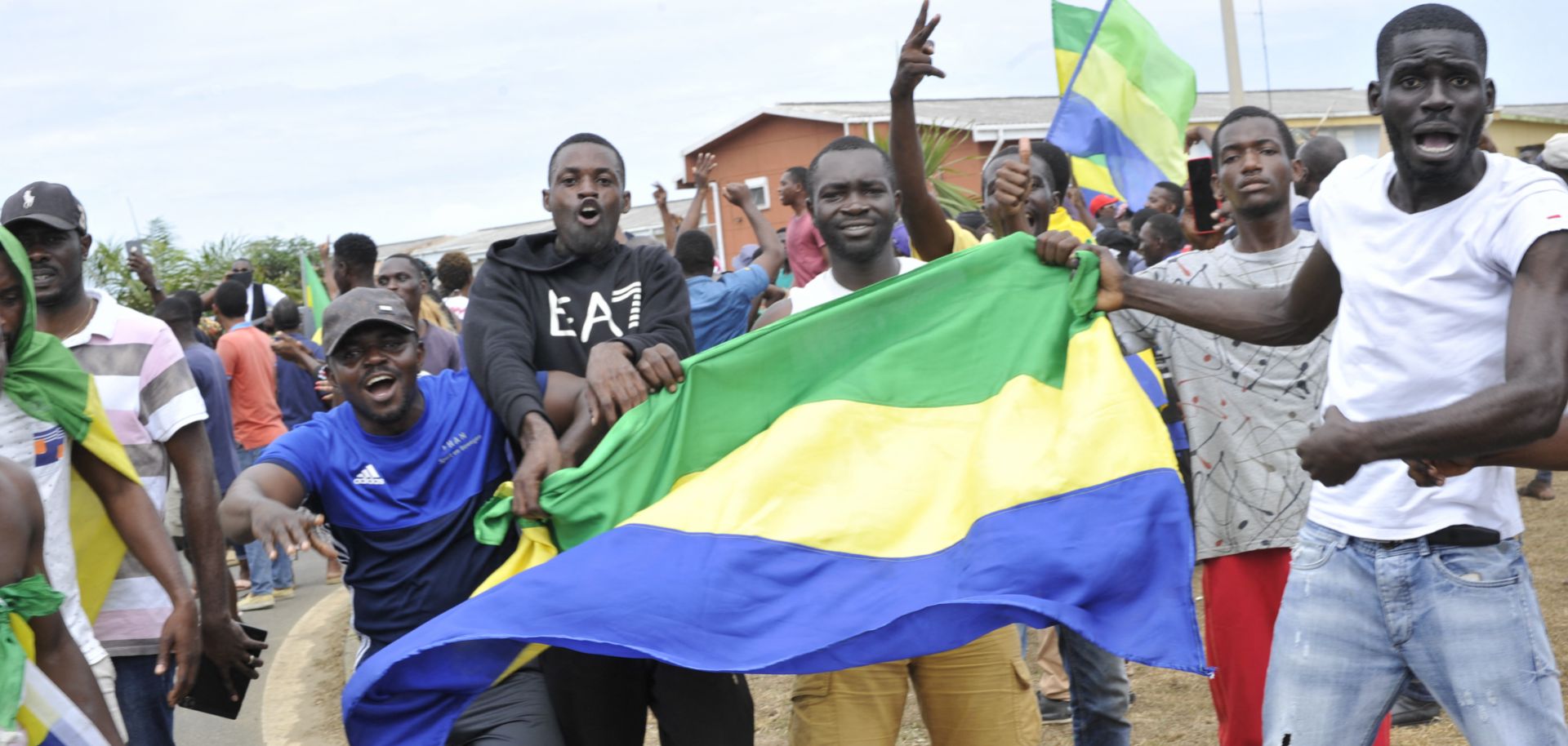
The fallout from Gabon's coup will likely be relatively limited as the military will probably sustain oil and gas exports, even as the pledged transition period will not necessarily lead to democratic processes and risks incentivizing more coups across central Africa. On Aug. 30, a group of military officers calling themselves the Committee of Transition and Restoration of Institutions announced that they had seized power and deposed President Ali Bongo, just hours after he was declared the winner of Gabon's Aug. 26 presidential election. The officers said that they represented all of Gabon's security and defense forces, and that they acted in response to Gabon's ''severe institutional, political, economic and social crisis.'' Coup leaders also announced the dissolution of the government, the Senate, the National Assembly and the Constitutional Court, as well as the closure of the country's borders ''until further notice.'' Bongo is reportedly being kept under house arrest with his family, although one of his sons has apparently been arrested for ''high treason.'' Gunfire erupted briefly in the capital of Libreville after the officers announced the coup, but no major security incidents arose before hundreds of people then turned out to celebrate the announcement. Later on Aug. 30, soldiers on national television named General Brice Oligui Nguema as the transition's leader.
- Gabon's electoral commission announced early on Aug. 30 that Bongo had secured another term in office after winning 64% of the vote in Saturday's ballot, soundly defeating opposition candidate Albert Ondo Ossa's 30%. The opposition party and external election observers cited electoral irregularities.
Widespread discontent with Bongo's rule suggests that the military has the support of much of the country, which will likely limit the disruptiveness of the political change. Bongo's victory in the Aug. 26 election would have extended his family's 56-year rule. The deposed president's father, Omar Bongo, governed Gabon from 1967 until his death in 2009 when his son succeeded him. Both men engaged in repeated fraud, violence, cronyism, corruption and state capture in order to achieve successive electoral victories — a tradition the new coup leaders have pledged to break. After decades without fundamental liberties and widespread perceptions of government self-enrichment at the expense of the Gabonese people, resistance to the Bongo regime is extensive and tends to flare during election cycles — another reason the coup leaders gave for their intervention. The situation is still evolving and resistance to the coup could still foment among Bongo loyalists. For now, however, it appears as though the military has the support of the majority of the population, alleviating potential stressors on the new administration like unrest.
Public support for the military, a likely muted international response and Gabon's dependence on its oil and gas sector will likely further limit disruptions, although the military takeover will not necessarily improve governance and could still increase the risk of more coups in broader central Africa. The dynamics of the coup in Gabon are very different from those of the recent coups in Sahelian states like Niger and Mali. The Gabonese coup leaders overthrew an unpopular authoritarian leader and have at least promised to rebuild the country's institutions. By contrast, coup leaders in the Sahel have increasingly used anti-French sentiment and jihadist encroachment as their rationale, with the exception of the recent coup in Niger and the 2020 coup in Mali (but the outcome of those two coups nonetheless led to similar developments). Given this and the nature of Bongo's autocratic regime, the international response to the coup in Gabon will likely be milder, although the African Union, European Union and others will almost certainly still be chastised for their inconsistent responses. Gabon's dependence on oil revenue will likely restrain any of the more extreme aspirations of coup leaders, with the country's oil and gas industry accounting for more than a third of the government's revenue and about two-thirds of its exports. This means the new junta is not only unlikely to disrupt its relationships with international oil companies but will probably also seek a political arrangement that is amenable to its external partners, likely further limiting the severity of the international response. As such, the new leadership will likely propose a transitional timeline, during which it will attempt to build new government institutions, purge the government of Bongo loyalists and hold elections — potentially with some military interference. Nonetheless, the transition period is far from guaranteed to produce stable institutions or democratic governance. Additionally, Gabon's military takeover could still have regional reverberations by potentially spurring a ''coup contagion'' that spreads to other Central African countries with dynastic authoritarian rulers who lack clear successors (like Paul Biya in Cameroon, Denis Sassou Nguesso in the Republic of Congo, and Teodoro Obiang Nguema Mbasogo in Equatorial Guinea). The precise triggers for further coups would vary by country. But in general, coup plotters' perception that they can successfully overthrow a government without major domestic or foreign pushback — regardless of veracity — could see opportunistic military leaders and other actors attempt their own power grabs elsewhere in Central Africa.
- The European Union and the African Union, along with France and several other Western governments, condemned the Aug. 30 coup in Gabon using language similar to that used following the Sahelian coups of recent years. But these international entities still appear unlikely to take a hard line against the country's new junta.
