
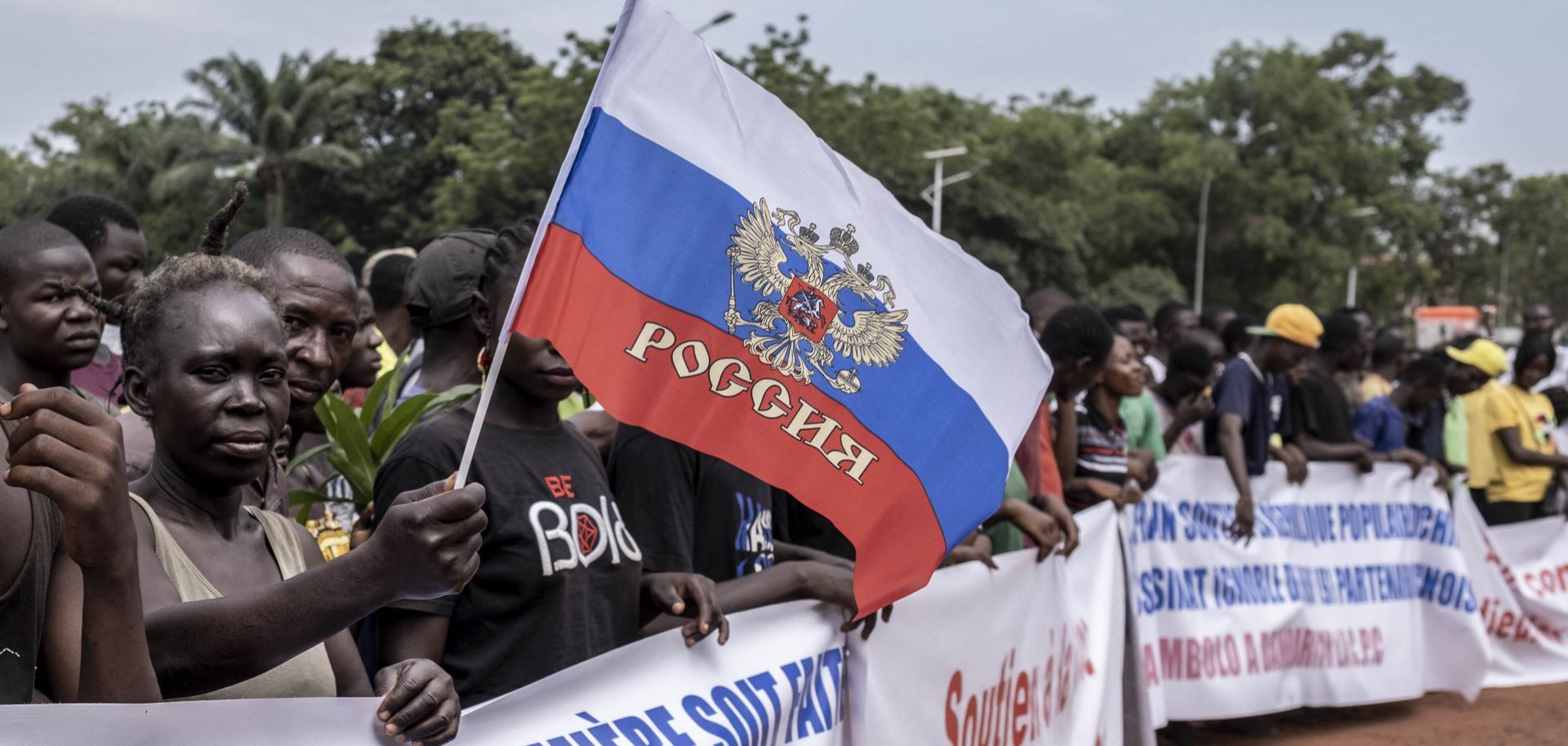
While the upcoming Russia-Africa summit will result in new promises of Russian grain deliveries and military assistance, it is unlikely to prompt a decisive reorientation of African states closer to Russia. On July 27, the second Russia-Africa summit will commence in St. Petersburg. According to the Russian government, this will be ''the highest-profile and largest-scale event in Russian-African relations'' and its goal will be to ''bring about a fundamentally new level of partnership'' by expanding cooperation across all areas of society, including politics, security, economic relations, technology, and the cultural and humanitarian spheres. New bilateral projects and agreements in these areas may be announced at the summit. But compared with the summit's previous iteration in 2019, which took place under significantly lower geopolitical tensions, this year's gathering will likely be overshadowed by recent events, including Russia's recent withdrawal from the Black Sea grain deal, uncertainty regarding the future of the Wagner Group and Russia's military cooperation in Africa, and the ongoing diplomatic battle over global reactions to Russia's invasion of Ukraine. While African responses will vary widely, these issues will likely dominate the trajectory of Russia's relations with the continent in the near to mid-term, jeopardizing Moscow's ability to make truly impactful or durable inroads with its African partners.
- On July 25, Russian President Vladimir Putin's aide indicated that of the 49 African states slated to attend the 2023 summit in St. Petersburg, only 27 would be represented by their heads of state or government, with the rest being represented by ministers or their ambassadors. This marks a significant decline from the first Russia-Africa summit held in Sochi in 2019, which was attended by 43 African heads of state or government. Western pressure to condemn Russia's recent exit from the Ukraine grain export deal reportedly drove many African governments to send lower-level officials to this year's summit, leading Moscow to claim the United States was trying to sabotage the event.
- On June 26, Russian Foreign Minister Sergey Lavrov said key topics in the summit's agenda will include technology transfers, the development of industry and critical infrastructure on the continent, projects on the digitalization of African states, the development of energy, agriculture and mining projects, and ensuring food and energy security, among other issues.
Russia's Interest in Africa
While the geopolitical context is different than in 2019, Russia's broader strategy for Africa is largely the same: exploiting power and influence vacuums left by the West on a low-cost basis. To do this, Russia has sought to secure deals in extractive industries and prop up authoritarian African governments that, much like Russia, feel Western pressure on transitions of power, democratic values, human rights, dependence on China and other issues.
While Russia will likely offer free grain to its African partners, this will not be enough to significantly reduce food insecurity in the region. The Black Sea grain deal that Russia recently exited allowed the export of 32 million tons of grain from three Ukrainian ports to 45 countries from July 2022. Even though the total volume of Ukrainian grain exports going to African countries under the deal was relatively low, its cancellation has already caused price hikes in African markets in response to fears of shortages. Given African leaders' disappointment with the deal's cancellation, along with their greater concerns over grain and food security and agriculture, will likely feature heavily during the summit. Moscow will probably attempt to pacify African leaders with plans for ''free grain,'' which Russian President Vladimir Putin initially suggested on March 20 and Kremlin Spokesman Dmitry Peskov reaffirmed on July 18, saying Russia would replace Ukrainian grain supplies to needy countries ''free of charge.'' But while the details and reliability of these Russian assurances are still unclear, the discussed volume of ''free grain'' shipments is unlikely to meaningfully impact food insecurity in Africa because countries will still face the consequences of global price shocks. Russia is reportedly discussing exporting an additional one to four million tons of ''free'' grain to African nations, but this is unlikely to sufficiently offset the impact of the Black Sea grain deal's collapse, as it is only a small portion of the many millions of tons of Ukrainian grain effectively removed from the global market that was often reexported or freed up by other states to increase shipments to African states. Furthermore, food insecurity across Africa was rampant before and during the grain deal; while Ukrainian grain marginally mitigated hunger in some countries, it was only a drop in the bucket in terms of the volume of food assistance that the continent needs. This is especially true for East African countries (including Ethiopia, Eritrea, Kenya, Somalia and Sudan), which have historically been among the largest recipients of Ukrainian and Russian grain.
- The African continent only directly received about 12% of Ukrainian grain volumes exported under the grain deal (or about 4 million tons, with the bulk of shipments going to North and East Africa). But rampant food insecurity prompted several African leaders to attempt to persuade Putin to renew the agreement before he announced its cancellation on July 17, knowing that any removal of grain from the physical market will likely harm African countries the most.
- Reports suggest that Russia could send about an additional one million tons of grain ''for free'' to Turkey to then be shipped onwards to Africa, with Qatar or other states footing the bill. One million tons is roughly equivalent to the amount of grain shipments Africa receives under the U.N. food program. But this is a small amount for Russia, which exported over 55 million tons of grain in 2022.
- China was arguably the largest beneficiary of the Black Sea grain deal, purchasing over a quarter of Ukraine's grain exported under the agreement. Now that the deal has been scrapped, China will be willing to pay whatever cost is necessary to maintain domestic food security — a major priority for Beijing — leaving poorer African countries saddled with higher prices resulting from bidding wars for grain shipments.
- Many African countries are highly dependent on Russian grain exports, with African wheat imports accounting for almost 90% of trade with Russia. But the collapse of the grain deal is unlikely to reduce the volume of these grain shipments to Africa, which have largely continued in recent months despite the deluge of Western sanctions against Russia. On July 23, Putin claimed Russia exported 11.5 million metric tons of grain to Africa in 2022, and was on track to deliver even more in 2023, which it will likely achieve as part of its efforts to displace blame from itself for rising food prices on the continent.
As speculation about the Wagner Group's future presence in Africa abounds, Russia will use the summit to offer military collaboration agreements and arms sales to strengthen ties with its partners on the continent. Following the recent armed revolt, Wagner-affiliated sources claim the group will have several thousand mercenary soldiers in Belarus without urgent assignment. While Wagner forces' continued presence across sub-Saharan Africa seems certain for the time being, the arrival of the group's forces in Belarus reignites questions about the size and capabilities of its African operations in the medium-to-long term. On one hand, some African governments may be hesitant to explore new cooperation with the organization, as Wagner's influence appears in decline and will likely remain under scrutiny inside Russia following the group's uprising last month. But on the other, the possibility of using Wagner's manpower to deepen ties with Russia and bolster the personal security details and/or forces will likely appeal to some African leaders — most notably those in Mali, Central African Republic, Libya and potentially Burkina Faso and/or Sudan, where short-term imperatives can dominate decision-making. In this context, the reaffirmation or announcement of new formal military collaboration agreements will be important to watch, as such deals could serve as a substitute for deeper cooperation with the Wagner Group, or, alternatively, as a springboard for a greater Russian footprint, paving the way for Wagner or other Russian private military companies' activities. Military collaboration agreements traditionally involve technical support in the form of arms sales, of which Russia has historically been a top provider in Africa. Such deals, however, would likely be relatively small and essentially symbolic due to Russia's extremely limited capacity for significant security arrangements, as the war in Ukraine rages on and Russia's falling arms exports are earmarked for more strategically important partners such as India.
- Between 2015 and 2019, Moscow signed 19 military collaboration agreements with African governments, but announcements of new deals have since slowed amid the Wagner Group's growing activities on the continent in recent years.
- Some discussion of the group may permeate the public discussions at this year's summit given that the Kremlin has — for reasons that aren't entirely clear — admitted its direct ties to the group in recent weeks. Following Wagner mercenaries' June 23-24 march on Moscow, Putin said on June 27 that Wagner had been ''fully financed'' from the state budget to the tune of 86 billion rubles (nearly $1 billion), albeit presumably within the context of the Ukraine war, and that Wagner chief Yevgeny Prigozhin's Concord Management had received a similar amount from state contracts to supply food to the Russian army. This admission has significantly eroded the plausible deniability that used to be central to Moscow's use of Wagner as a proxy, marking a fundamental shift that injects more uncertainty into the organization's future.
The stratification of African countries' ties with Moscow means that the summit is unlikely to bring about a more unified and common approach to Russia-Africa relations. Russia sees the summit as an opportunity to bolster the viability of its turn away from the West by gaining deeper influence with non-Western, Global South countries. But Moscow's approach won't engender greater unity, given that there is already significant variation in African states' amenability to increased Russian influence. Countries that openly support Russia on the global stage — like the Central African Republic, Eritrea, Mali, Sudan and Zimbabwe, which all voted against U.N. resolutions condemning the war in Ukraine — are likely to continue to do so and, in some case,s may pursue enhanced security arrangements with Russia (and the Wagner Group) as a result. But African states that are most closely aligned with the West — like Ghana, Kenya, Somalia, Rwanda and Niger, which, by contrast, have generally backed U.N. resolutions condemning the war — will likely remain distant from Moscow and resistant to new security deals. Even the countries that sit somewhere between these two camps — like the Democratic Republic of Congo (which has historical ties to Russia and has previously expressed interest in the Wagner Group, but has also publicly condemned Moscow's aggression in Ukraine in an effort to preserve its economic ties with the West) — are unlikely to more decisively align with Russia as a result of the upcoming summit.
- Some of the African countries that will participate in the Russia-Africa Summit are not seeking close ties with Russia. Kenya, for example, has been pursuing closer trade ties with the United States in recent months, and also criticized Russia's decision to exit the grain deal. In the meantime, Ethiopia, meanwhile, is attempting to regain status under the U.S. Africa Growth and Opportunity Act (AGOA) trade deal that enables duty-free access to American markets.
- Sudan's military leader Abdel Fattah al-Burhan is set to attend the summit and may celebrate ''free'' Russian grain, given his country's closer relationship with Moscow and the massive hunger crisis brought on by Sudan's ongoing civil war.
The summit will, however, offer insight into the state of Russia's relations with officially neutral countries like South Africa and Angola, as well as with francophone countries looking for distance from former Western colonial powers. South Africa is likely to keep a low profile during the summit to avoid drawing additional Western suspicion that President Cyril Ramaphosa supports Putin. Against this backdrop, any statements or deals between South Africa and Russia during the summit will provide insight into how Ramaphosa intends to navigate the battle between the West and Russia for influence. Moscow will likely also attempt to nudge countries like Angola (a major purchaser of Russian weapons) toward a more open diplomatic exchange. But while the Angolan government may sign additional economic and security deals, it is unlikely to alter its policy of neutrality on the world stage due to relatively high trade volume and economic cooperation with the United States and Western Europe. Meanwhile, Russia will likely attempt to deepen and/or forge new diplomatic pathways facilitated by grain and military deals with francophone countries that are increasingly turning away from France — like Burkina Faso, Guinea, Cameroon and the Republic of the Congo — which will likely garner some success, particularly as the leadership in several of these francophone countries face active insurgencies and/or additional threats to the longevity of their rule. On balance, stronger ties between Russia and one or two African states already leaning toward Moscow will not weaken global resolve against the war or tip the scales in favor of Russian influence on the continent. But the summit will still likely facilitate Russia's gradual deepening of partnerships with authoritarian African governments, serving to provide a façade of legitimacy for both sides on the world stage.
- South Africa has sought to maintain a neutral stance on the Ukraine war, which has seen it abstain from every U.N. vote on resolutions condemning Russia's invasion. But allegations that a Russian ship collected weapons from a naval base near Cape Town in March — along with President Ramaphosa's refusal to concede to Western calls to arrest Putin if he attended the July 23 BRICS summit in person in Johannesburg — have fueled Western accusations that South Africa, in fact, favors Russia.
