
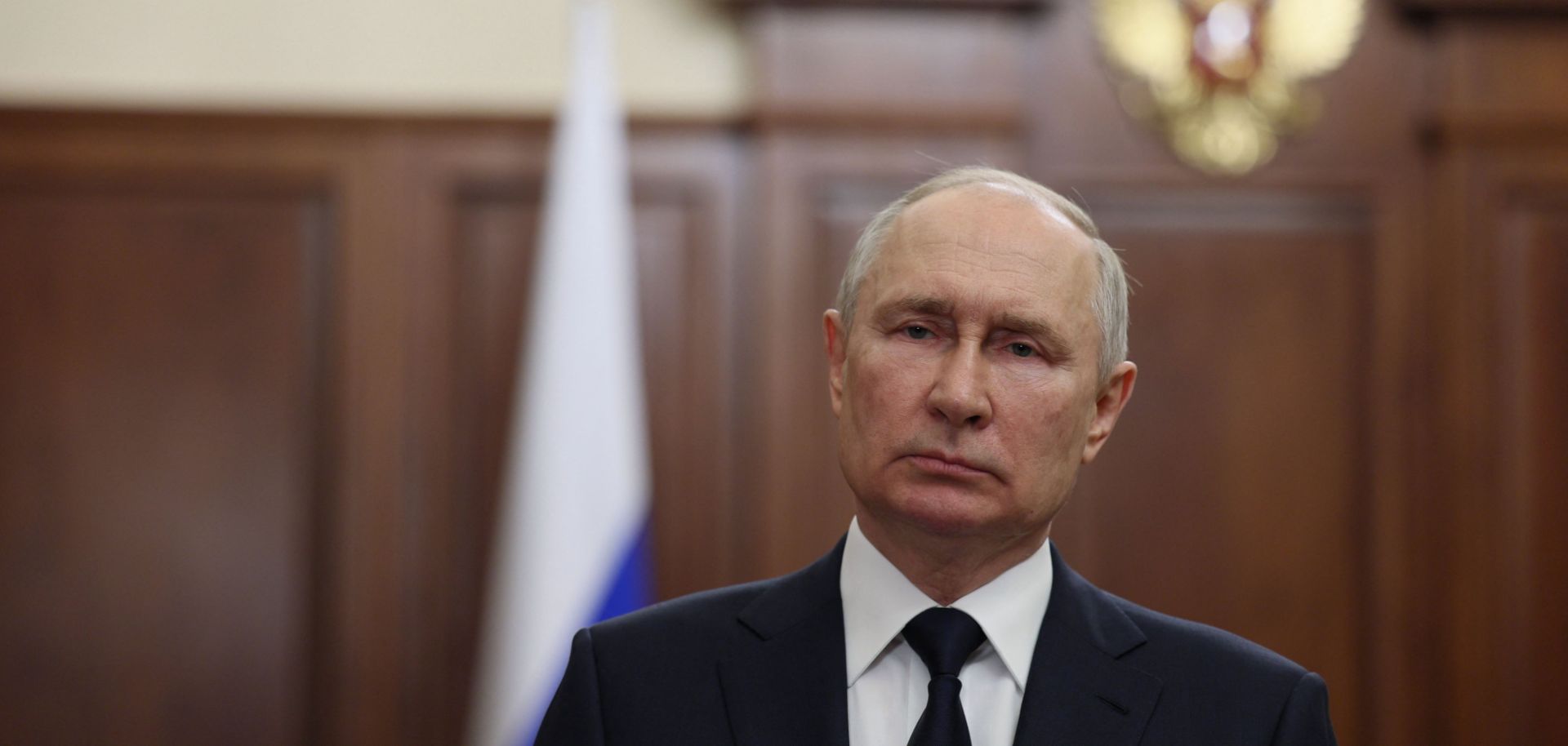
The Russian government may not fully observe the informal deal it reached to end Wagner chief Yevgeny Prigozhin's armed uprising, raising questions about the future of President Vladimir Putin's regime and his war in Ukraine. Putin made his second public address in as many days on June 26, and his first since Wagner mercenaries ended their June 23-24 march on Moscow. Like his previous address on June 24, Putin played both sides, directly calling the organizers of the rebellion traitors for making Wagner commit ''fratricide [as] Russia's enemies wanted,'' while also claiming that ''the vast majority'' of the group's fighters and commanders were still ''Russian patriots, devoted to their people and state.'' Most importantly, Putin offered Wagner fighters the opportunity to continue serving Russia on the frontlines in Ukraine by entering into contracts with the defense ministry, thus reaffirming his support for Defense Minister Sergey Shoigu's order that Wagner and other ''volunteer detachments'' formally come under his ministry by July 1 (which Wagner leader Prigozhin claims precipitated his uprising). Notably, Putin also said he would uphold his ''promise'' of allowing Wagner troops to join Prigozhin in neighboring Belarus, but that he was sure only those who recognized their ''tragic mistake'' of participating in the mutiny would actually do so.
Against this backdrop, how the incidents of June 23-26 will impact the trajectory of Russia's political stability and invasion of Ukraine will depend on events that will become clearer in the coming days. Key questions to assess the future of Russia's domestic and foreign policies include the following:
1) What is the Wagner Group's future as a legal and organizational entity?
The future of the Wagner Group largely depends on the extent to which its associated legal entities and brand will be permitted to continue operating in Russia as authorities frame its leadership as treacherous. So far, Russian officials have not directly said Wagner will be liquidated as an organization within the country. Even as he makes clear some of its leaders are corrupt and betrayed their country, and that its soldiers must be placed under the control of the regular Russian army, Putin is also not yet referring to the organization as if it no longer exists. Reports suggest that business structures in Russia supporting Wagner, at least for now, remain in operation following the uprising. This makes sense, as the Kremlin likely wants to avoid a premature legal crackdown that could jeopardize the group's activities — particularly those in Africa, which are vital to Russia's geopolitical strategy.
However, in the long run, it appears highly unlikely that Wagner will continue to operate abroad under its current branding and organizational structure. According to Prigozhin, Belarusian President Alexander Lukashenko offered to let him operate further within Belarus' ''legal jurisdiction,'' without providing details. The legal and public disassembling of Wagner forces would lead to the disbandment of some of Russia's more elite and experienced offensive formations, many of which will be hesitant to embed themselves into the rigid structures of the Russian Armed Forces. And while the dispersal of Wagner troops into the regular army is unlikely to result in an immediate loss of morale, further losses and a weak performance throughout Ukraine's counteroffensive could actually see more Russian soldiers eventually rally around Prigozhin and his criticisms of the Kremlin.
2) Will Putin uphold his deal with Prigozhin?
On June 24, the Kremlin announced it had reached a deal to end Wagner's insurrection, in which the Russian government agreed to drop mutiny charges against Prigozhin, who along with other Wagner personnel would also be allowed to leave Russia for Belarus if they wished to do so. In exchange, Prigozhin would end the drive on Moscow and Wagner fighters who didn't take part in the uprising would sign contracts with Russia's defense ministry. For Putin, the agreement serves to both appease the pro-Prigozhin sectors of the Russian people, elite and military, as well as increase pressure on his own inner circle to achieve better outcomes in the Ukraine war. For Prigozhin, the deal appears to maintain his influence over certain Wagner operations and the stability of its operations in the near term by allowing him and his associates nominal safety from intervention by Russian law. But while officials have commented on the broad contours of the agreement, its terms are not codified, nor are they considered binding or official — meaning Putin can easily renege on the deal should he see fit. The Russian president could, for example, break the spirit of the deal by keeping investigations directly related to the mutiny case against Prigozhin and Wagnerites closed, only to persecute them for corruption and other offenses. Putin could also eventually order to kill Prigozhin and the other Wagner fighters involved in the uprising, to more effectively intimidate any opponents and prevent dissension in the Russian government. By punishing Prigozhin and other Wagner leaders, Putin would reassert the strength of his regime and send a message to other potential conspirators as the 2024 presidential elections near. Putin will only follow the agreement to the extent to which he believes it serves his interests, and could easily bend and backtrack on the deal once Prigozhin has been sufficiently marginalized and the Russian government is ready to take over the Wagner group's activities under new leadership.
3) What is Belarus' role?
Putin thanked his Belarusian counterpart Lukashenko for helping broker the deal that ended Wagner's armed uprising — a narrative the Kremlin may believe will further tie Lukashenko's public image to Russia's war in Ukraine. It is difficult to discern what role the Belarusian president actually played in halting the rebellion, as it is very possible that Lukashenko was simply the easiest third party Putin could call on to help resolve the crisis. Prigozhin also claimed that Lukashenko approached him with a deal that would allow the Wagner Group to continue its operations in Belarus, and Lukashenko has publicly indicated that he hopes the Belarusian army can learn from Wagner's fighting experience. Given Belarus' vassal status to Russia, Prigozhin and Wagner personnel can be easily apprehended if they step out of line in Belarus. Their presence in the country may thus be intended for other purposes, like exaggerating an already implausible threat of a renewed Russian attack toward Kyiv from the north. But while it so far appears that Prigozhin and at least some of the approximately 8,000 Wagner assailants who took part in this weekend's events may relocate to Belarus, most Wagner forces will stay at their camps in Ukraine and Russia to prepare for new assignments under contracts with Russia's defense ministry, and play no part in the claimed Belarus exile. The number of Wagner forces who actually relocate to Belarus is thus unlikely to be enough to credibly threaten a new offensive from there. However, Prigozhin's influence has already cemented itself among the Russian populace, particularly the far-right and ultra-nationalist sectors. Should Prigozhin's mutiny incite further domestic unrest or challenges, it is very likely that he'd simply be targeted in Belarus or extradited to Russia.
4) Will Prigozhin remain a political actor?
Prigozhin's refusal to accept the Kremlin's spin that the war in Ukraine was going according to plan ushered his rise to political stardom in Russia, where many felt he was speaking truth to power. Even after the mutiny, Prigozhin has continued to push his narrative of events and grievances with Russia's defense ministry, and may very well keep criticizing Defense Minister Sergey Shoigu and General Staff Chief Valery Gerasimov, and eventually even Putin. Unless the Kremlin more actively moves to discredit Prigozhin, there is reason to believe he may remain Russia's second most popular political actor behind Putin, even in exile in Belarus. The Kremlin is thus likely exploring ways to muzzle him if he is allowed to live. If enacted in its publicly claimed form, the deal Prigozhin reached with Moscow to halt his recent uprising may enable him to temporarily continue leading Wagner operations in Africa from Belarus. But the Kremlin appears highly unlikely to allow this in the medium-to-long term, especially if Prigozhin keeps making critical statements about Russia's leaders. That said, if Russian troops face further setbacks in Ukraine, more Russian citizens could become disgruntled with the war effort and identify with Prigozhin's critical narratives regarding their government's strategy in Ukraine — in which case, punishing Prigozhin would run the risk of only worsening such popular dissatisfaction. There are no obvious candidates who could replace Prigozhin as Wagner chief in the interim, as most high-ranking individuals in the organization backed him, though finding someone more loyal to the Kremlin would not be difficult, at least in theory.
5) Will Shoigu and Gerasimov keep their jobs?
All current evidence indicates that, for now, the two main targets of Prigozhin's grievances — Defense Minister Sergey Shoigu and General Staff Chief Valery Gerasimov — remain at their posts. But the armed rebellion has provided Putin with very clear grounds to mandate their removal at any time, especially as it becomes increasingly difficult to claim that the Ukraine invasion has gone according to plan. Indeed, Prigozhin's armed revolt also showed that certain portions of the Russian public and even the military, along with influential far-right figures, support his critical views of the country's military leadership. But while ousting Shoigu and Gerasimov from office could bolster Putin's popularity among these crucial constituencies, it could also backfire on Putin by shaking the trust of loyalists in his inner circle (who, unlike Prigozhin, actually have the institutional and personal resources to secure power). For months, the Russian president has avoided calls to oust Shoigu and Gerasimov, as removing the two highest-ranking military officials in Russia (below Putin) would risk prompting other loyalists in Putin's inner circle to conspire against him by showing them he's no longer their protector. The Kremlin will thus probably continue to delay such a decision to avoid sending the message that it has capitulated to Prigozhin. But Shoigu and Gerasimov could be canned later this year if Ukraine makes more gains on the battlefield, which would enable Putin to tie the decision to the two leaders' incompetence and not Prigozhin's rebellion.
6) What can be gleaned from the international reaction to the Wagner rebellion?
For now, the overall reaction by Russia's regional partners and allies indicates that support for Putin's regime remains largely unchanged. Iranian President Ebrahim Raisi and Turkish President Recep Erdogan expressed their support for Putin and his government, and emphasized the need for domestic stability in Russia. In a June 25 statement, Chinese President Xi Jinping described the Wagner crisis as an ''internal affair,'' but also reasserted his support for Russia's sovereignty, indicating his continued support for Putin. Iran, China and other pro-Russian states will likely disseminate narratives that accentuate Putin's ability to de-escalate the situation and handle Prigozhin. However, should Putin's rule face future challenges, these countries may reassess their positions. At a regional level, Putin's mid-crisis briefings to Kazakhstan, Armenia, and Uzbekistan were met with indifference and a lack of commitment in coming to Russia's aid. And in the West, officials will likely continue observing for further signs of weakness in Putin's rule, and attempt to tie any similar events in the future with the need to capitalize on the window of opportunity they create by supporting Ukraine's counteroffensive operations.
