
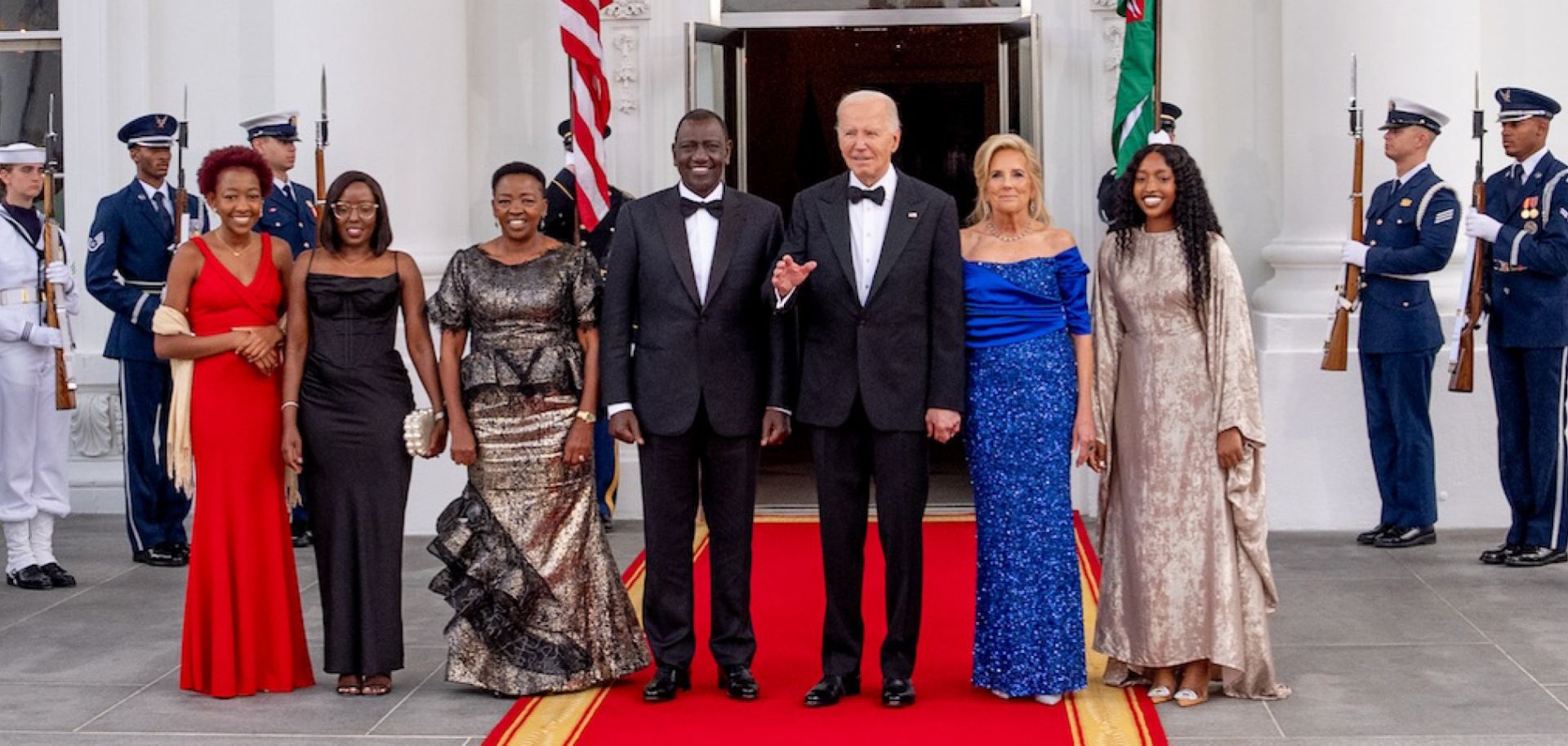
Stronger ties with the United States will raise Kenya's profile as a destination for U.S. investments and help it play a leading role in stabilizing the Horn of Africa, but the two countries' partnership will be tested by Nairobi's police deployment to Haiti and former U.S. President Donald Trump's potential reelection. On May 23, the White House announced that President Joe Biden would label Kenya as the United States' first major non-NATO ally in sub-Saharan Africa. The announcement came amid Kenyan President William Ruto's state visit to the United States, in which he clinched significant investment pledges into Kenya, including a $3.6 billion investment by Everstrong Capital LLC to build a highway connecting Nairobi to the port city of Mombasa, as well as a $1 billion investment by Microsoft and Emirati company G42 into a 1-gigawatt data center. In addition to securing strong backing from the private sector, Ruto's trip also secured strong bilateral cooperation with the United States in a variety of fields, including governance, energy, cybersecurity and artificial intelligence, defense and semiconductors.
- According to consultancy Tellimer, combined private sector investment pledges secured by Ruto during his May 2024 state visit to the United States amounted to 0.9% of Kenya's annual GDP. However, many investment pledges span several years, and some may be watered down due to changes in business strategy.
- During Ruto's state visit, Kenya and the United States established a Strategic Dialogue on AI, with the body's first meeting due to take place by the end of 2024. The two countries also agreed to strengthen cooperation on AI safety and work toward interoperable standards.
Ruto's state visit follows his government's efforts to strengthen bilateral ties with the United States in an effort to diversify Kenya's economic partnerships and secure additional financing to stabilize the country's economy. While in the United States, Ruto confirmed that Kenyan police officers would be deployed to the gang-ridden Caribbean country of Haiti in June as part of a U.N. mission. The Biden administration has strongly supported Kenya's police deployment in the hopes that Nairobi can stabilize Haiti, whose degraded security environment presents a number of potential threats to the continental United States. The deployment will mark a new milestone in Kenya-U.S. relations, which Ruto has sought to strengthen since taking office in September 2022. The Kenyan president's push to reinforce bilateral cooperation has been primarily driven by Nairobi's need to secure new financing — including development aid and private sector investments — to shore up Kenya's economy, which faces challenges amid a high debt load and a balance of payment deficit. Stronger economic ties with the United States also help Kenya diversify its economic partners, as the country significantly expanded its reliance on Chinese bilateral and commercial loans under former Kenyan President Uhuru Kenyatta. The Biden administration's expansion of development financing and labeling of Kenya as a major non-NATO ally can thus be understood as a vote of confidence in Ruto's drive to showcase Kenya as a leading U.S. ally in Africa. However, it may also be part of a broader strategy by the United States to shore up its influence vis-a-vis China in Africa, even though Nairobi is set to retain ties with Beijing as Ruto seeks to maximize foreign investments into Kenya.
- During Ruto's trip, the United States' Development Finance Corporation pledged a further $250 million of development aid for Kenya, bringing the organization's portfolio in the country to over $1 billion.
- Kenya's debt-to-GDP ratio stood at an estimated 73% of GDP in fiscal year 2023/2024, up from around 43% in 2013. Fitch Ratings gave Kenya's credit a B rating in February, with a negative outlook.
- As of January 2024, Kenya owed 70.1% of its bilateral external debt and 15.3% of its total external debt to China. Kenya owes over $5 billion to China's Exim bank as part of loans to finance the construction of a standard gauge railway connecting the port city of Mombasa to Nairobi.
Stronger economic cooperation with the United States will raise Kenya's profile as an investment destination and help the country insert itself in the lower end of global value chains, but high taxes, persisting corruption and infrastructural challenges will likely limit Kenya's attractiveness to foreign investors. A key priority for Ruto will now be to finalize a bilateral Strategic Trade and Investment Partnership (STIP) with the United States, which both sides want to conclude ahead of the U.S. presidential election in November. The agreement's ratification would help Kenya attract additional foreign investments, which the country needs to drive growth given Kenyan companies' difficulties in accessing credit amid high interest rates. The Biden administration has also proved keen to encourage investments in Kenya's low-carbon energy and carbon capture and storage (CCS) projects, with the goal of showcasing the energy transition's opportunities to other developing countries. Investments in Kenya's power sector will support authorities' efforts to meet the country's rapidly growing electricity demand and eventually help lower high energy costs, which remain one of the main hindrances to the country's industrialization. By unlocking more foreign investments, Nairobi's strengthening economic and technical cooperation with Washington could enable the country to progressively expand its role in the lower end of global value chains, supporting Kenya's manufacturing and tech sectors. However, Kenya's high debt levels will likely compel Ruto to maintain fiscal consolidation measures, including high taxes, to reassure markets about the country's solvency, which will curb investor appetite in the short-to-medium term. Corruption and persisting infrastructure challenges will add to Kenya's hurdles in capitalizing on friend-shoring trends, requiring the country to press ahead with further domestic reforms to fully unlock its economic potential.
- The Biden administration has not yet indicated whether it would seek congressional approval for the STIP, but if it does, the lapsing of the United States Trade Promotion Authority in 2021 means that securing approval will require a three-fifths majority in the U.S. Senate, rather than a simple majority, and that Congress could later amend the agreement, potentially causing significant delays to its ratification
- On June 18, Ruto's government introduced the Finance Bill 2024 in the Kenyan parliament. The bill includes several fiscal consolidation measures, including tax hikes targeting the country's financial services, manufacturing and retail sectors.
- 90% of Kenya's electricity is currently produced using renewables. During Ruto's trip to the United States, the two countries also launched the United States-Kenya Climate and Clean Energy Industrial Partnership, which aims to boost the deployment of renewable energy projects as well as support the emergence of low-carbon manufacturing in Kenya, including steel production and the refining of minerals. CCS projects are set to be central to this new partnership, with the United States looking to help Kenya unlock further investments and capitalize on its location along the Great Rift Valley, which is underlaid with porous basalt rock that can be pumped with CO2 captured in the atmosphere via direct-air-capture technologies. A number of companies developing these technologies are already planning to open plants in Kenya, including Germany's Carbon Atlantis and Belgium's Sirona.
- During Ruto's trip, the Biden administration outlined its ambition to help strengthen Kenya's regulatory environment and upskill its workforce to raise the country's appeal as an investment destination for semiconductor manufacturing, with a focus on assembly, testing and packaging.
The United States' pledge to designate Kenya as a major non-NATO ally portends stronger bilateral defense cooperation, which will support Nairobi in leading stabilization efforts in neighboring Somalia, in turn risking an uptick in al-Shabab attacks targeting Kenya. The Biden administration's upcoming labeling of Kenya as a major non-NATO ally will offer Nairobi access to enhanced training, defense cooperation and military research. But while the designation is motivated by Nairobi's leadership of U.N. forces in Haiti, it will also help Kenya play a more active role in stabilizing the Horn of Africa. This will prove especially important given the planned departure of African Union (AU) peacekeepers from Somalia by the end of 2024, which will risk creating a security vacuum that could be further exacerbated if Ethiopian troops are expelled from the country amid the ongoing diplomatic dispute between Addis Ababa and Mogadishu over Somaliland. Enhanced training and the provision of additional U.S. defense systems will enable Kenya to better patrol its border with Somalia, and will also support Kenya's efforts to strengthen the capacity of Somali security forces. Kenya's role in stabilizing Somalia is thus likely to grow, including through an expansion of joint counterterrorism operations with Somali security forces that could pave the way for Nairobi to maintain a troop presence in its eastern neighbor following the departure of AU peacekeepers. However, this will also raise Nairobi's profile as a target for attacks by the Somalia-based jihadist group al Shabaab, which could result in a marked escalation of the terrorism threat in eastern Kenya should al Shabaab receive advanced weapons systems from Iran-backed Houthi militants in nearby Yemen.
- During Ruto's state visit to the United States, Kenya secured the delivery of 150 M1117 Armored Security Vehicles, as well as 16 utility helicopters, including 8 Bell UH-1 Iroquois and 8 MD-500s.
- On May 23, Somalia's federal cabinet approved a draft bilateral defense agreement with Kenya that includes intelligence sharing, joint military operations, and capacity building.
- Around 3,500 Kenyan troops are currently deployed in Somalia through the African Union Transition Mission in Somalia, but the AU mission is currently due to withdraw from the country by the end of 2024.
- On June 11, CNN reported based on U.S. intelligence sources that the Houthis were considering providing al-Shabab with unspecified weapon systems. The two groups already have loose ties over regional illicit arms trafficking, suggesting that direct talks between the Houthis and al-Shabab could involve higher-grade weapon systems, such as surface-to-air missiles or attack drones.
In the long term, stronger U.S.-Kenya relations will support Nairobi's ambition to play a leadership role in African affairs, but the two countries' partnership could become strained if Nairobi caves to domestic political pressure to draw down its police forces in Haiti, and/or if Trump reenters the White House. The Biden administration will likely leverage its stronger ties with Kenya to expand the United States' outreach across Africa, for example through the Nairobi-Washington Vision, which aims to expand financial support from multinational institutions to countries facing high debt burdens. But as it faces competing international priorities, the United States may also increasingly delegate the management of regional crises to Nairobi, which would support Ruto's goal of turning Kenya into a leading diplomatic player on the continent. However, Washington's willingness to outsource the oversight of local crises will be tested by Kenya's police deployment to Haiti, as Ruto's willingness to cope with political pressure in the event of mounting casualties among Kenyan security forces in the Caribbean country will be key for Washington in assessing Nairobi's reliability as a security partner. While Ruto is currently keen to showcase Kenya's credentials as a reliable U.S. ally, strong domestic backlash against the police deployment would pressure Ruto to draw down Kenyan officers in the run-up to Kenya's 2027 presidential election. Moreover, a Trump victory in the U.S.'s November 2024 election would likely delay the approval of the STIP, though Trump would be unlikely to scrap the deal given that his administration launched talks for a bilateral free trade agreement with Kenya during its first term. Furthermore, in order to shift U.S. trade relations with African countries to a bilateral basis, Trump may refuse to renew the African Growth Opportunity Act, which would raise tariffs on a wide range of Kenyan exports to the United States in the absence of a bilateral free trade agreement.
- On June 9, Ruto stated that Kenya's police deployment to Haiti would take place within one to two weeks.
- The African Growth Opportunity Act provides Kenya and other designated sub-Saharan countries duty-free access to the U.S. market for over 1,800 products, in addition to the more than 5,000 products that are eligible for duty-free access under the Generalized System of Preferences program.
