
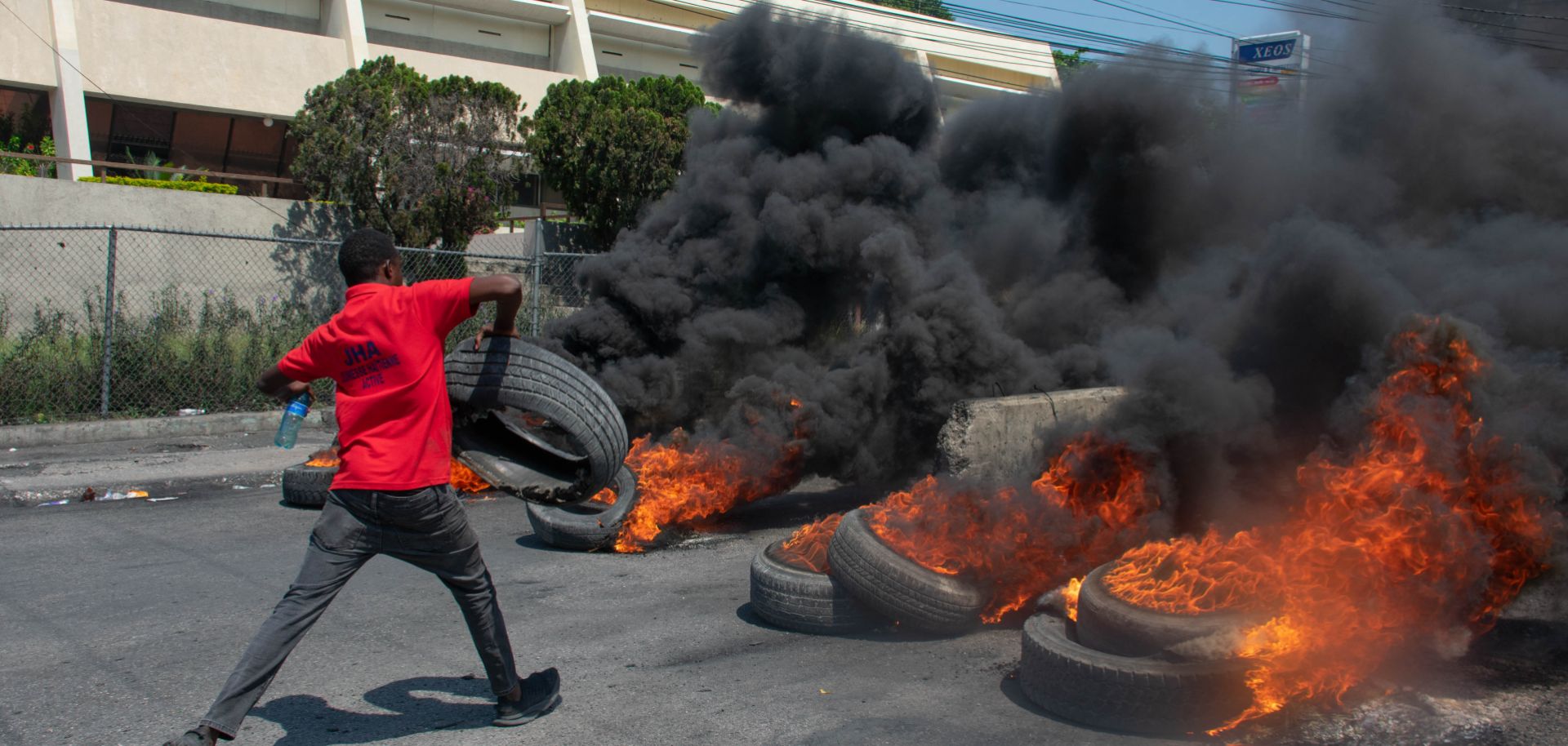
The deployment of 1,000 Kenyan police officers to Haiti would likely boost U.S.-Kenya relations and pave the way for further Western economic support to the East African country, but backlash among the Kenyan public in the event of high fatalities will risk weakening the government politically and could compel it to adopt a less ambitious foreign policy. On March 13, Kenyan President William Ruto confirmed on X (formerly Twitter) that Kenya would lead the deployment of a U.N.-backed mission in Haiti to combat local criminal gangs there amid the Caribbean country's rapidly deteriorating security environment. This came after Ruto signed an agreement on March 1 with outgoing Haitian Prime Minister Ariel Henry to enable the deployment of Kenyan police forces to Haiti, which has experienced a sharp spike in gang violence in recent weeks. The agreement was seen as paving the way for Kenya's deployment of 1,000 police officers to Haiti after Kenya's High Court ruled on Jan. 26 that such an agreement was a necessary precondition for the deployment to proceed.
- The United Nations approved the deployment of the Kenyan-led Multinational Security Support (MSS) mission to Haiti in October 2023, but court challenges within Kenya had delayed the deployment. However, the United Nations' mandate does not require the MSS to be led by Kenya for the deployment to go ahead.
- Ruto's March 13 comments came after Kenya's foreign ministry announced on March 12 that it would freeze its police deployment to Haiti following Henry's March 11 announcement that he would step down as the country's prime minister.
- A major point of contention within Kenya over a potential deployment to Haiti comes from the fact that Kenya's constitution does not overtly provide for the deployment of police forces outside of the country. Nonetheless, Ruto has been keen to see Kenya's General Service Unit (GSU), an elite unit of the Kenyan police, lead the mission to Haiti given its preparedness for urban combat, arguably making it better suited than regular Kenyan troops to secure a successful outcome of the mission.
- On March 6, Kenyan opposition figure Ekuru Okot stated that he would launch an additional legal challenge against the deployment of Kenyan police officers to Haiti, claiming that Henry, who postponed Haitian elections scheduled in February 2023, lacked the legitimacy to enter into such an agreement. However, the formation of Haiti's transitional presidential council, which is set to replace Henry after he resigns, could ease legal challenges within Kenya against the deployment.
Ruto's push to lead a multinational force in Haiti comes as he has ramped up initiatives to defuse conflicts in Kenya's neighborhood, with the goal of cementing his country's status as a leading mediator in East Africa and beyond. Soon after taking office in September 2022, Ruto agreed for the Kenyan military to lead the East African Community's regional force to the Democratic Republic of the Congo's North Kivu province to reinstate stability to the conflict-ridden region amid an insurgency from M23 rebels. While the regional force's track record is mixed and was ultimately instructed to depart from the country by Congolese President Felix Tshisekedi, Kenya's leadership of the force nonetheless highlighted Ruto's desire to have his country play a more active role in mediating nearby conflicts. Indeed, under Ruto, Kenya has also sought to arbitrate the civil war in Sudan between the country's Sudanese Armed Forces and Rapid Support Forces paramilitary group, as well as rising tensions between Somalia and Ethiopia amid the latter's maritime deal with Somalia's breakaway region of Somaliland. Ruto's ambitions come as Ethiopia has taken a more assertive foreign policy under the leadership of Prime Minister Abiy Ahmed, which has impeded Ethiopia's ability to serve as a neutral power capable of mediating regional conflicts — thus leaving a void for Kenya to fill. Beyond these regional dynamics, Ruto is also looking to assert Kenya's status as a champion of African interests, as seen in September 2023 when he hosted the first Africa Climate Summit, which laid out a consensus among participating African countries about their climate priorities. Kenya's leadership of the MSS deployment to Haiti thus fits within Ruto's broader foreign policy, potentially enabling him to raise Nairobi's profile as a key player in facilitating cooperation between countries in the Global South.
- Kenya's ambition to reinforce Africa-Caribbean cooperation predates President Ruto's ascension to power, as his predecessor Uhuru Kenyatta prioritized developing the A3+1 format between African and Caribbean nations at the U.N. Security Council.
While a successful deployment of a Kenyan-led multinational mission would boost U.S.-Kenya relations, it will come at a high risk and could result in growing domestic backlash that may compel Ruto to adopt a less ambitious foreign policy. The United States has been one of the main supporters of the deployment of a Kenyan-led multinational mission to Haiti, pledging $300 million to fund the MSS mission. Should the deployment successfully improve Haiti's security environment, it would further strengthen U.S.-Kenya relations, which Ruto has sought to enhance in a departure from his predecessor Kenyatta, who tilted closer to China. This, in turn, would pave the way for closer defense cooperation between Washington and Nairobi. It would also likely unlock more state-backed U.S. and EU economic support for Kenya, such as through the G7-backed Partnership for Global Infrastructure and Investment, which would in turn help improve Kenya's medium-term economic outlook amid continued concerns over the country's debt. However, Kenya's stance that it will not deploy its 1,000-strong police force to Haiti until a ''new constitutional authority'' is in place in the Caribbean country could ultimately result in Nairobi's leadership of the MSS being transferred to another country in the event that the formation of Haiti's new transitional presidential council faces persisting deadlock. Even if the deployment goes ahead, it will face major challenges amid Haitian gangs' widespread control of the country, especially in the capital Port-au-Prince. Given limited support for the deployment among the Kenyan public, high casualties among Kenyan officers deployed to Haiti could quickly crystallize the public's opposition to the mission. Such backlash could raise domestic pressure on Ruto to withdraw Kenyan troops from the Caribbean nation, which would damage the credibility of his push for Kenya to play a more active role in international affairs.
- In September 2023, Kenya and the United States signed a defense agreement that would see both countries strengthen bilateral cooperation against the jihadist group al Shabaab.
- The U.S.-backed Millennium Challenge Corporation signed a $60 million program with Kenya aimed at improving growth and urban mobility in September 2023, shortly after Kenya agreed to lead the MSS to Haiti.
- An additional hurdle potentially facing Kenya's deployment to Haiti will be the potential for human rights abuses, with experts voicing concerns regarding the human rights record of Kenya's police forces.
