
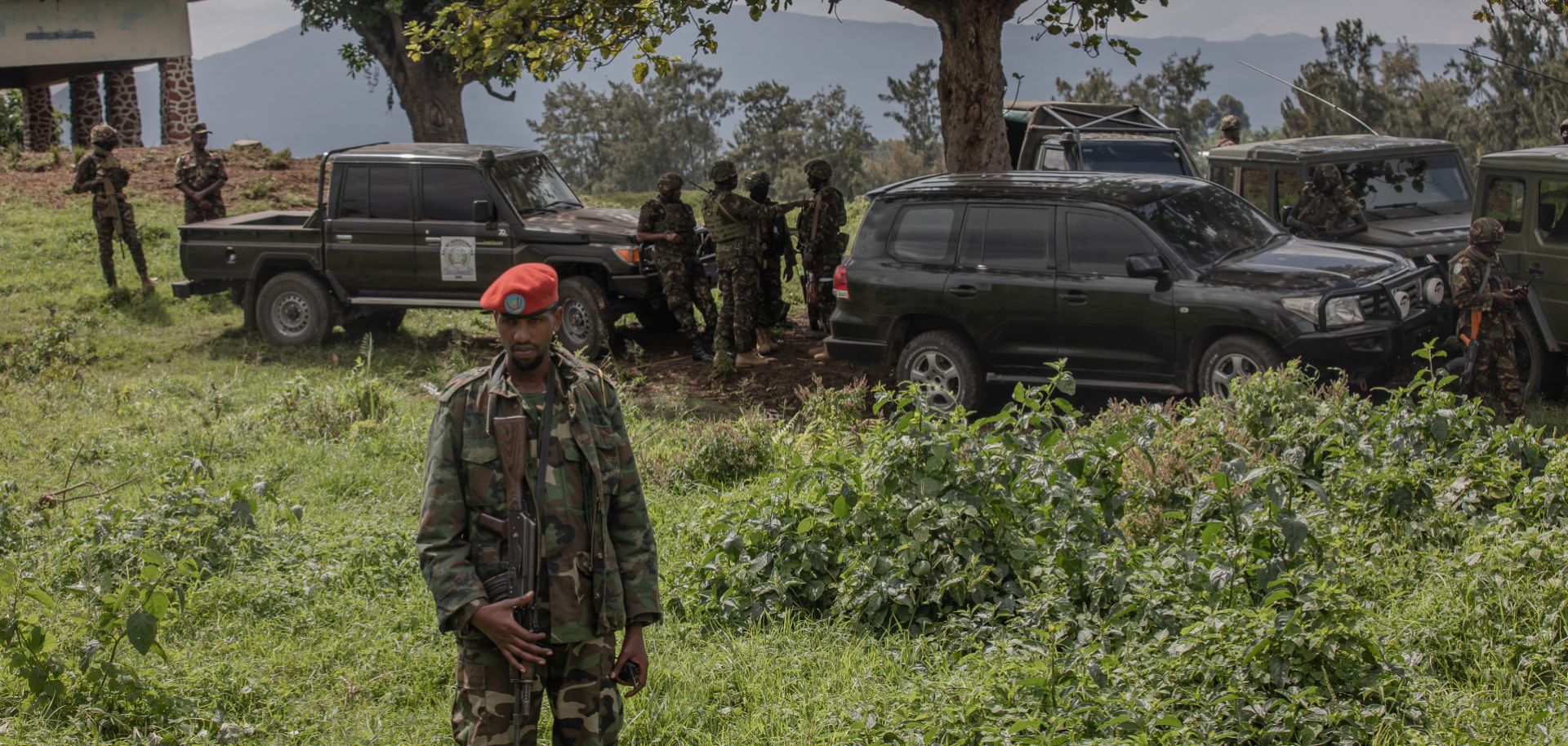
M23 fighters guard the area during a meeting between the rebel group and East African Regional Force (EACRF) officials at the Rumangabo camp in the eastern Democratic Republic of Congo on Jan. 6, 2023.
Rwanda's attack on a Congolese jet will elevate already high bilateral tensions and increase the risk of Congolese retaliatory measures that could limit the progress of peace processes in eastern Congo. Rwandan forces fired at a Sukhoi-25 fighter jet of the Democratic Republic of the Congo on Jan. 24 for allegedly violating Rwandan airspace. The Rwandan government claimed that the fighter jet was flying over Rwanda’s Rubavu district — which is located across the Congolese border from Goma (a provincial capital city of about 5 million people) — when the Rwandan military took “defensive measures” by shooting at the aircraft. The Congolese government has denied Rwanda’s accusation that the jet violated Rwanda’s airspace, instead claiming in a Jan. 24 statement that “Rwandan shooting was directed at a Congolese aircraft flying inside Congolese territory,” while confirming that the jet had landed in Goma without any major damage. Moreover, the Congolese statement alleges that Rwanda’s actions “amount to an act of war” intended to undermine regional efforts to resolve the ongoing armed conflict in eastern Congo.
- An unverified video widely shared on social media that shows a fired projectile exploding near an airborne military aircraft purportedly captured the incident. However, there are currently no reports suggesting where exactly the aircraft was located when it was fired upon.
- The Democratic Republic of the Congo has been plagued by decades of armed conflict, largely stemming from its civil war — as well as the Rwandan genocide and civil war — in the late 1990s and early 2000s. As a result, an estimated 120 non-state armed groups operate in the country. This includes the Congolese Tutsi rebel group M23, which launched a rebellion against the Congolese government and was defeated in 2012. M23 was largely dormant until its resurgence in 2021-2022, when it claimed that the Congolese government had reneged on its promise to integrate the group into the Congolese military and society.
The incident comes amid heightened tensions between the Democratic Republic of the Congo and Rwanda following the resurgence of the M23 rebel group in eastern Congo over the past year. Since the summer of 2022, M23 has launched major offensives in the Democratic Republic of the Congo’s North Kivu province, seizing territories in Bunagana, Rutshuru and Kibumba (approximately 20 kilometers, or about 12 miles, north of Goma) and displacing over 450,000 civilians. The Congolese government, the United Nations and other Western powers have all accused Rwanda of supporting the rebel group, but Rwanda denies the allegations. The conflict has prompted two separate peace processes, including the most recent Luanda peace accord facilitated by Angola. In November, the Angola-brokered peace accord prompted Rwanda and the Democratic Republic of Congo to agree on the need for a cease-fire between the Congolese military and M23 (Rwanda approved of the cease-fire, but still denied allegations regarding its support for the group). Amid the ongoing dialogue, the East African Community (EAC) has also deployed a Regional Force (EACRF) spearheaded by Kenya to North Kivu and other provinces — in part to try and negotiate M23’s withdrawal from occupied territories, which has reportedly so far has led the rebels to withdraw from at least one of their territories in Rumangabo. But despite the declared cease-fire and the presence of EACRF troops, clashes between M23 and Congolese forces have persisted, especially as the Congolese government continues to claim that M23 has not withdrawn from all of its occupied territories. This is now the third time Rwanda has accused the Congolese government of violating its airspace since M23’s resurgence. But the Jan. 24 incident is the first in which Rwanda has responded to an alleged airspace violation with force.
- In November, an unarmed Congolese warplane landed at a Rwandan airport following a reconnaissance mission near the border, which the Congolese government claimed was an accident. Then on Dec. 28, the Rwandan government claimed that a Congolese fighter jet briefly violated its airspace in Rubavu territory, further stating that the “repeated violations are against the spirit of Luanda and Nairobi peace initiatives.”
Heightened tensions and constrained dialogue between the Democratic Republic of Congo and Rwanda will contribute to the perpetuation of the conflict with M23 and slow progress toward its peaceful resolution. While previous diplomatic flashpoints have primarily been rhetorical via accusations and condemnations, there are precedents for episodes of more direct confrontation (like the Jan. 24 incident) resulting in greater retaliation, including severed diplomatic ties, border closures and low-level violence (like cross-border shellings or incursions). This means that Congolese retaliation that goes beyond heated rhetoric against Rwanda is possible. Even before Rwanda’s attack on the Congolese jet, Congolese President Felix Tshisekedi, citing Rwanda’s alleged support for M23, had reportedly refused to attend a Jan. 23 meeting with Rwandan President Paul Kagame in Doha, Qatar, to discuss the ongoing conflict in eastern Congo. Thus, Rwanda’s attack on the Congolese jet (and, implicitly, the Congolese military’s potential third airspace violation) will only reinforce the mistrust and risk miscalculation in response to the incidents. This will at least hinder continued dialogue and, at worst, prompt escalatory violence that brings the two countries to more direct, large-scale confrontations. In a low-probability but high-impact scenario, a series of miscalculations regarding the proportionality of retaliatory action (such as amassing troops on the border and cross-border incursions targeting soldiers rather than rebels) could lead to an escalation to war. However, neither country has the resources to support an inter-state war, which means that both will likely use heated rhetoric amid these flashpoints, while also trying to keep the conflict within tolerable margins.
- In May, tensions escalated after Rwandan forces reported cross-border shelling from the Democratic Republic of Congo in its northern Musanze district that injured several civilians and caused significant infrastructural damage. The shelling reportedly occurred around the same time that the Congolese government captured two Rwandan soldiers for allegedly crossing into Congolese territory. Then in November, Rwanda claimed to have shot and killed a Congolese soldier who had crossed into Rwandan territory and fired on Rwandan security forces.
- In a report leaked in late December, the United Nations claimed it had found “substantial evidence” that the Rwandan army was providing weapons, ammunition and uniforms to M23, giving credence to the Democratic Republic of Congo’s allegations of Rwandan support for the rebel group.
