
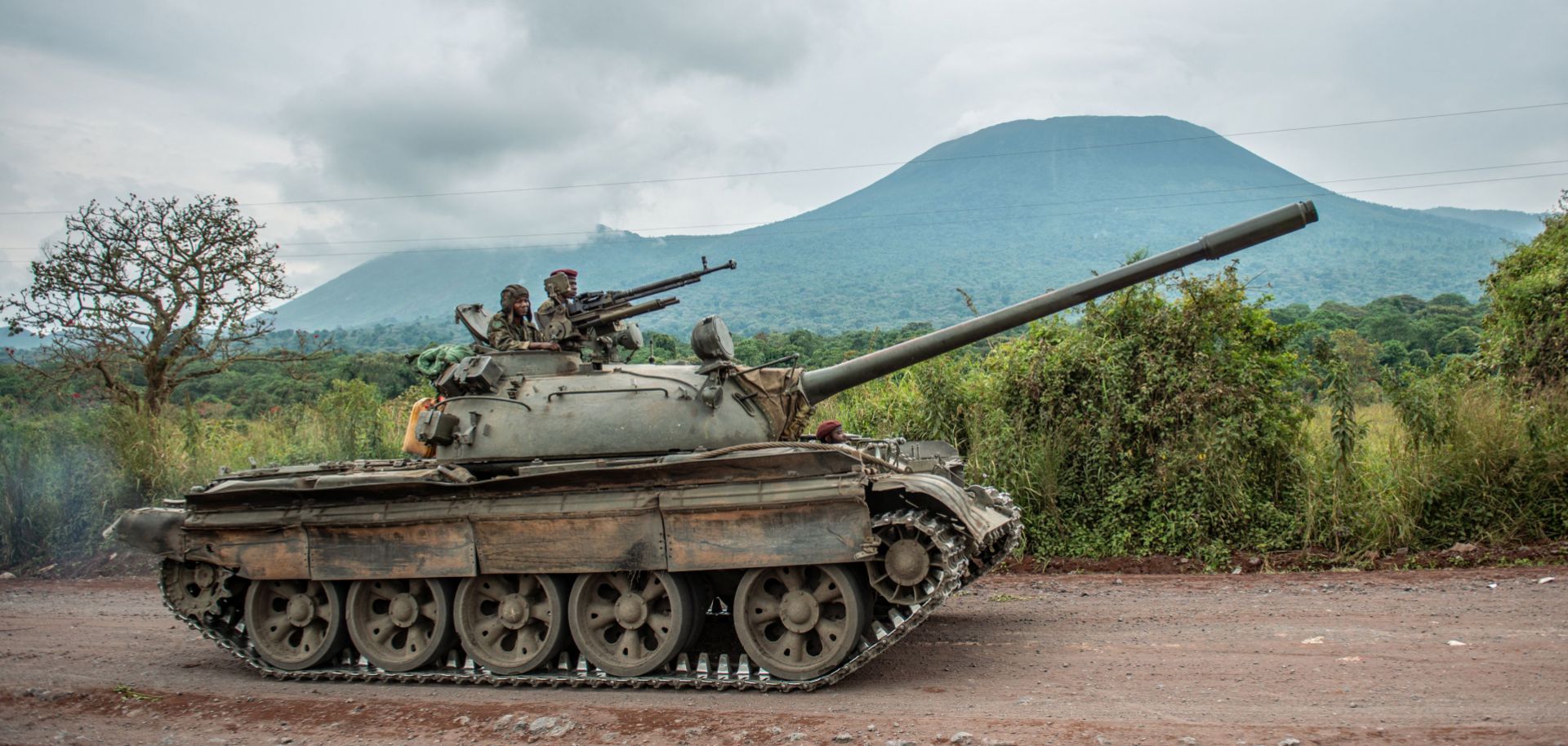
A Congolese army tank heads toward the eastern city of Goma on May 25, 2022, amid clashes with M23 rebels.
While unlikely to trigger a direct military conflict with the Democratic Republic of the Congo, Rwanda’s desire to maintain influence in eastern Congo and alleged support of local militants there will continue to fuel diplomatic tensions and further undermine Congo’s ability to govern its war-torn, resource-rich eastern provinces. Tensions between the two African neighbors have escalated in recent weeks after Rwanda accused the Armed Forces of the Democratic Republic of the Congo (FARDC) of shelling civilians across the border in late May. In response, Congo accused Rwanda of supporting the M23 rebel group that is active in eastern Congo. Congolese President Felix Tshisekedi then subsequently summoned Rwanda’s ambassador and suspended flights from Congo’s capital city of Kinshasa to the Rwandan capital of Kigali. The Rwanda Defense Force (RDF), Rwanda’s national military, also alleged that Congolese forces had captured two of its soldiers who were patrolling the countries’ shared border. While Rwanda and Congo have a long history of animosity, the latest escalation in tensions coincides with the increased activity of the M23 militant group, which Congo says Rwanda covertly supports (the United Nations also accused Rwanda of backing M23 in 2014).
- Amid the current uptick in tensions, the Congolese government also recently suspended a deal in which Congo’s state-owned mining firm Sakima sent gold to Rwandan firm Dither LTD for refining.
- On June 13, M23 rebels overran Congolese forces and seized Bunagana, a town in the eastern North Kivu province located about 60 kilometers (37 miles) from Goma, a city of nearly 2 million. Bunagana reportedly remains under rebel control, illustrating the increased capabilities of M23 fighters — a factor that’s likely helping fuel tensions between the Central and East African neighbors.
- On June 17, a Congolese soldier crossed the Rwandan border and fired at Rwandan soldiers. Rwandan forces then fired back, killing the assailant.
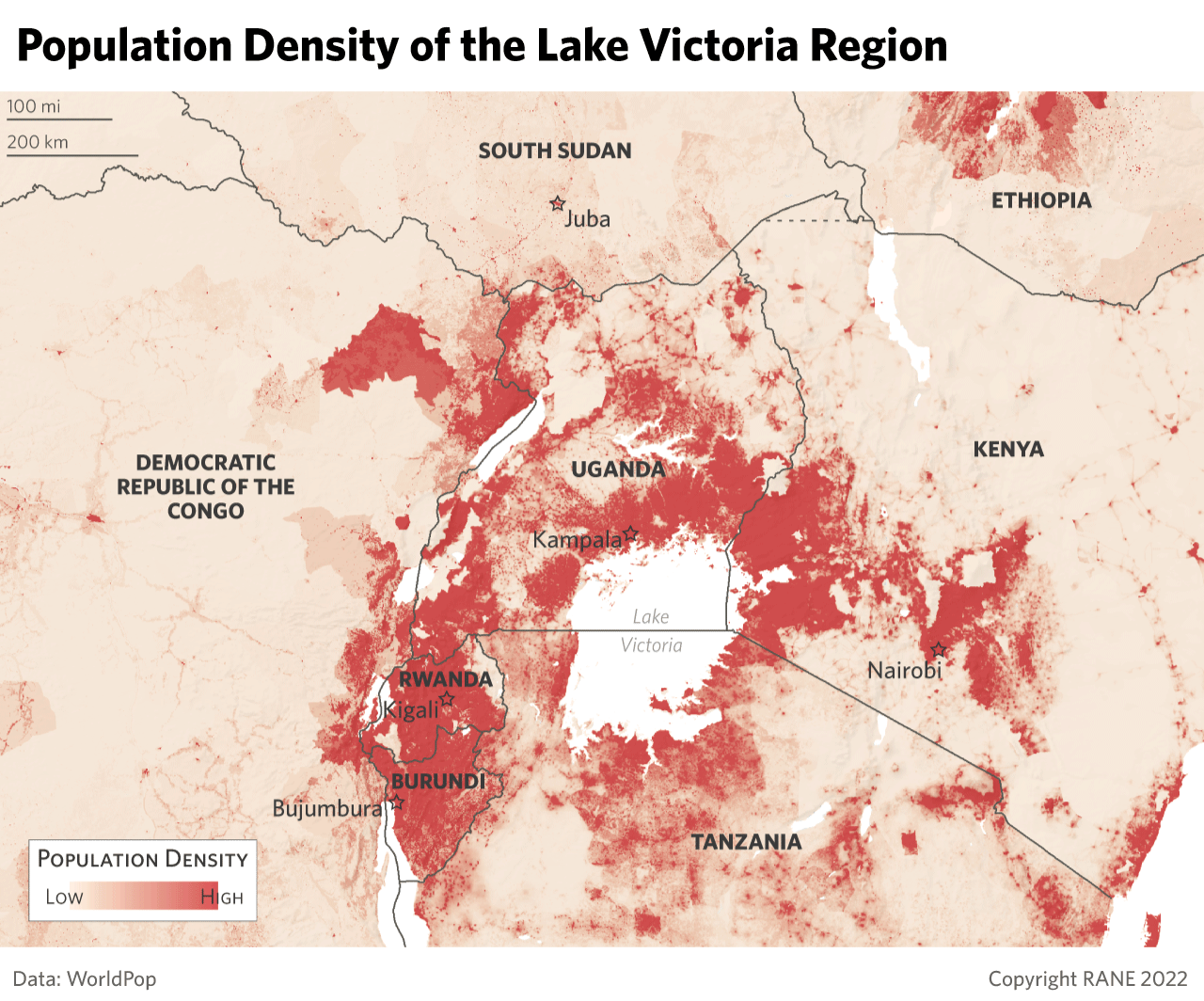
Congo and Rwanda’s animosity is anchored in accusations of support for rival rebel groups vying for territory and influence in Congo’s eastern provinces. Rwanda and Uganda invaded Congo twice during the 1990s. This, combined with the 1994 Rwandan genocide during which ethnic Hutus massacred an estimated 800,000 ethnic Tutsis, sent millions of refugees across the Congolese border and caused a surge in militia activity. The M23 rebel group is one of over 50 militias in the eastern Congo. The group initially emerged as a Tutsi force in 2009 with the aim of finding and killing ethnic Hutus who escaped justice for their alleged roles in the genocide. M23 also formed as a counter the Democratic Forces for the Liberation of Rwanda (FDLR), a Hutu militia that remains active in eastern Congo as well. Congo’s accusations of Rwanda’s support for M23 rebels have factual merit (several rebel leaders who have arrest warrants in Congo are currently living freely in Rwanda and Uganda). M23, however, is an independent militia and is not controlled by the Rwandan state. So while it may support the group materially, financially or by tacitly sanctioning illicit activity, the Rwandan government ultimately does not control the group’s activities and operations. Congo, for its part, can also do little to fully counter M23 activities by itself, given the rampant insecurity in the region and the limited capabilities of its military, but condemns what it perceives to be the exploitation of Congolese resources and people by Rwanda’s alleged proxy.
- Despite the elite-level machinations involved in the numerous militia group activities, academic experts continuously point to local factors as the drivers of the decades of conflict in Congo that has killed millions. Severine Autessere, former U.N. aid worker and author of several books on the Congo, points to land disputes among local populations as a key factor that conflict mediators like the United Nations frequently ignore.
- Several joint security initiatives are operating in Congo. 18,000 personnel under the peacekeeping operation U.N. Organization Stabilization Mission in the Democratic Republic of Congo (MONUSCO) are currently stationed in the country. This includes the U.N. Force Intervention Brigade (FIB), which is made up of Tanzanian, Malawian and South African troops that have carried out offensive operations against militias since 2013.
- In December, Uganda and Congo launched Operation Shuuja, a joint force to combat a rebel group called the Allied Democratic Forces (ADF). Over the past six months, Burundian troops have also allegedly been pursuing a Burundian rebel group based in the eastern Congo that attacked the Bujumbura airport in September.
Rwanda’s involvement in eastern Congo is focused on countering threats to domestic political stability and maintaining access to the region’s rich mineral resources. Throughout the 22-year tenure of Rwandan President Paul Kagame, Rwanda has intervened in the eastern Congo several times in order to counter Hutu militias (like the Democratic Forces for the Liberation of Rwanda) that could potentially threaten the country’s domestic political stability. Indeed, Rwanda’s alleged support for M23 aligns with past Rwandan prioritization of maintaining its security at the expense of relationships with its neighbors. Further, while the continuation of the conflict in Congo harms Rwandan border security, Rwanda wouldn’t necessarily benefit from a stable Congo. With its vast mineral resources and relatively large population of nearly 90 million, a prosperous Congo would have immense political and economic reach, likely disrupting Rwanda's regional position in a zero-sum game of geopolitical influence. Insecurity in Congo’s North Kivu, South Kivu and Ituri provinces also grants Rwanda access to the vast reserves of cobalt, copper, coal, gold and other extractives in those regions. During times of conflict, rebel groups like M23 often establish illegal artisanal mining operations and smuggling routes (Bunagana, for example — the North Kivu town recently seized by M23 — is a Congolese hub for coltan trafficked to Rwanda and Uganda). Once across the border, Rwandan companies benefit from export business, while some politicians use the profits from the smuggled goods to feed political patronage.
- The Congolese state mining company Gecamines holds varying stakes in most joint operations with foreign companies, many of which are Chinese. But insecurity in North Kivu, South Kivu and Ituri provinces has impeded development and, in some cases, suspended operations.
Rwanda and Congo will likely seek to avoid a direct military conflict, which is in neither country’s best interest. But the recent uptick in tensions and inflammatory rhetoric raise the risk of miscalculations that could inadvertently trigger a war. Despite decades of conflict in eastern Congo and tumultuous diplomatic relations, Congo and Rwanda have not fought against one another for over 22 years and are unlikely to do so again — at least intentionally. Rwanda’s military is far better equipped than that of Congo in terms of training, resources, personnel and capabilities. But going to war with its western neighbor would likely come at too high a cost for Rwanda’s international reputation and could politically destabilize the country. Given Congo’s relatively inferior military position and the FARDC’s long-standing battle against myriad rebel groups, Congo also doesn’t have the military or political bandwidth to go to war with Rwanda. Additionally, Kenyan President Uhuru Kenyatta is leading a concerted effort through the seven-member East African Community (EAC) to broker peace in Congo and quell animosity between Kigali and Kinshasa. Following a preliminary agreement signed in April, the EAC announced on June 20 that it will set up a joint force to intervene alongside the United Nations in North Kivu, South Kivu and Ituri. The formation of such a force is not guaranteed, giImven the EAC’s history of funding and coordination problems. But the potential for an EAC mission and increased international focus on the conflict in eastern Congo further decreases the likelihood of a direct military confrontation between Rwanda and Congo, as both countries rely on members of the EAC for trade, diplomacy and economic partnerships. Even so, the inflammatory rhetoric, myriad of armed actors involved in the conflict and seeming willingness on the parts of both Congolese and Rwandan leaders to pursue diplomatic escalation are creating an environment in which a miscalculation on the ground or misinterpreted information could inadvertently lead to war. In this scenario, conflict between Congo and Rwanda would likely proceed via cross-border attacks without either side formally declaring war.
- Congo joined the EAC in March 2021 along with Tanzania, Kenya, Burundi, Rwanda, South Sudan and Uganda.
The political and diplomatic animosity between Congo and Rwanda is likely to persist, undermining Congo’s efforts to establish lasting security and governance structures in the country’s conflict-ridden eastern regions. Congo and Rwanda’s relationship is unlikely to improve in the short-to-medium term, given the two countries long history of acrimony and Rwanda’s vested interest in keeping eastern Congo engulfed in conflict. This means that if Rwanda is in fact backing the M23, it is likely to continue to do so, as the allegations are difficult to prove and therefore come at a low cost to Kigali. This will continue to cause mass displacement in North Kivu and fuel violence against civilians, Hutu militias and FARDC forces. While M23 is just one of many militias perpetuating the conflict, its activities will continue to impede Kinshasa’s efforts to quell violence and extend state authority to the relatively ungoverned territories in eastern Congo. Militias will likely continue to thwart efforts to complete infrastructure projects like roads, bridges, schools and hospitals pioneered by either the international development community or the government. The risk of attacks on mines, mining villages and convoys will likely remain high, as will mineral and extractives smuggling. International investors will likely continue to view Congo as a “risky” investment, hampering Congolese President Felix Tshisekedi’s efforts to attract foreign investment. For some Congolese ethnic groups, anti-Rwandan sentiment and xenophobia will likely remain high if not escalate, potentially extending bouts of unrest in Kinshasa and Goma.
