
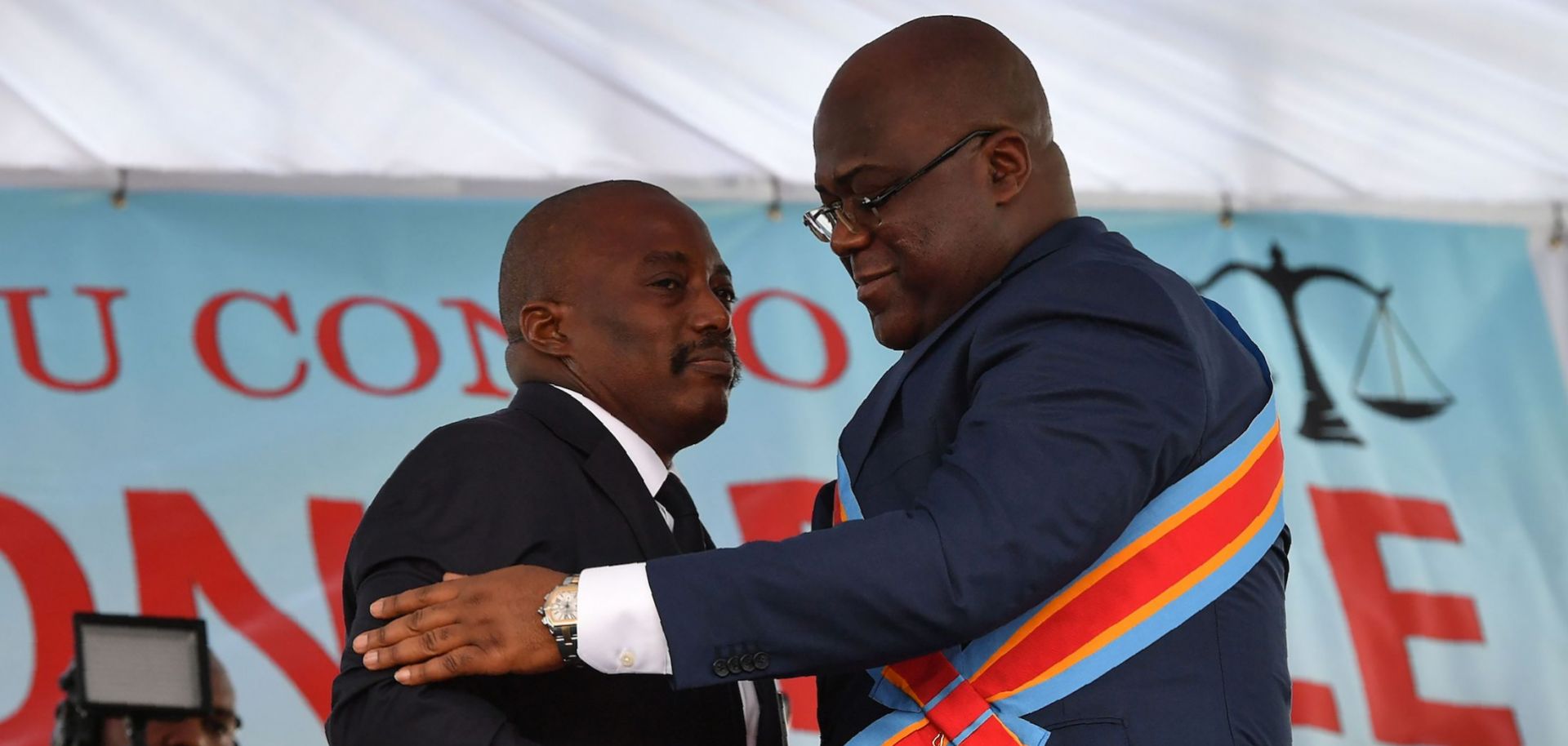
Outgoing Democratic Republic of the Congo President Joseph Kabila (L) embraces newly inaugurated President Felix Tshisekedi on Jan. 24, 2019, in Kinshasa.
President Felix Tshisekedi's decision to form a new coalition in the Democratic Republic of the Congo ends a 20-month+ fragile coalition with former President Joseph Kabila, promising more political unrest and uncertainty that could lead to early legislative elections. Tshisekedi's Dec. 6 announcement comes after three weeks of political consultations in November with opposition leaders on building a new coalition government. Tshisekedi said he would appoint someone to lead the process of forming a new coalition as early as this week, a step that would trigger a process of up to 60 days of seeking a new majority in the National Assembly. Building a new coalition government would require buy-in from some of Kabila’s former allies, and a formal rupture in the Kabila-Tshisekedi alliance will lead to increased investigations, raising the specter of corruption charges in Congo's important mining sector and elsewhere targeting Kabila's extensive business empire — setting up political and physical clashes ahead of 2023 presidential elections.
- Under the Congolese Constitution, the president must appoint a prime minister from the party that holds a majority in the National Assembly; if no party holds a majority, the president may appoint someone to lead a 30-day exploratory mission — extendable once — to try to form such a majority.
- Kabila's Common Front for Congo (FCC) contends that it remains a clear majority in the National Assembly, which would make Tshisekedi's breakup of the coalition and appointment of someone charged with forming a majority unconstitutional.
- In an early sign that Tshisekedi may have significant support in the National Assembly, the body passed a motion Nov. 8 to hold a vote Nov. 10 on removing its pro-Kabila speaker.
The alliance between Tshisekedi and the FCC was always a marriage of convenience following 2018 elections, since the constitution forbade Kabila a third consecutive term. Tensions between the two have been rising as Tshisekedi has sought to reduce the FCC and Kabila's influence while consolidating his own independent political base, ratcheting up tensions in 2020. Kabila has sought to wield significant influence over the Tshisekedi-led government and the Congolese state through the FCC's majority in the National Assembly and the vast array of political appointments he made during his years in office to other Congolese institutions. Tshisekedi argues that the FCC has prevented him from delivering on his promise of anti-corruption investigations and other political and economic reforms. He has enjoyed some success in sidelining Kabila in 2020, most notably through the appointment of two figures to the country's constitutional court.
Tshisekedi will have an uphill battle in building a new coalition, as this would require significant support from previously pro-Kabila FCC members. Should he fail, early legislative elections could ensue, as could significant legal challenges to the legality of his moves. Even if he wins such challenges are likely. During the political consultation process, Tshisekedi met with a number of prominent opposition leaders. This included former Katanga province Gov. Moise Katumbi and Movement for the Liberation of the Congo chief Jean-Pierre Bemba, two of the four leaders of the opposition Lamuka Coalition. These meetings gave rise to speculation that Tshisekedi could be seeking to build a coalition with them. Meanwhile, it remains unclear if Adolphe Muzito and Martin Fayulu, the latter of whom may have actually won the 2018 election, will support a new coalition. Any Tshisekedi appointee would need to amass some level of support among FCC members in order to wrest the parliamentary majority the FCC claims. While some defections are possible, Kabila's shadow looms large over FCC members since he was only barred under the constitution from holding three consecutive presidential terms, and so is eligible to run again in 2023. If he cannot build a clear majority, Tshisekedi could attempt to dissolve the National Assembly and hold new elections. But even that could face court challenges, as he must consult with the prime minister before dissolving the national assembly — and the FCC would be unlikely to support such a move.
The lack of an easy path forward for Tshisekedi means increased political unrest in the Democratic Republic of the Congo will occur between now and 2023 elections. This will increase the reputational and contractual risk to companies operating there, further undermining the country's fragile security environment. And political warfare between the two main camps will persist.
- Anti-corruption investigations are likely to be a powerful tool the FCC and Tshisekedi can wield against one another; this is likely to produce significant anti-corruption investigations in the mining sector likely to probe improprieties surrounding contracts, money laundering and bribery.
- As the Democratic Republic of the Congo becomes tougher for Western firms given corruption and money laundering scandals, China can work to consolidate its strong position in the strategic Congolese mining industry as Beijing seeks to maintain good relations with supporters of Tshisekedi and Kabila.
- If Tshisekedi manages to build a stronger coalition largely independent of Kabila, mining and other business ventures tied to Kabila could see their influence diminish over time. A significant investigation into, or attempt to sideline, Kabila's business empire — akin to the ongoing one in neighboring Angola surrounding the family of former President Jose Eduardo dos Santos — would become increasingly likely.
- If Tshisekedi fails to build a coalition, he will become increasingly reliant on executive action, provoking the FCC to challenge him even more through legal and other means. The probability of Tshisekedi's impeachment before 2023 elections would also rise, testing the strength of Tshisekedi's new appointees to the Constitutional Court.
- An increase in political unrest in the Democratic Republic of the Congo would go hand in hand with increased assassinations, violence and demonstrations, particularly in the capital of Kinshasa. Protests for and against Tshisekedi's announcement began there Dec. 7, with tear gas deployed against protesters. Physical confrontations between political rivals are possible even in the halls of government.
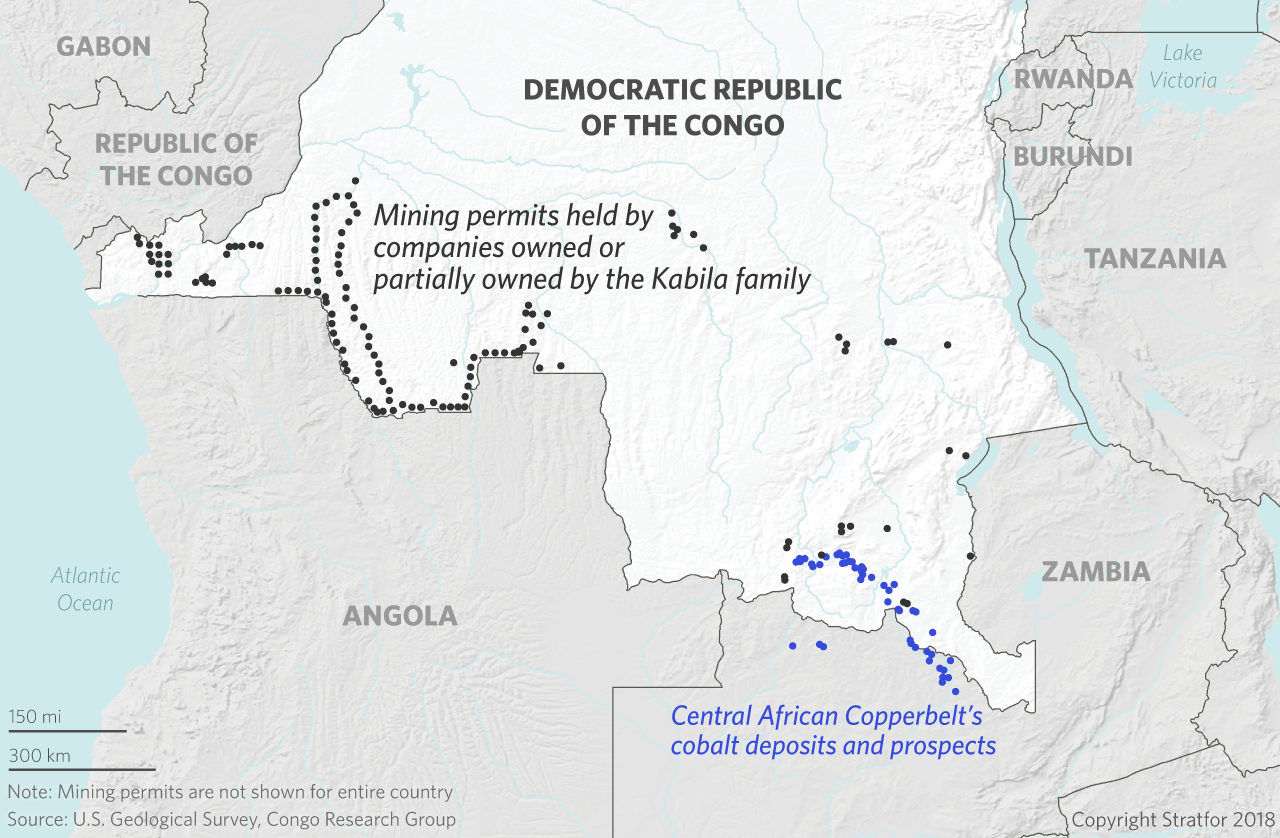
A significant political crisis in Kinshasa and the Democratic Republic of the Congo would quickly engulf the region.
- Political turmoil in Kinshasa would reverberate throughout sub-Saharan Africa's largest country and its immediate neighbors. Its neighbors and other countries in the region have long meddled in Congolese affairs. Tshisekedi and other Kabila rivals will attempt to strengthen their positions through cultivating ties with such countries in a bid for financial and military support plus greater international credibility.
- Political turmoil will distract from Kinshasa's ability to conduct military operations against the plethora of militia groups active there, including the Allied Democratic Forces, particularly in far-flung eastern Congo. Should the country fall into political chaos, Rwanda and Uganda would be forced to become even more deeply involved there to protect their own borders.
