
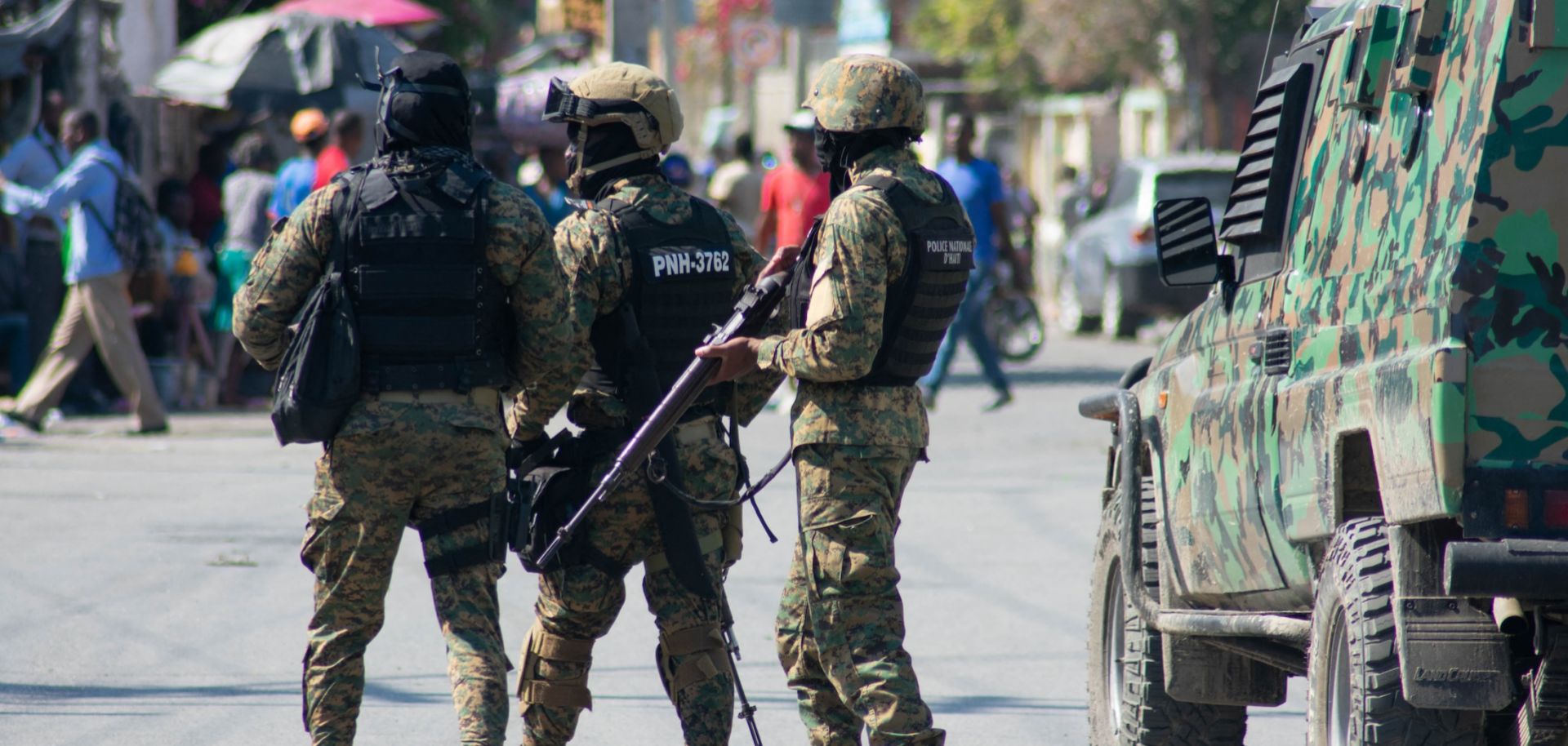
In Haiti, the government's announcement of a political transition plan will do little to improve the deteriorating security situation in the country, and if U.N.-backed troops are deployed to contain the escalating gang activity, it will likely only cause a spike in violence and exacerbate the humanitarian crisis in Haiti. On March 11, after an urgent meeting called by Caribbean Community (CARICOM) countries, Prime Minister Ariel Henry said in a pre-recorded video that he would step down from office once a presidential transition council was established. The move comes as gang violence has spread throughout the capital city Port-au-Prince, prompting the United States to deploy marines to the U.S. embassy to airlift non-essential staff out of Haiti on March 10. Gang violence has intensified dramatically since Feb. 29, as gang leader Jimmy Cherizier continues to threaten to escalate the conflict into a civil war. On March 3, coordinated attacks on the National Penitentiary in Port-au-Prince and Croix-des-Bouquets prison led to the escape of more than 4,500 inmates, while clashes between the gangs and security forces closed the Toussaint Louverture International Airport and shuttered hospitals and schools across the capital. Against this backdrop, Haiti's de-facto government extended a state-of-emergency order through April 3, imposing a night-time curfew and banning all forms of protest. As the international community struggles to cobble together a U.N.-backed multinational security force, Prime Minister Henry, currently in Puerto Rico, has been unable to re-enter Haiti since visiting Kenya in late February to sign an agreement that would allow the deployment of 1,000 Kenyan police officers to the crisis-ridden Caribbean country.
- On March 6, Jimmy Cherizier, the criminal boss known as ''Barbecue'' who runs Haiti's largest gang — G9 Family and Allies — told reporters that if the prime minister did not resign, the country was ''heading straight for a civil war that [would] lead to genocide.''
- In October 2023, the U.N. Security Council authorized a 12-month Multinational Security Support (MSS) mission to ''support the efforts of the Haitian National Police to re-establish security in Haiti and build security conditions conducive to holding free and fair elections.''
- According to the United Nations' Office of the High Commissioner for Human Rights (OHCHR), more than 1,193 people have so far been killed in Haiti in 2024, while the country's ''health system is on the brink of collapse.'' On March 10, the U.N International Organization for Migration estimated that there were currently 362,000 internally displaced people in Haiti.
- Henry has been absent from Haiti for nearly two weeks. After leaving the country to attend a CARICOM meeting in Guyana on Feb. 28, Henry flew to Kenya to sign a bilateral agreement with Kenyan President William Ruto to authorize the MSS deployment. Since then, his attempts to re-enter Haiti have been deterred, and on March 6, it was reported that he landed in Puerto Rico, where he has been since after the government of the Dominican Republic rejected landing permission for his aircraft. With Henry out of the country, his finance minister, Michel Patrick Boisvert, issued the state of emergency order on March 7.
Haiti has faced elevated political turbulence and worsening violence since President Jovenel Moise was assassinated in July 2021, but the gangs' recent escalations have thrust the country into a full-blown political and security crisis. After a brief power struggle in the immediate aftermath of President Moise's murder on July 7, 2021, Ariel Henry was sworn in as interim prime minister and acting president a few weeks later after being endorsed by the United States, the United Nations and much of the international community. Henry's mandate was supposed to end in February 2023, but the prime minister has repeatedly delayed elections, citing challenges in holding elections amid severe gang violence. For the entirety of his time in office, Henry has faced widespread popular opposition, with regular protests demanding his resignation or removal. Under Henry's leadership, Haiti's democratic institutions have been hollowed out: the country's already-weakened National Assembly has sat empty since January 2023, the Supreme Court is not functioning, and the government has been unable to provide basic services such as water, electricity and medical services. Amid this power vacuum, criminal groups have expanded with near impunity to control roughly 85% of Port-au-Prince, according to a U.N. report from early 2023. The Global Initiative Against Transnational Organized Crime estimates that around 200 gangs operate in Haiti, with over 95 of them concentrated in the capital city. This crowded criminal environment has resulted in frequent clashes between different gangs, as they compete for political influence among elites and lawmakers, and territory to extort private businesses and traffic illicit goods. In September 2023, two of Port-au-Prince's largest gang federations, the G9 and Gpep, announced that they had reached an agreement called Viv Ansanm (Haitian-creole for ''living together'') to loosely unite ahead of a potential multinational deployment to confront the international forces.
- Jimmy Cherizier, a former police officer and current leader of the G9 gang, is currently the most recognizable and influential criminal boss in Haiti. He frequently conducts media interviews with foreign press and was sanctioned in December 2020 by the U.S. Treasury Department for participating in a 2018 attack as a Haitian National Police officer that resulted in the death of 71 Haitians and the destruction of hundreds of homes.
- According to data from Bogota-based InsightCrime, at least 4,789 people were killed in Haiti in 2023, a 126% increase from 2022. This figure comes from a U.N. office in Haiti, and is almost certainly an undercount.
- In early February, thousands of protesters demonstrated across main cities in Haiti, setting up roadblocks, clashing with the police, and calling for Henry's resignation.
Facing challenges to his legitimacy on all fronts, Henry agreed on March 11 to a political transition. Before Henry announced he would step down, his legitimacy was being challenged on all fronts as he watched the crisis in his country unfold from Puerto Rico, seemingly unable to return to Haiti. Large-scale protests calling for his ouster have become commonplace. Opposition political parties, including the Pitit Desalin Party, Committed to Development (ED) party and Fanmi Lavalas Party, as well as multiple civil society groups, have submitted plans for a political transition to take place. Haiti's criminal groups, meanwhile, have capitalized on popular dissatisfaction with the government to bolster their own strength, with gang leadership frequently appearing on publicly broadcasted interviews rallying against an international security deployment and calling for Henry to step down. Finally, international support, formerly a key legitimizing factor in Henry's rule, has waned. While Henry was waylaid in Puerto Rico, U.S. diplomats began to publicly question Henry's future political standing in the country. The 15-member CARICOM, which has called repeatedly for a transition government to be established in Haiti, called a meeting in Jamaica for March 11 to ''urgently address this state of affairs,'' and after eight hours of negotiation, announced the creation of a broad coalition that will be composed of a nine-member presidential transition council to manage the government through the security crisis, appoint an interim prime minister, and later set up general elections. Henry, on the same day, announced that he would step down once the council was established. Members of any transition council will probably be targeted by criminal groups in Port-au-Prince, so they may seek to establish operations from the northern city of Cap Haitien or even internationally.
- On a phone call with the Haitian prime minister on March 7, U.S. Secretary of State Antony Blinken pushed Henry to ''expedite a political transition through the creation of a broad-based, independent presidential college'' to manage the MSS deployment and coordinate free and fair elections, according to a press release from the U.S. embassy in Haiti.
- CARICOM has for months been pushing civil society organizations (like the Montana Agreement), political parties (like Pitit Dessalines and Reveil National) and prominent opposition political actors in Haiti to reach consensus with Henry to form a transitional unity government. But talks have stalled as many of the groups had conditioned their participation on Henry's departure from office.
Henry's successors will inherit a rapidly deteriorating security crisis that will continue to hinder the Haitian government's ability to provide even basic services. The transition council will take office in the midst of a rapidly eroding security environment. The interim prime minister and council's efforts to organize and plan the MSS deployment will likely run into steep challenges, given that gangs now control such a substantial portion of the capital city and currently operate with impunity. Furthermore, competing incentives and electoral ambitions will probably give rise to internal disputes within the council, potentially slowing the decision-making process. And with Henry stepping back, gang leadership may reject the formation of the transition council, especially as the United States took part in negotiations, which could lead them to escalate attacks against key Haitian institutions. If gang violence intensifies following the establishment of the transition council, Haitians may lose trust in the new temporary government, eroding its tacit legitimacy and constricting its ability to implement security policies.
- To qualify for participating in the presidential transition council, representatives must agree to facilitate the MSS deployment. They cannot currently be under U.S. or U.N. sanctions and will be barred from running for president in future presidential elections.
On top of funding constraints, Kenya's leadership role in the MSS deployment has faced multiple domestic legal and political challenges, which has delayed action. Kenya's deployment has been delayed for months due to political backlash from Kenyan opposition lawmakers, challenges emanating from Kenya's High Court, and concerns from human rights experts regarding the record of Kenya's police forces. It is still unclear if Kenya's force will be legally sanctioned to lead the mission; if not, the U.N. Security Council would be hard-pressed to find another country willing to do so. Washington so far has rejected any discussions of putting U.S. boots on the ground, but in total has pledged $300 million to fund the mission, some of which would be used to provide intelligence, communications and medical assistance. However, as of March 1, only $10.8 million had been deposited into the U.N.-managed trust fund that is collecting the international contributions for the mission. Fearing spillover violence to other countries in the region, or the de-facto rule of gangs in Haiti, the international community has been urgently pushing for a multinational deployment. If Kenyan courts continue to block Nairobi from sending police forces to Haiti, the United Nations will likely try to find another country to lead the mission. Kenyan lawmakers may become hesitant to deploy the force as the security environment has deteriorated substantially in Haiti since Kenya originally agreed to lead the mission. Furthermore, the MSS was approved for a 12-month period starting after the adoption of the U.N. resolution on Oct. 2, 2023, meaning that the mission will have to be reapproved in October 2024 to continue operations. If there are heavy Kenyan casualties once the force is deployed, domestic support may also begin to wane, jeopardizing new waves of reinforcements. On March 13, the Kenyan government announced it was waiting until the transition council was established to move forward with the MSS deployment.
- After the CARICOM meeting on March 11, U.S. Secretary of State Antony Blinken announced that the U.S. Department of Defense would allocate another $100 million for the MSS mission, and an additional $33 million in humanitarian aid to Haiti.
- On March 11, the U.N. Security Council issued a joint statement urging the deployment of the Kenyan-led MSS ''as soon as possible.'' The same day, Kenyan Interior Minister Kindiki Kithure told reporters that the mission was ''in the pre-deployment stage.''
If the U.N. mission is deployed, it would run into significant cultural, financial, and tactical constraints, likely leading to an escalation of violence in the short term that would increase security risks for Haitians, exacerbate the humanitarian crisis, and trigger new waves of emigration. If and when the MSS does deploy, its multinational force would face steep cultural, personnel and tactical challenges. To start, there will be a language barrier between the Haitian National Police forces and the deployed Kenyan Police officers, hindering cooperation. However, French-speaking forces from Benin may partially alleviate this constraint. Manpower is also a concern, with the promised MSS security forces dwarfed by the estimated 20,000 to 30,000 gang members currently operating in Haiti. Finally, with gang violence forcing the closure of the strategic International Port-au-Prince (APN) port terminal and the Toussaint Louverture International Airport, it is unclear how a multinational deployment would effectively enter the country in the first place. However, assuming that such a deployment does take place, violence in Haiti would likely spike in the short term as the reinforced Haitian National Police clash with gangs in densely populated urban environments across Port-au-Prince to retake control of strategic infrastructure throughout the capital. This would create significant safety and security risks for bystanders, businesses still operating in the capital, and humanitarian organizations delivering aid and services to Haitians. As a greater number of Haitians become internally displaced, fleeing critical violence and severe economic conditions, the U.S.-Mexico border will likely see an influx of Haitian migrants attempting to enter the United States. If properly resourced, the multinational support mission may be able to achieve some improvements to the security situation and restore some level of stability to the business environment in the country. However, gang activity would almost certainly persist in a reduced form, posing significant safety and logistical challenges to organizations over the long term.
- So far, Kenya has committed 1,000 officers to the MSS mission. Benin has pledged another 1,500 personnel, and the Bahamas, Bangladesh, Barbados and Chad have told the United Nations they plan on taking part in the mission, without disclosing how many troops. These personnel would complement Haiti's 10,000 poorly disciplined and poorly resourced police force to challenge the powerful gangs' territorial control of Port-au-Prince.
- On Feb. 22, Canada's foreign ministry announced that Ottawa was committing $80.5 million to support the MSS.
- A recent assessment conducted by Kenya's security forces suggested the mission would need approximately 5,000 personnel and $240 million per year.
- The U.S. Customs and Border Protection (CBP) has reported greater numbers of Haitians trying to enter the United States through the U.S.-Mexico border in recent years: There were 76,130 ''encounters'' between Haitian migrants and CBP in FY 2023, up from 53,910 and 47,255 reported ''encounters'' in FY 2022 and 2021, respectively.
