
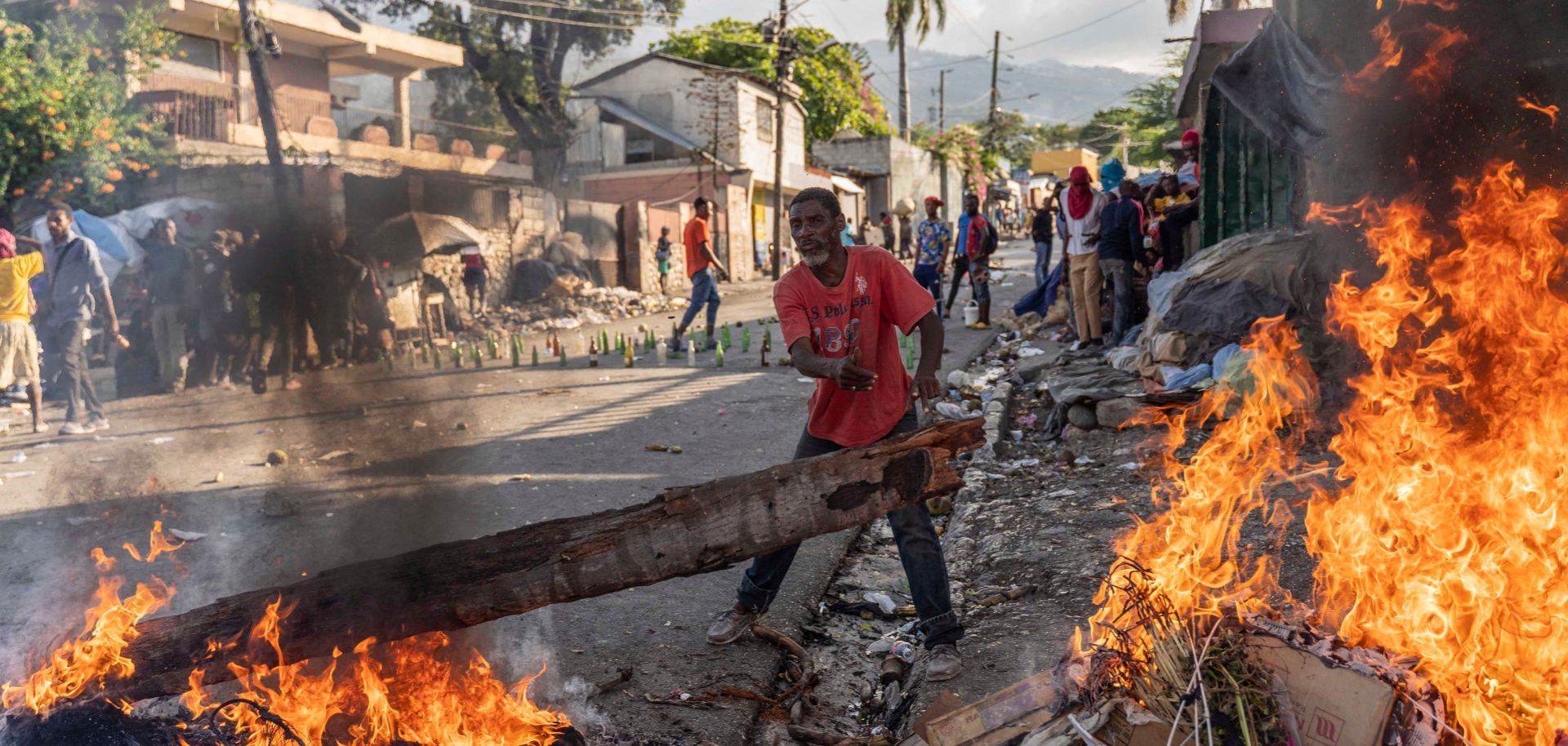
A man adds wood to a fire burning in the streets of Port-au-Prince, Haiti, on Oct. 3 amid protests demanding the resignation of Haitian Prime Minister Ariel Henry.
As mass anti-government protests in Haiti enter their eighth week, compounding political, criminal and economic crises limit the country's near-term prospects for improvement, posing security risks domestically and regionally. Protests against the government of Prime Minister and acting President Ariel Henry began on Aug. 22 in the capital of Port-au-Prince in response to poor economic conditions and severe gang activity; they have since spread across the country, with hundreds and sometimes thousands of people participating in demonstrations each week. The largest protests have occurred in the capital, but virtually all major population centers have also experienced large-scale unrest, including the northern port cities of Cap-Haitien, Port-De-Paix and Gonaives, which are typically more peaceful than southern Haiti. Demonstrations escalated on Sept. 11 after authorities announced a 115% fuel price hike, which Henry defended as necessary to keep the government running and provide social services amid limited funding. Protesters have marched holding signs denouncing Henry's alleged dictatorship and erected roadblocks on major roads across the country using fallen trees and burning debris, while some have attacked and looted businesses and government buildings. Violent clashes between protesters and police — or, in some cases, between protesters and gang members — have prompted the use of tear gas, rubber bullets and live ammunition. Violence has resulted in deaths likely in the dozens, but the total number is unknown amid a lack of verified reporting. Foreign governments have expressed increasing concern over the unrest, with the U.N. envoy to Haiti warning on Sept. 24 that multiple crises are converging into a humanitarian catastrophe. President Luis Abinader of the neighboring Dominican Republic also referred to the situation in Haiti as a ''low-intensity civil war'' on Sept. 15. Most diplomatic missions and nongovernmental organizations in Haiti are operating at reduced capacity, with employees being told to shelter in place due to safety risks.
- Further disrupting public transportation, the United Front of Transporters and Workers of Haiti launched a nationwide strike on Sept. 26 to demand the reduction of fuel prices and Henry's resignation, although the precise level of participation in the strike remains unclear.
- Illustrating further challenges that could exacerbate deteriorating conditions in the country, Haiti's health ministry identified a cholera outbreak in early October, with dozens of cases already reported. A cholera outbreak in 2010 (which much of the Haitian population blames on the United Nations due to allegations that the disease initially spread from U.N. peacekeepers) killed 10,000 people.
The protests in Haiti are the result of worsening conditions in the country over the last year due to a constitutional crisis and increasing gang violence, as well as soaring inflation and unemployment rates. Haiti has long experienced poor political, security and economic conditions, but problems have severely escalated since the assassination of former President Jovenel Moise on July 7, 2021, a crime that remains unsolved. Moise had appointed Henry as the country's new prime minister to replace incumbent Claude Joseph two days before the assassination, and Henry was sworn in as prime minister and acting president on July 20. This process of transferring power was unpopular among many Haitians, partially due to the role of the United States, the European Union and other foreign governments in facilitating Henry's rise to power, spurring calls for new elections. While Henry promised to organize elections, a 7.2-magnitude earthquake on Aug. 14 strained government resources, limiting the government's ability to hold a vote, which more than a year later has still not taken place. As the government lacked a popular mandate and was notably ineffective in responding to the earthquake, already-powerful gangs moved to fill the power vacuum, seizing control of fuel, water and food supplies in the country, which exacerbated preexisting shortages of basic necessities. Criminals also increased kidnapping-for-ransom attacks against Haitians and foreigners, including diplomats and missionaries. Violence has worsened over 2022, as rival gangs fight one another for territorial control of areas in and around Port-au-Prince, killing local residents en mass, sexually assaulting women and children, and destroying homes. Deteriorating security conditions have caused both local and foreign-owned businesses to decrease or suspend operations due to roadblocks, while fuel shortages and looting have made Haiti less attractive to the manufacturing and tourism sectors. These developments have occurred against the backdrop of skyrocketing inflation, food insecurity, power cuts and other major economic strains that have raised unemployment levels and limited the government's revenue from personal and business taxes that would otherwise support social programs. Protests over these compounding and long-standing challenges have occurred intermittently since the Moise assassination in July 2021, but none have persisted as long as the current unrest, indicating that Haiti may have reached a breaking point.
- Assertions that Henry was involved in the Moise assassination have exacerbated protesters' political grievances; although there is little evidence to back up such allegations, there is a popular perception that Henry has been reticent to seriously investigate the assassination.
- Violent crime has long plagued Haiti due to the limited capabilities and widespread corruption of its security forces and the widespread influence of gangs. To this end, Haitian presidents (including Moise and Henry) have allegedly sponsored criminal groups for financial or political gain. Recent violence in Port-au-Prince has been driven by G9, a federation of multiple, smaller local gangs. Fighting in the Cite Soleil neighborhood between G9 and rival gang alliance G-Pep in July and August led to the death of hundreds of people, with hundreds more trapped in the neighborhood as gangs blocked off major roads to both security forces and needed humanitarian aid.
- On Sept. 19, G9 seized control of Haiti's main oil terminal, Varreux, blocking roads and digging trenches surrounding the facility; security forces have clashed with the gang's members but have been unsuccessful in pushing them out of the terminal.
- In June, Haiti's inflation rate reached 29%, the highest in 10 years. Amid high prices, the U.N. World Food Program (WFP) reported in July that nearly half of Haiti's population of 11 million people regularly goes hungry. As nearly 86% of the country's electricity is dependent on petroleum products, according to the United Nations, hospitals are on the verge of closure. Many businesses have closed as well, including facilities in Caracol, Haiti's largest industrial park, located east of Cap-Haitien, risking thousands of jobs.
The combination of political instability, severe gang violence and poor economic conditions suggests there are multiple ways Haiti's crises could evolve in the next year. In many ways, Haiti already meets the informal definitions of a failed state: the country's government lacks the capability to provide basic services to its population and appears incapable of regaining control of its own capital city. Activists have repeatedly called for elections to be held, but they are likely not feasible in the coming months amid limited government funding and with entire neighborhoods and major transportation routes under gang control; furthermore, even if elections were held, they are highly unlikely to be seen as legitimate, which could worsen popular grievances. This suggests that, regardless of whether election preparations begin in earnest, and amid authorities' inability to confront deepening political, economic and security crises, widespread anti-government sentiment is likely to persist, limiting support for any solutions proposed by the Henry government. With that in mind, there are several possible trajectories for how the current crises could unfold over the next year, including:
- Scenario #1: Slow deterioration. Spurred by protesters' fatigue and/or security forces' crackdown, the current protests could fizzle out with Henry still in office, as has occurred during previous rounds of demonstrations against the Henry government. While this scenario would enable the government to remain in power, popular political grievances would not abate and economic and security conditions would continue to slowly deteriorate over the next year, as major improvements are highly unlikely without significant developments, such as an unexpected major increase in governmental capabilities to fight crime. Additional protests would likely occur, but they would likely end after a few days or weeks, similar to previous protests.
- Scenario #2: Henry is removed from office. Given mass opposition to Henry specifically, rival political or military figures may forcibly remove him, either by staging a coup or by pressuring him to resign. In the event of a coup, Henry would likely face prosecution for corruption (or involvement in the Moise assassination) by the succeeding government in an effort to garner popular support. But while unrest may temporarily abate due to Henry's removal, the new government would face similar challenges in mitigating gang violence, as well as the same logistical difficulties with holding elections — raising the potential for future protests sparked by Haitians' continued frustration with their country's bleak economic and security conditions.
- Scenario #3: Gangs take control. As gangs like G9 already control many of Haiti's resources, they are well placed to further bolster their forces over the coming months, perhaps even gaining the necessary strength to assassinate Henry or make him fear assassination enough that he flees the country. In the resulting power vacuum, gangs would continue to compete for territorial control with little to no pushback from state security forces, expanding their control to areas that previously experienced lower levels of violent crime, including northern Haiti. This lower likelihood but much more impactful scenario would be most likely to trigger foreign military intervention due to concerns over a gang-controlled country in close proximity to the United States.
- Scenario #4: Incremental improvements. Although this scenario is unlikely, the country's crises could spur the provision of significant financial and other assistance from the international community, which could bolster Haitian security forces' ability to restore order and enable the economy to slowly improve. However, severe corruption in the Henry government (as well as its suspected connections to gangs) limits the likelihood of this scenario. Even if there are minimal improvements to Haiti's security and economic outlooks, they will be fragile and could backslide following further crises.
- Scenario #5: Civil society forms a new government. A civil society coalition known as the Montana Accord seeks to replace Henry and establish a new government, but the coalition has no clear path forward in its efforts. This lack of trajectory is due to several hurdles, including the need for Henry to be removed from power (willingly or by force), for the Montana Accord's diverse members to remain united, and for international allies to provide significant financial and political support; even then, the Montana Accord would likely struggle to gain control of security forces and other government bodies given extensive corruption and patronage networks linked to Henry. The Montana Accord's government also would face the same economic challenges as the current government and could face severe backlash from gangs. However, at least initially, it could face lower popular opposition due to its distance from Henry's rule.
Gauging the Potential for Foreign Intervention
As the security situation in Haiti has worsened over recent weeks, various governments have taken small steps to provide support to the Henry government, including a fundraiser in September for Haiti's police force and ongoing efforts to impose sanctions on the country's gangs. However, aside from recent statements during the U.N. General Assembly, the U.S. Biden administration has been markedly silent, likely due to concern that military and/or larger economic intervention would be politically unpopular in both the United States and Haiti. On Oct. 7, Henry's government made a global appeal for a ''specialized armed force'' to combat gangs' presence at the Varreux oil terminal; the United States and the United Nations subsequently said they are evaluating the request, but as of Oct. 12 there is currently no indication that intervention in Haiti is forthcoming. However, if countries like the United States, Canada, France or others sought to increase their involvement in Haiti, they could provide additional funding to the Henry government and/or humanitarian aid directly to the Haitian population, transfer weaponry or other resources to Haitian security forces, deploy military forces (either unilaterally or as part of a larger peacekeeping mission) to reestablish order, or even back anti-Henry forces to remove him from office. Foreign military intervention could, at least in the near term, enforce order, but Haiti's history of colonial exploitation and military occupation by the United States and France means that the Haitian population is likely to perceive foreign intervention negatively, challenging its sustainability and effectiveness over time. For instance, the Montana Accord has already strongly come out against the deployment of foreign troops, and thousands have already violently protested the idea and reportedly waved Russian flags to express anti-American sentiment.
Regardless of how the current unrest unfolds, Haiti's security and economic environments are almost certain to remain critical over the coming months, creating operational disruptions and posing severe safety risks to locals and travelers. Gang activity and violent protests have made much of Haiti increasingly difficult to traverse, which will continue to prevent organizations from ensuring their local employees and facilities receive necessary shipments, including basic necessities and raw materials needed for manufacturing. These difficulties are most pronounced in Port-au-Prince and southern Haiti, while protests in the north are making it increasingly difficult to transport goods from the port of Cap-Haitien, Haiti's second-largest city. If gang activity increases in the north, it would further hinder organizations' operations, which have increasingly relied on Cap-Haitien and other northern areas as Port-au-Prince becomes more unstable. Looting also poses growing risks for both businesses and nongovernmental organizations, with warehouses for humanitarian organizations across the country being robbed by both criminals intending to illicitly resell items and desperate individuals unable to acquire necessities elsewhere. Organizations will likely face additional operational risks due to worsening corruption among government officials and repeated bank robberies, which security forces are seemingly unable to combat. Separate from operational risks, protests and criminal activity pose severe safety threats to both local residents and foreign travelers. Protests are increasingly escalating into violent clashes that have left people dead or seriously injured, posing collateral risks to bystanders. Additionally, gangs are targeting foreigners in kidnapping-for-ransom schemes due to their perceived wealth and expected higher possible ransom payments, making any travel to Haiti extremely dangerous. Haitians known to be employed by foreign organizations face similar risks, but local Haitians also face risks of mass kidnappings, as gangs have previously abducted entire busloads of civilians. There are also persistent threats of shootouts in public areas as gangs continue to compete with one another to expand control of neighborhoods in Port-au-Prince and southern Haiti. Overall, the poor security environment will pose increasing financial costs to organizations as they strive to ensure staff safety and limit operational disruptions from crime.
- On Sept. 16, protesters robbed food warehouses belonging to the WFP and the Catholic charity Caritas Internationalis in the northern city of Gonaives before setting the facilities on fire. A factory in Ouanaminthe, located on the Dominican border, was also looted in late September.
- Haiti's Center of Analysis and Research on Human Rights recorded 551 kidnapping cases in the first half of 2022 compared with 382 in the same period in 2021. Incidents include the May kidnapping of 17 people (including Turkish citizens) from a tourist bus in Port-au-Prince's Croix-des-Bouquets neighborhood by members of the 400 Mawozo gang.
The worsening political, economic and security crises mean that migration from Haiti is likely to increase, posing region-wide risks as high migration levels continue to drive regional unrest and organized crime. Haitian migration levels have been elevated for years, as citizens have fled natural disasters and limited socioeconomic opportunities, but levels surged following Haiti's July Moise assassination and August earthquake. The Mexican government reported that more than 50,000 Haitian migrants sought asylum in the country in 2021, compared with fewer than 6,000 in 2020. This growing outflow of Haitian migrants, especially in combination with millions of others throughout the region, will increasingly raise the risk of unrest wherever migrant populations clash with locals. The neighboring Dominican Republic has long borne the brunt of Haitian migration due to the countries' shared land border, and Haitian migrants are often accused of increasing criminal activity and taking Dominican jobs, sometimes spurring marches in Santo Domingo demanding that the government oust the Haitian population. As an illustration of what could occur if anti-migrant sentiment significantly escalates, locals in Chile in January-February destroyed tent structures belonging to an encampment of Venezuelan migrants in the port city of Iquique; truckers from there and several other cities also blocked roads and prevented access to critical infrastructure. Even if anti-Haitian protests do not occur on such a scale, similar events remain possible in Mexico, Guatemala, the Bahamas, Cuba and Puerto Rico, where Haitian migrants have fled. Migration is also creating maritime risks in the Caribbean Sea and the Gulf of Mexico as Haitian migrants flee the country using unsafe watercraft. Maritime smuggling networks commonly prioritize profits over safety, with repeated incidents of vessels carrying tens (or in some cases hundreds) of Haitian migrants sinking off the coast of Florida or Caribbean islands, killing everyone on board. As the death toll from maritime migration rises, regional coast guards, including from the United States, may increase deployments to the area, decreasing resources in other regions. Finally, increased migration drives insecurity along migration routes, as organized crime groups commonly increase their operations near migrant encampments in order to prey on desperate people, kidnapping, extorting or recruiting them into their illicit operations. Illustrating this relationship, authorities in Chile in 2020 arrested a Haitian migrant along with a group of local criminals for smuggling drugs into a prison.
- In August, U.S. Customs and Border Protection (CBP) reported 104,679 encounters with migrants from outside Central America, up from 61,518 a year prior. CBP does not break down this total into specific nationalities, but Haitians are believed to be partially responsible for the increase.
- Haitian asylum seekers in the Mexican border city of Reynosa (where about 85% of the migrant population is from Haiti) have protested in recent weeks as wait times to legally cross into the United States have extended to months — and in many cases, years.
